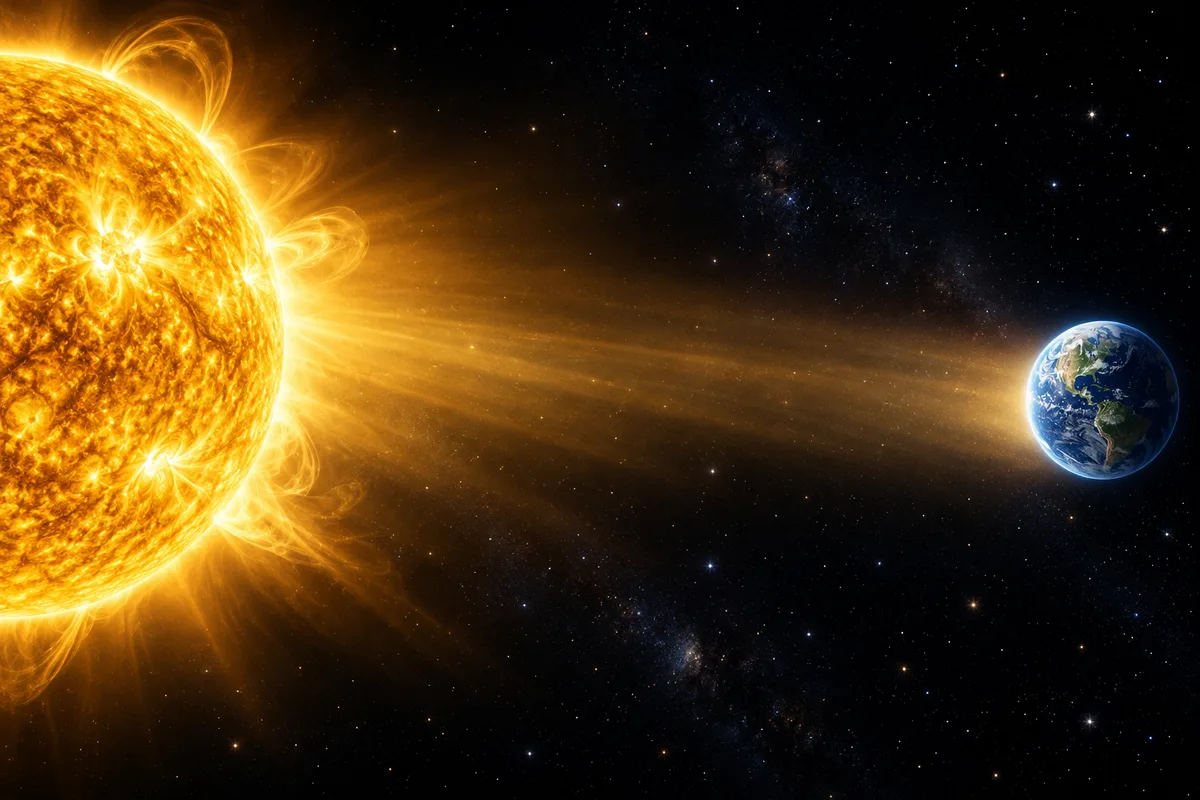
Sunlight takes about eight minutes and nineteen seconds to travel from the Sun to Earth at a distance of one astronomical unit. Rounding that to eight minutes and twenty seconds is common and useful. The exact travel time changes through the year because Earth's orbit is slightly elliptical rather than perfectly circular.
The calculation begins with a simple relationship: time equals distance divided by speed. What makes the answer striking is the scale. Light moves extremely fast, yet the space between our planet and its star is large enough for the trip to take several minutes.
The calculation in kilometers and seconds
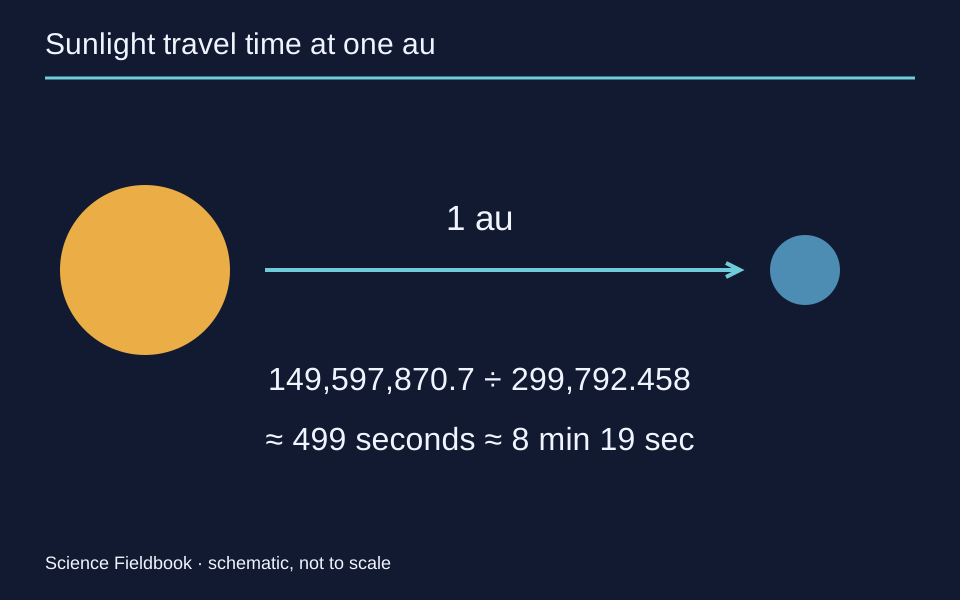
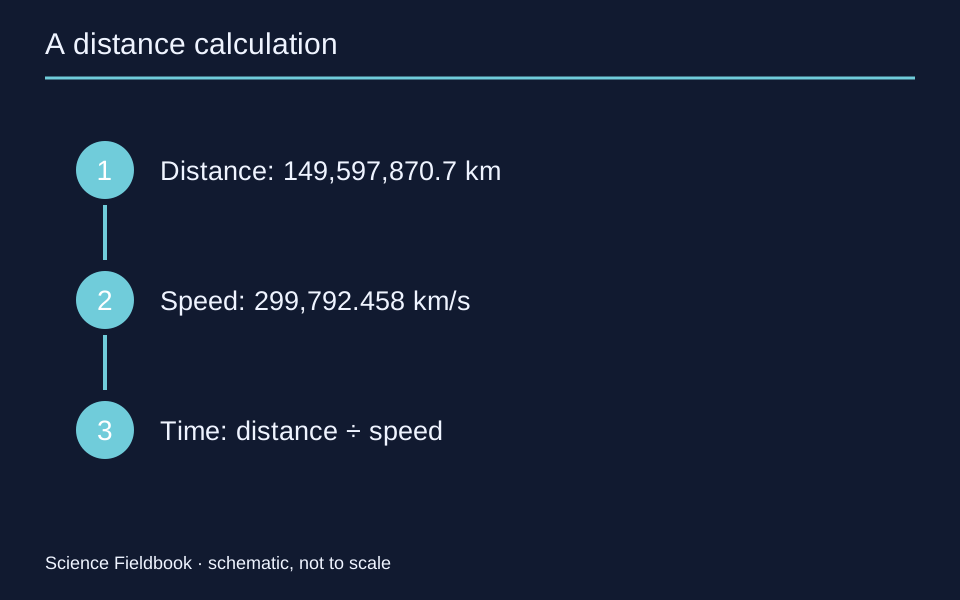
One astronomical unit, abbreviated au, is defined as 149,597,870.7 kilometers. The speed of light in a vacuum is exactly 299,792.458 kilometers per second. Dividing the distance by that speed gives approximately 499 seconds, or eight minutes and nineteen seconds.
Using rounded values gives the same practical result: 150 million kilometers divided by 300,000 kilometers per second equals 500 seconds. The one-second difference is the consequence of rounding, not a dispute about whether light has a consistent vacuum speed.
NASA's introduction to solar-system distances lists the Sun–Earth distance as about 8.3 light-minutes. That is a distance expressed through travel time, not a claim that a minute has become a unit of speed.
Why the answer changes slightly during the year
Earth travels around the Sun on an ellipse. Near its closest orbital point, sunlight has a somewhat shorter trip; near its farthest point, the trip is somewhat longer. The difference is on the scale of seconds rather than many extra minutes.
The familiar eight-minute figure is therefore a reference value, not a timestamp that is equally exact on every date. High-precision calculations may also specify the observer's location and the point on the Sun from which a signal is considered to originate.
Those refinements matter for specialized work but do not change the introductory conclusion. The visible Sun is being observed after a journey of roughly eight minutes. Precision should match the question rather than turn a useful explanation into a false claim of exactness.
Seeing the Sun means seeing its recent past
Light carries information from the place and time where it was emitted or last scattered. If something changes at the visible solar surface, the corresponding light cannot reach Earth immediately. An observer here receives that information only after the light has crossed the intervening space.
This is not a peculiarity of the Sun. Looking at any distant object involves a delay. The delay for an object across a room is negligible for everyday perception; for planets and stars, the distances make it noticeable and scientifically important.
NASA's discussion of cosmic distances uses light-time to connect distance with looking into the past. A star several light-years away is not being shown to us live in the everyday sense, even though its light is arriving now.
The same delay applies to a radio message
Visible light and radio waves are both electromagnetic radiation. In a vacuum they propagate at the same speed. A spacecraft communication link therefore has a delay determined largely by the changing distance between the spacecraft and the receiving station, not by whether the signal carries pictures or speech.
A radio reply also needs a return journey. Confusing one-way and round-trip travel time introduces a factor-of-two error, just as it does when using an echo to estimate the distance to a wall. Processing time may add further delay in a practical communications system.
The journey is not an ordinary sound wave traveling through air. Radio and visible light do not require the mechanical medium that sound does. Space can transmit electromagnetic signals even where it contains too little matter for ordinary airborne sound.
Does sunlight take only eight minutes from the core?
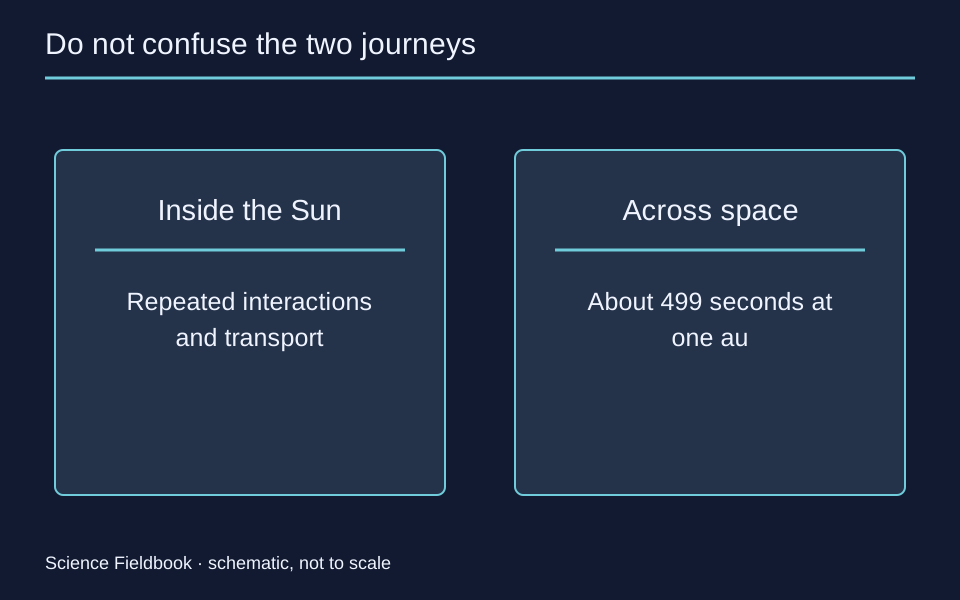
No. The eight-minute figure describes the trip across space after radiation leaves the Sun's visible outer layers. It does not describe the time involved in energy moving from nuclear reactions deep inside the Sun to those outer layers.
Inside the Sun, radiation repeatedly interacts with matter, and energy is transported through different regions by different mechanisms. Treating that entire journey as a single photon flying straight from the core to Earth is misleading. The radiation emerging from the photosphere is not simply an untouched original core photon.
Estimates for energy transport inside the star are model-dependent and concern a different physical problem. They should not be added casually to the light-travel calculation as though both were one fixed stopwatch measurement. The surface-to-Earth journey remains approximately eight minutes.
What a light-minute actually measures
A light-minute is the distance light travels in a vacuum in one minute. It is about 18 million kilometers using rounded values. Saying the Sun is about eight light-minutes away is another way of describing the same enormous separation in more intuitive terms.
A light-year follows the same principle over a year. Despite the word “year,” it is a distance unit. The distinction helps avoid a common wording error: objects are not moving “at a speed of one light-year” unless a time interval is also specified.
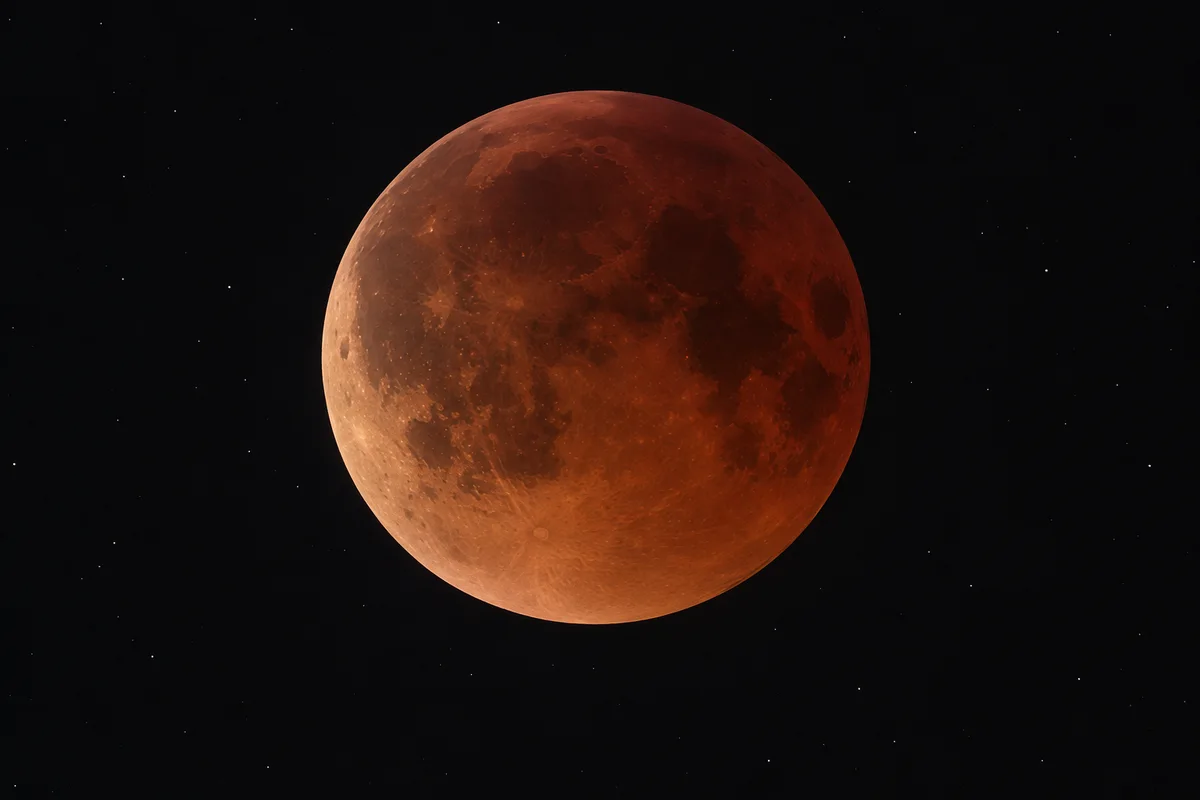
Different solar-system objects have different light-times. The Moon is much closer to Earth than the Sun, while the outer planets are farther away and move relative to us. The changing geometry is also why a lunar eclipse depends on alignment rather than just the existence of a shadow somewhere in space.
An analogy that preserves the important relationship
Imagine a message traveling at a fixed speed along a road. Doubling the distance doubles its travel time, provided nothing else changes. Light-time uses that same proportional reasoning, although light is not a physical courier driving along a track.
The analogy becomes unreliable if it suggests that electromagnetic radiation can accelerate beyond its vacuum speed to compensate for a longer trip. It cannot. A more distant astronomical object supplies older light because the path is longer, not because its light becomes less energetic merely from having a lower speed.
The takeaway
At one astronomical unit, sunlight needs approximately 499 seconds to reach Earth. Orbital variation changes the exact time, but eight minutes and twenty seconds is an excellent everyday approximation. The delay describes travel through space, separate from energy transport within the Sun.
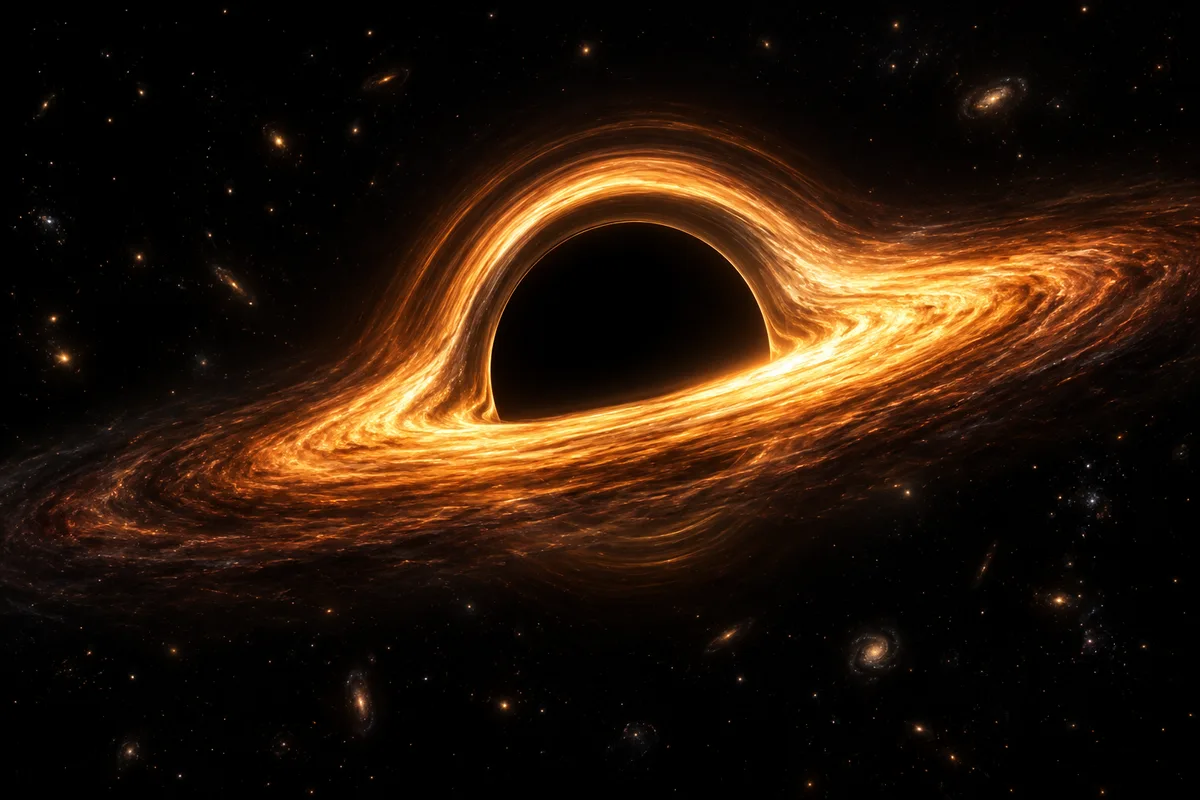
That finite speed connects a kitchen-table division to a major astronomical idea: looking outward means receiving information from earlier times. The same principle is part of interpreting light from matter around black holes, where distance and gravitational effects require even more careful attention.