
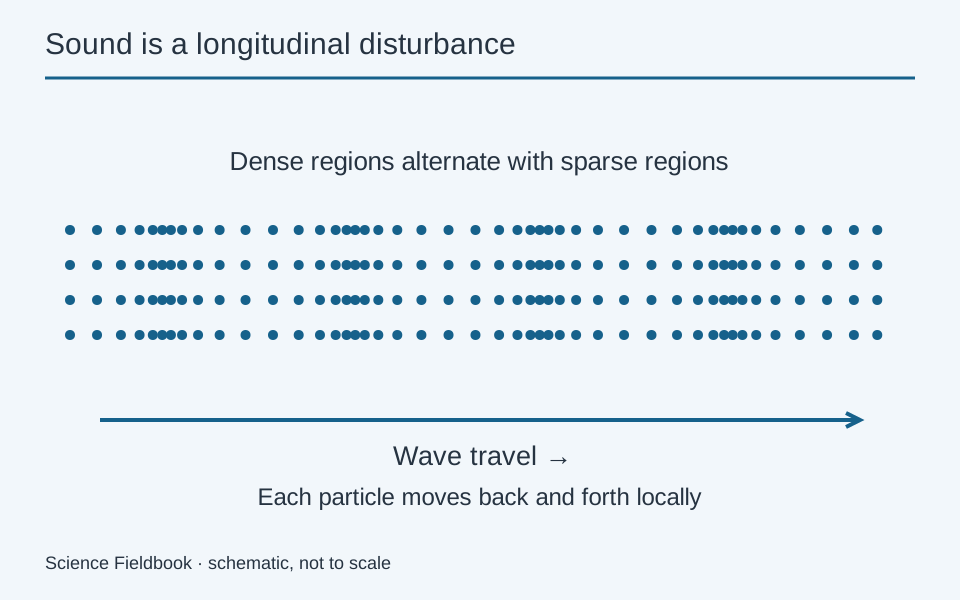
Sound travels through air as a moving pattern of pressure changes. A vibrating source pushes and pulls nearby air, and interactions between neighboring molecules pass the disturbance onward. The air molecules mostly move back and forth around their local positions; they do not ride all the way from the source to your ear.
That difference between moving matter and a traveling pattern is the central idea. A loudspeaker across a room can deliver sound without sending a steady stream of its original nearby air into your ear. The wave carries energy and information through the medium.
A speaker starts a pressure disturbance
When a speaker cone moves outward, it slightly compresses the air immediately in front of it. When it moves inward, it creates a region of lower pressure. Repeated motion produces alternating compressions and rarefactions that spread away from the source.
Air already contains constant random molecular motion. A sound wave adds a tiny coordinated disturbance to that background. Molecules collide and exert forces on their neighbors, allowing pressure information to propagate through the gas.
The effect is often drawn as a smooth sine wave, but the air is not usually flowing along an up-and-down snake. In an ordinary sound wave in air, the particle oscillation is mainly parallel to the direction of travel. That makes it a longitudinal wave.
The familiar plotted curve represents a quantity such as pressure at different positions or times. Reading the graph literally as the path followed by a molecule confuses the representation with the physical motion.
Frequency, pitch, amplitude, and loudness
Frequency is the number of oscillations per second, measured in hertz. A source vibrating at 200 hertz repeats its motion 200 times each second. The auditory system generally associates higher frequencies with higher pitch, although pitch perception can be more complicated for mixed sounds.
Amplitude describes the size of the disturbance, such as the pressure variation from its average value. Increasing a sound wave's pressure amplitude increases its intensity under otherwise comparable conditions. Perceived loudness also depends on frequency, duration, and the listener, so amplitude and loudness are related but not identical concepts.
Most everyday sounds contain many frequencies at once. A violin and a flute playing the same note can have similar fundamental frequencies but different patterns of overtones. That frequency mixture, together with how the sound starts and fades, contributes to timbre.
Noise is not defined simply as “a messy wave.” A sound can be unwanted even when its pattern is highly regular. Conversely, a broad mixture of frequencies can carry useful information, such as speech consonants or the sound of running water.
Wavelength connects frequency to distance
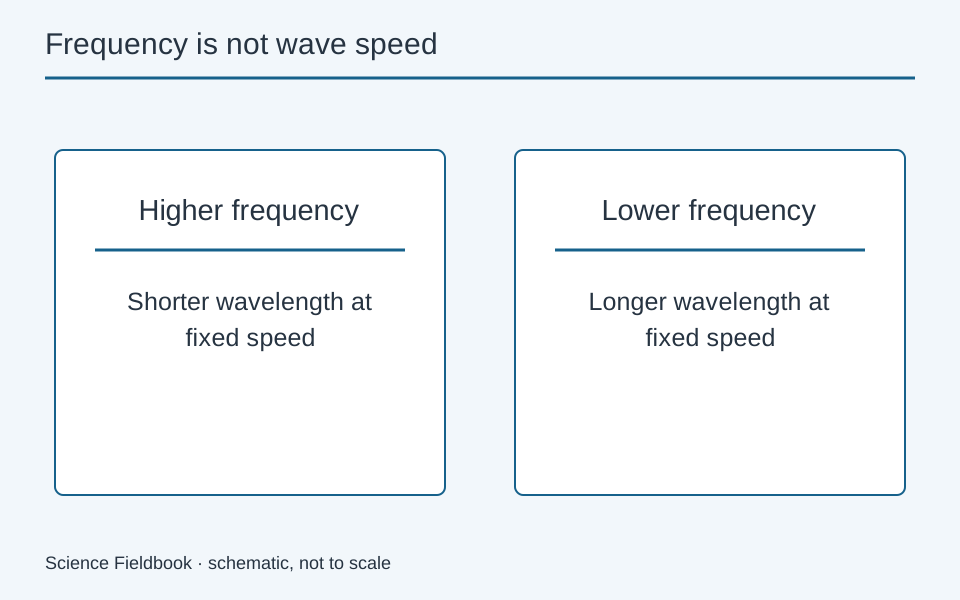
Wavelength is the distance between equivalent points in a repeating wave, such as one compression and the next. Wave speed equals frequency multiplied by wavelength. In a given medium under fixed conditions, a higher-frequency sound therefore has a shorter wavelength.
At roughly 20°C, sound in ordinary air travels at about 343 meters per second. A 343-hertz tone then has a wavelength of about one meter. A 686-hertz tone has a wavelength of about half a meter. These are calculated examples using the rounded speed, not measurements of the tuning fork illustration.
The equation is useful because it separates two ideas people often confuse: how quickly the pattern moves and how often the source repeats. Raising a note's pitch does not normally make the sound outrun lower notes through the same ordinary air.
Why sound does not arrive instantly
The finite speed of pressure disturbances explains echoes and the delay between seeing lightning and hearing thunder. Light crosses familiar outdoor distances far faster than sound, so the visible flash usually arrives first.
Using 343 meters per second, a three-second sound delay corresponds to approximately one kilometer. Real atmospheric conditions and the extended shape of a lightning channel complicate a distance estimate. More importantly, this calculation is not a safe reason to stay outdoors: follow official lightning safety guidance discussed with thunderstorm formation.
An echo involves an additional travel path. If a sound goes to a wall and returns, the total path is twice the distance to the wall. Forgetting that return journey produces a distance estimate that is too large by a factor of two.
Why temperature changes sound speed
Sound speed depends on how a medium responds to compression and on its density. In a gas, temperature strongly influences those relationships. Warmer air generally transmits sound faster than colder air under ordinary atmospheric conditions.
This does not mean the original air from a warm source races across the room. The pressure pattern propagates through the medium that occupies the path. Temperature gradients can change the speed along different parts of that path and bend the wave's direction through refraction.
Wind can also alter the effective travel of sound relative to the ground. Variations with height help explain why a distant source can be easier to hear under some weather conditions than others. Loudness at a distance depends on the atmosphere as well as the source.
Sound needs a medium, but not necessarily air
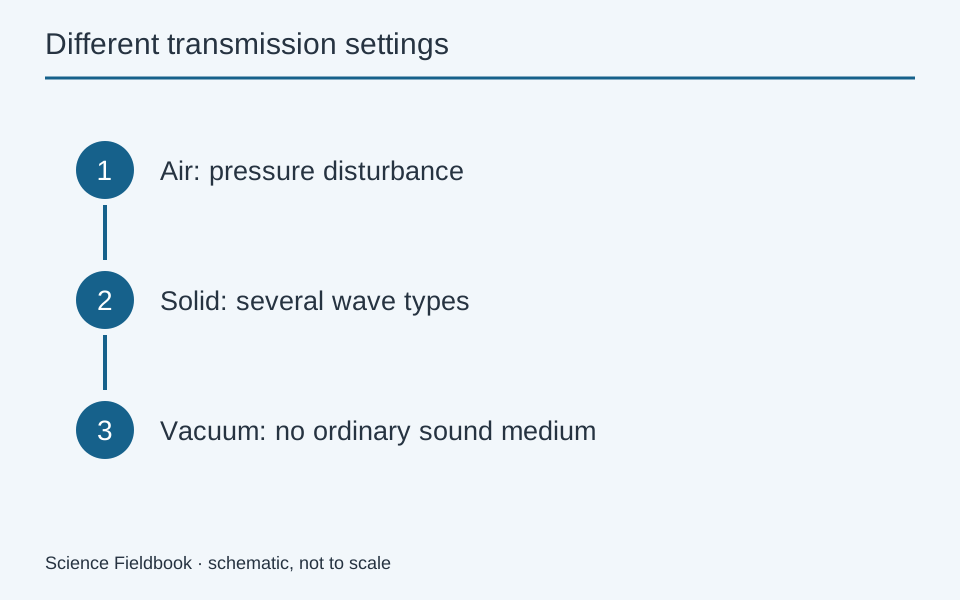
Sound can travel through liquids and solids because they also transmit mechanical disturbances. Its speed is often greater in these materials than in air, but density alone does not determine the result. Stiffness and the particular kind of wave matter too.
Solids can support additional wave types, including shear waves, because they resist changes in shape. Liquids and gases do not support ordinary bulk shear waves in the same way. A single drawing of alternating dots in air cannot describe every possible acoustic wave in every material.
A vacuum contains no material through which ordinary sound can propagate. Radio signals and visible light can cross space because they are electromagnetic waves, not because they are especially strong sound waves. A spacecraft's radio turns speech into electromagnetic signals and another receiver turns those signals back into sound.
What stops a sound from reaching your ear?
Sound energy spreads over larger regions, reflects from surfaces, and can be absorbed or scattered. Soft porous materials often reduce reflections by converting some acoustic energy into tiny amounts of heat. They do not remove every frequency equally well.
Two pressure waves can also overlap. Their pressure changes add, sometimes reinforcing and sometimes partly canceling one another. Noise-canceling headphones use that superposition principle near the ear, alongside the physical isolation provided by the earcups or tips.
This mechanical behavior is different from static electricity, even though both can begin with familiar movements. In one case the important pattern is pressure; in the other it is the distribution of electric charge.
Reflection, absorption, and a room's changing sound
When a pressure wave encounters a boundary, some energy can be reflected and some can be transmitted or absorbed. The balance depends on the materials, geometry, and frequency. A hard empty room often produces strong repeated reflections, while furnishings and porous surfaces can reduce some of them.
Reverberation is the combined persistence of many reflections. It differs from a distinct echo, where a delayed reflection can be recognized separately. Speech can become harder to understand when overlapping reflections smear the timing of successive sounds, even if the speaker is sufficiently loud.
Absorption does not make energy vanish. Some organized acoustic motion is converted into less organized internal energy in the absorbing material and air. The temperature increase from ordinary room sound is generally too small to notice, but the energy accounting remains important.
This also shows why a single “soundproof” material claim needs context. A panel that reduces reflections inside a room does not necessarily prevent sound from passing through its walls. Controlling reflection, transmission, and a noise source are different acoustic tasks, although all influence the final listening experience.
The takeaway
Sound in air is a traveling pressure pattern created by vibration. Frequency sets the repetition rate, amplitude describes the size of the disturbance, and the medium determines how the wave propagates. The molecules pass the disturbance along without making the complete journey with it.