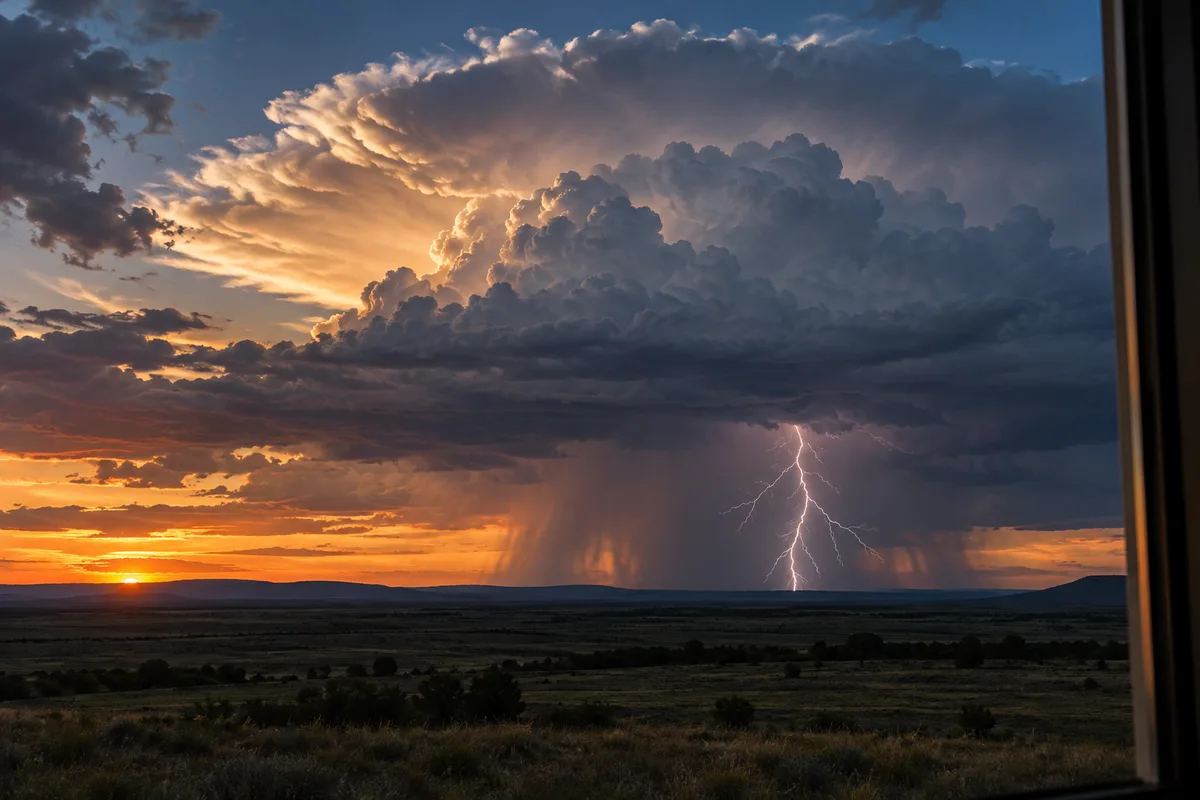
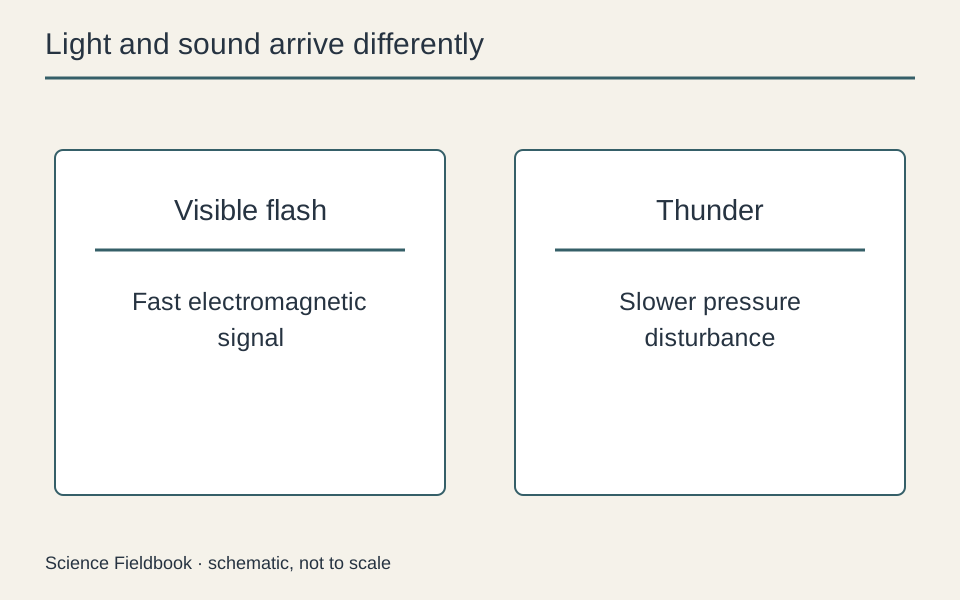
Lightning is an electrical discharge that develops when charge becomes separated within a thunderstorm and the electric field becomes strong enough to create a conducting path through air. Thunder is the sound produced as the air around that lightning channel heats and expands extremely rapidly. You see the flash before hearing the sound because light travels much faster than sound.
The familiar sequence begins well before the bright flash. A storm's rising air, falling precipitation, ice particles, and evolving electrical fields build a large, complicated charge system. A lightning bolt is the visible part of that larger atmospheric process.
A thunderstorm starts with rising moist air
Warm, moist air can rise when the atmosphere allows convection. As a rising parcel expands and cools, water vapor can condense into cloud droplets. Condensation releases latent heat, which can help maintain buoyancy relative to the surrounding air.
A developing storm contains updrafts that carry droplets and ice upward. Precipitation and cooled air can also descend, creating downdrafts. The cloud is not a motionless collection of mist: it is a changing system with different temperatures, particle sizes, and air motions at different heights.
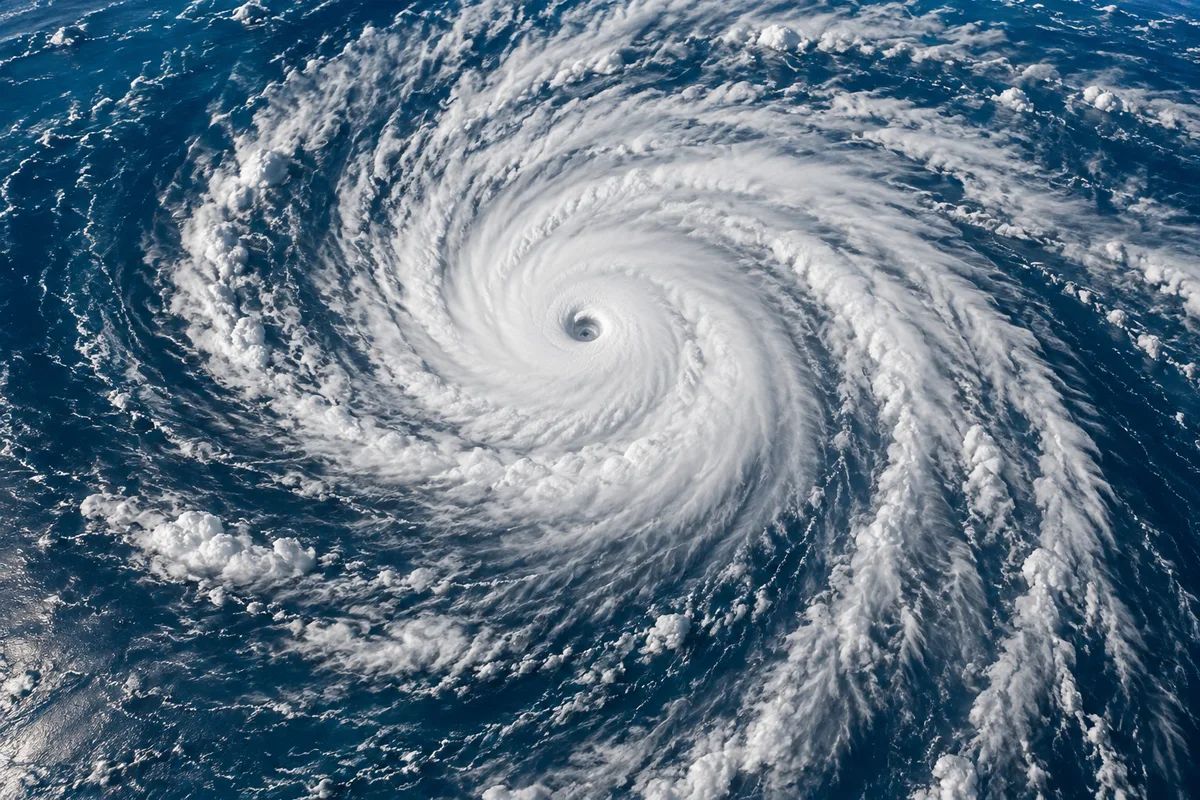
Not every cloud becomes a thunderstorm. Sufficient moisture, an unstable atmosphere, and a lifting mechanism need to combine. Storm organization also depends on the surrounding wind pattern. The same general ingredients appear at a larger scale in hurricane development, although a hurricane is not just one gigantic thunderstorm.
How a storm separates electrical charge
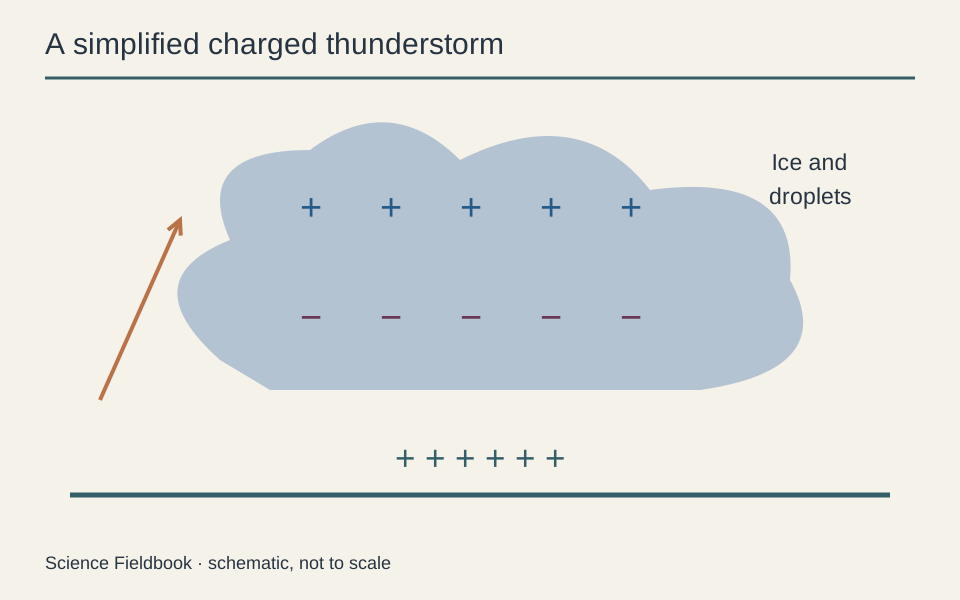
In parts of a thundercloud where ice particles, supercooled droplets, and rimed ice particles interact, collisions can transfer charge. Updrafts and gravity then help separate particles that carry different charge signs. A common broad pattern has positive charge higher in the storm and a main negative region below, often with other charge regions as well.
That is a useful simplified picture, not a fixed wiring diagram for every storm. The sign and amount of charging depend on conditions such as temperature and liquid water content. Charge regions evolve as the storm grows, produces precipitation, and interacts with other cells.
The growing electrical field also affects charge distributions at the ground. A negatively charged cloud region can induce a relatively positive charge near the surface below it. Tall objects can intensify the field locally, but the landscape does not need to contain a tower for a discharge to occur.
NOAA's lightning explanation discusses this collision-based charging model and the unresolved details within it.
What the static-electricity comparison gets right
A charged balloon or a doorknob spark demonstrates separation of charge and the possibility of a discharge. That makes it a helpful introduction, but the details of storm charging are more complex than rubbing a balloon against hair.
Lightning involves long air paths, large charge reservoirs, changing fields, and branching channels. The atmosphere is not an ordinary copper wire waiting to be switched on. Its ability to conduct changes as the electric field creates and sustains ionized paths.
It is therefore misleading to say that two clouds simply “rub together and make a spark.” Collisions among small particles inside the cloud, together with the storm's air motions, are central to the charging process.
How a conducting path becomes a bright flash
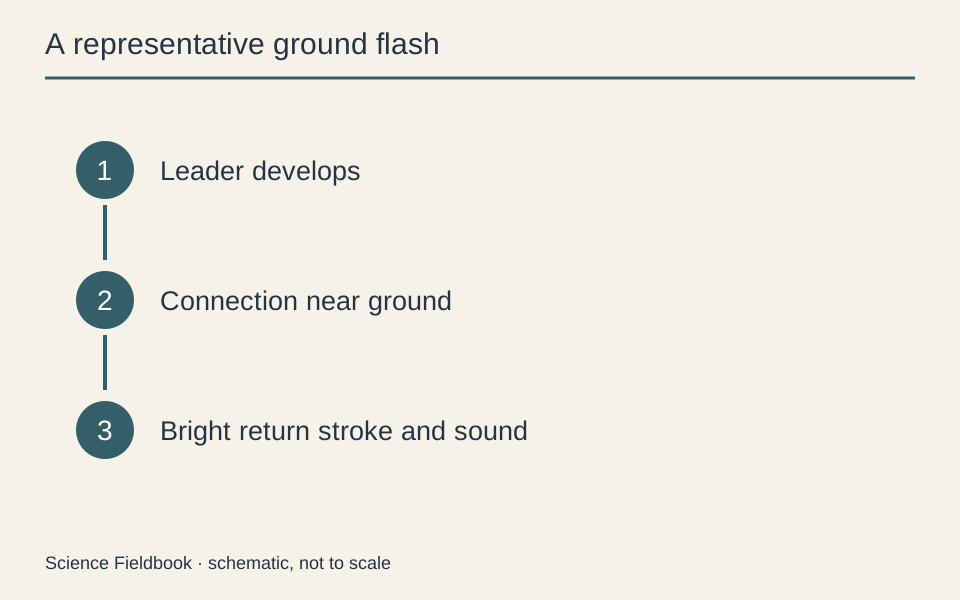
Many cloud-to-ground flashes develop through a branching leader that extends from the cloud in steps. As it approaches the surface, upward connecting leaders can rise from objects on the ground. When a connection forms, a powerful return stroke travels along the established channel and produces the bright flash.
The visible event can include multiple strokes along a similar path, which helps explain flickering. The time sequence is far too fast for a casual observer to follow as a simple downward-moving line. A photograph may combine branching and repeated activity into one apparent shape.
Not all lightning reaches the ground. A great deal occurs within a cloud or between charged regions in nearby clouds. A cloud may light up broadly because it scatters the light from a channel hidden inside, rather than because electricity uniformly fills the entire cloud.
Different kinds of lightning can have different polarity and development. A single introductory diagram should therefore be read as one representative cloud-to-ground sequence, not a catalog of all possible discharges.
Why lightning produces thunder
Current flowing through the channel rapidly heats the surrounding air. The sudden increase in pressure creates an expanding disturbance that becomes an acoustic wave. Very close to the channel the disturbance behaves as a shock wave; farther away, people hear it as thunder.
The light does not directly “turn into” the sound. Both are consequences of the discharge, through different processes. The electrical event produces light from the hot, excited channel and produces sound through its rapid effect on the air.
The channel can be long and crooked. Sound from its nearby and distant parts arrives at different times, and reflections and atmospheric refraction further shape the result. That is why thunder can rumble for several seconds instead of sounding like one short click.
What the delay between flash and thunder tells you
At around 20°C, sound in ordinary air travels roughly 343 meters per second. A three-second delay therefore represents about one kilometer of sound travel, while roughly five seconds corresponds to one mile. These are approximate relationships, not precise storm-ranging instruments.
Temperature, wind, and the lightning channel's geometry affect what you hear. You may see one part of a flash while first hearing another part. Distant thunder may be difficult to detect at all because background noise and atmospheric conditions reduce its audibility.
The underlying principle is the same as other examples of sound traveling through air. However, counting seconds must never become a reason to delay seeking shelter. Hearing thunder already indicates that lightning is close enough to pose a threat.
Lightning safety follows the storm, not the rain
The National Weather Service's safety overview recommends going inside a substantial building or an enclosed, hard-topped vehicle when thunder is heard. Open shelters, trees, tents, and being merely out of the rain are not equivalent protection.
Lightning can occur outside the area of heavy rainfall. Waiting for rain to start, or assuming a clear patch overhead means safety, misses the extent of a storm's electrical activity. A distant-looking storm can still produce a dangerous ground strike.
The same official guidance calls for waiting at least 30 minutes after the last thunder before resuming outdoor activity. Follow current local warnings and the instructions of emergency officials. This article explains the mechanism; it does not replace a location-specific safety plan.
Inside a building, avoid activities involving plumbing and direct contact with corded electrical systems during the storm. The risk is not that ordinary indoor air suddenly becomes a lightning channel, but that a strike can travel through connected conductive systems.
Common lightning myths
Lightning can strike the same place repeatedly. Tall or exposed structures may receive repeated strikes because their position and geometry make them favorable connections. A previous strike does not discharge a site permanently or make it a protected location.
Metal does not need to “attract” a bolt from across the sky to create a hazard. It conducts electricity well and can carry current after a strike. Height, exposure, nearby paths, and contact with conductive objects matter, so focusing on one small metal possession can distract from seeking proper shelter.
Thunder is not caused by clouds colliding or by a sonic boom from a solid object falling through the sky. It comes from the air's response to the lightning channel. Once that distinction is clear, the flash, delay, crack, and rolling rumble fit one consistent sequence.
Why the longest rumble does not measure the longest bolt
A flash can contain several strokes, branches, and sections at different distances from the observer. Sound from those sections arrives over an interval. Terrain reflections and atmospheric bending add further delays, while higher frequencies can weaken more rapidly over a long path.
Consequently, the duration of a rumble is not a direct ruler for the lightning channel's length. Two observers can hear quite different versions of the same flash because their distances, surroundings, and atmospheric paths differ. A recording captures the received pressure pattern, not a complete map of the discharge.
The first audible part is generally the shortest relevant sound path that survives strongly enough to be heard. It need not correspond to the lowest visible point of a bolt in a photograph. This is another reason a flash-to-thunder estimate is approximate rather than a measurement suitable for deciding whether an exposed place is safe.
A cloud's charge pattern is an evolving model
The familiar positive-top, negative-middle diagram represents an important common pattern, but researchers observe additional charge regions and different storm structures. Charging can depend on the sizes and growth of ice particles and on temperature and liquid-water conditions.
NOAA's National Severe Storms Laboratory describes particle collisions and separation as central mechanisms while noting unresolved details. That distinction matters: scientists can have strong evidence for the broad process without predicting the exact location and timing of the next leader inside a turbulent cloud.
The takeaway
A thunderstorm separates charge, an electrical discharge forms a conducting path, and the rapidly heated air produces thunder. Light and sound travel at very different speeds, creating the delay observers notice. The most useful practical response is simple: treat thunder as a warning to seek appropriate shelter, rather than as a cue to watch one more flash.