
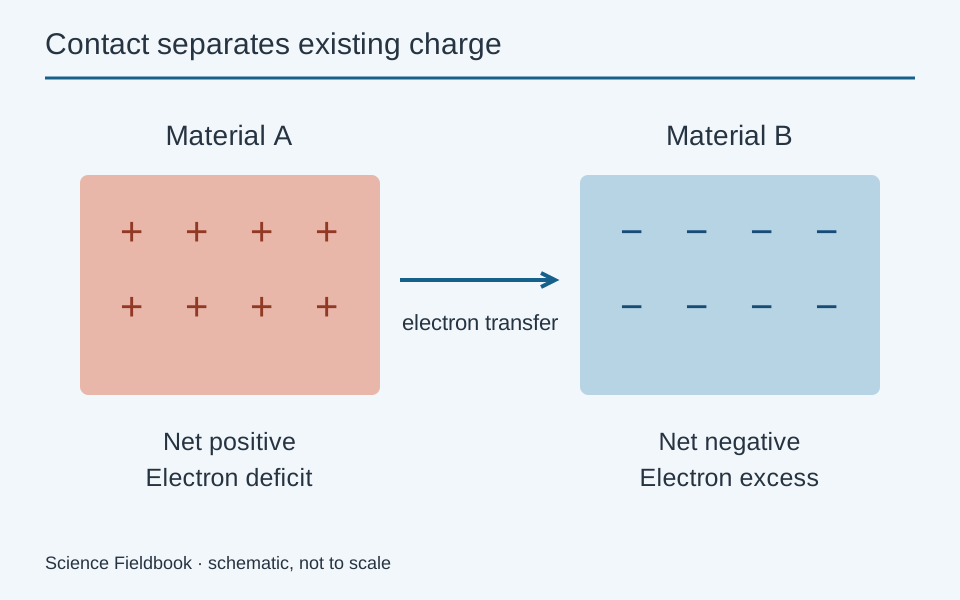
Static electricity happens when electric charge becomes unevenly distributed and remains separated long enough to produce noticeable forces or a discharge. Contact between materials can transfer charge. Separating those materials can leave one surface with an excess of electrons and another with a deficit. The imbalance may persist until charge can move away.
That is the basic explanation behind a balloon attracting hair, clothes clinging together, and a brief shock from a doorknob. Friction often helps create the conditions, but rubbing does not manufacture electrons. It changes how existing charge is distributed between objects.
What positive and negative charge mean
Atoms contain positively charged protons and negatively charged electrons. In ordinary neutral matter, positive and negative charge balance overall. An object does not need to lose every electron or acquire a dramatic new substance to become charged: a small imbalance is enough to produce an electrostatic effect.
Electrons can move between some contacting surfaces while the atomic nuclei remain part of the materials. Losing electrons leaves an object more positive; gaining them leaves it more negative. The signs are names for two kinds of charge, not judgments about whether an object has more or less energy.
Like charges repel and opposite charges attract. Those rules describe forces between charged regions. They also explain why separate hairs may spread apart after charging: similar charges on the strands push them away from one another, while an oppositely charged balloon can attract them.
Charge is conserved in these ordinary processes. If one isolated object acquires negative charge, another part of the system must account for the corresponding change. The familiar classroom description focuses on electron transfer, although real surface charging can involve more complicated material chemistry and particle transfer.
Why contact and separation matter more than friction alone
Different materials interact differently with electrons at their surfaces. Pressing them together and pulling them apart can leave a charge imbalance. Rubbing increases the number of contacts and brings fresh parts of the surfaces together, which is why it is a convenient way to demonstrate the effect.
The result depends on the actual pair of materials and on their condition. Moisture, surface contamination, roughness, and previous treatment can all matter. A simple “triboelectric series” can help organize examples, but it should not be treated as an infallible ranking for every real surface.
The OpenStax explanation of charge transfer describes contact, friction, and conduction. An important distinction is that the charge imbalance is electrical, while the rubbing motion supplies mechanical work. The word “static” describes the accumulated separation, not an absence of all particle motion.
A neutral wall can still attract a charged balloon
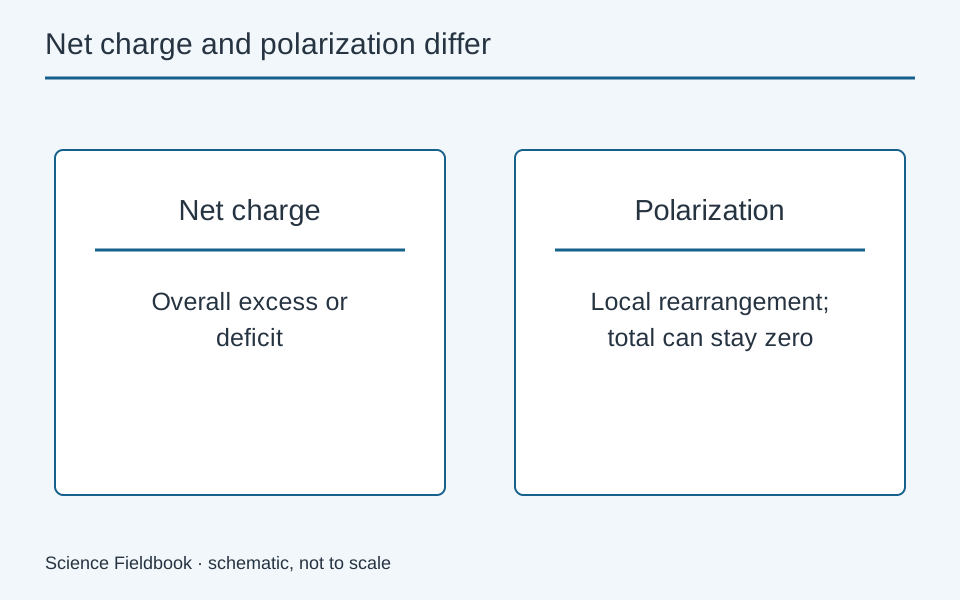
A charged balloon does not require an oppositely charged wall to be attracted. Its electric field can shift or distort charges in the wall slightly. Opposite charge becomes effectively closer to the balloon than like charge, producing a net attraction.
This rearrangement is called polarization. In a conductor, mobile electrons can redistribute across larger distances. In an insulator, the rearrangement is generally more local, involving bound charges and molecular responses. Neither description means the entire wall must acquire a large net charge.
The same principle explains why a charged comb can attract small neutral paper pieces. Attraction by itself therefore does not prove that the paper originally carried the opposite charge. Distinguishing a net imbalance from an induced rearrangement prevents one of the most common electrostatics misunderstandings.
Conductors, insulators, and the escape route
Charge can move relatively freely through a conductor such as a metal. An insulator, such as many plastics, restricts that motion, so charge may remain concentrated on particular regions. The categories are useful generalizations, not declarations that one material has infinite conductivity and the other exactly zero.
A metal object can still hold a net charge if it is insulated from its surroundings. Conversely, a plastic surface can slowly lose charge through moisture, dirt, or contact with other materials. Whether a charge persists depends on the available path as well as the material itself.
Grounding provides a connection to a much larger electrical reservoir, often Earth. Charge can move along that connection until the relevant potential differences are reduced. Grounding does not mean electrons universally “want to go downward”; the direction depends on the electrical conditions.
What causes the sharp shock at a doorknob?
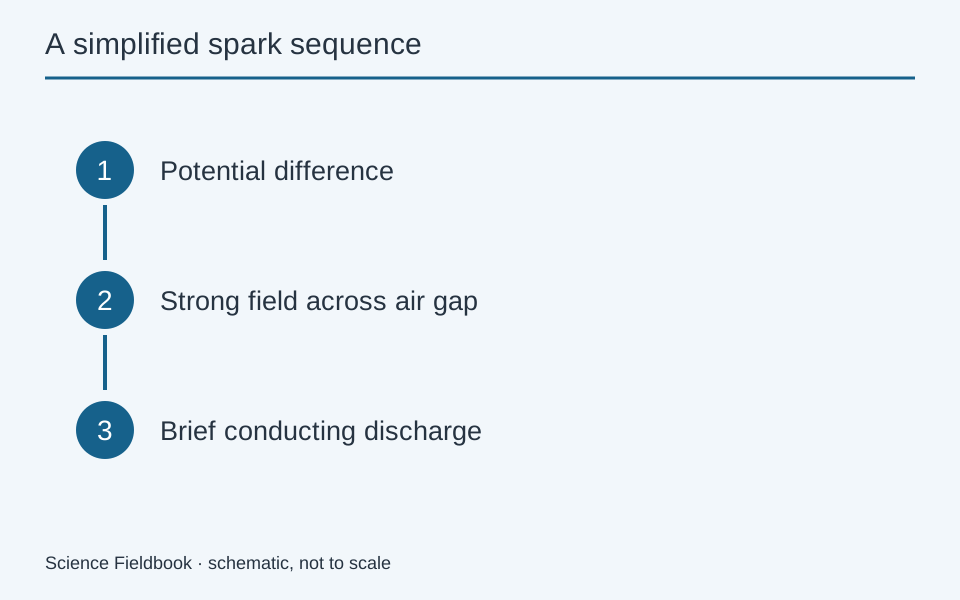
After walking across a suitable floor, your body can be at a different electric potential from a nearby metal object. As your finger approaches, the electric field across the tiny air gap can become strong enough to make the air conduct briefly. The resulting discharge transfers charge rapidly.
The spark is short, but its concentrated current and localized heating can produce a sharp sensation. High voltage does not necessarily mean a large total energy: a small charged object can have a substantial potential difference while storing a modest amount of energy. That distinction should never be used to assume that an unknown electrical source is harmless.
The crack from a small discharge and the much larger sound of thunder after lightning both involve rapid changes associated with electrical discharges, but a household static example is not a safe scale model of a storm. Lightning has vastly greater energy and involves complex atmospheric processes.
Why dry conditions often make the effect noticeable
Moisture on surfaces can provide routes for charge to leak away. In dry indoor conditions, those routes may be less effective, allowing an imbalance to persist longer. This helps explain the familiar association between static shocks and heated buildings in winter.
Humidity is not the only variable. Footwear, flooring, clothing, and the way materials contact one another can change the result. Some objects and environments accumulate troublesome charge even when the air is not especially dry, so “winter causes static” is too broad a rule.
Water's interactions with surfaces are one reason material behavior needs more than a single label. In another setting, the arrangement of water molecules explains why ice floats; in electrostatics, moisture can matter because it changes how easily charge escapes.
Useful observations and important limits
A balloon and a few light paper pieces can reveal attraction without requiring a dramatic spark. Keep the demonstration away from electronics, flammable vapors, and equipment with unknown electrical conditions. Do not deliberately create discharges near batteries, fuel, or medical devices.
Electrostatic discharge can damage sensitive electronic components even when a person barely notices it. Workplaces use specific grounding and handling systems to control that risk. A general explanation of static electricity is not a substitute for the procedures required around electronic hardware or combustible materials.
For comparison, wireless charging uses a deliberately changing magnetic field to transfer energy between circuits. It is not a controlled version of a static shock. Both are electrical phenomena, but the mechanisms and operating conditions differ.
Electric potential is different from the amount of charge
Electric potential difference, measured in volts, describes energy change per unit charge between locations. Charge, measured in coulombs, is a different quantity. Two situations can have similar voltage while involving very different amounts of available charge and energy.
A small isolated object behaves in part like a capacitor: the relationship between its charge and potential depends on its capacitance. In a simple ideal capacitor, stored electrical energy is one-half of capacitance multiplied by voltage squared. The formula explains why voltage alone does not describe an entire discharge, without implying that an unknown high-voltage source is safe.
Geometry matters as well. A sharp point can create a stronger local field than a smooth broad region under otherwise comparable conditions. The relevant air gap and field distribution help determine when charge begins to move through the surrounding gas. A distant view of an object cannot reveal that field precisely.
Does neutral mean there are no electrical effects?
A neutral object contains positive and negative charges in overall balance. Those charges can still respond to an external field, which is why polarization can produce attraction without a net charge transfer. Neutrality describes a total, not a requirement that all internal charge distributions remain fixed.
This distinction is especially helpful with metal. Electrons can redistribute on a conductor so that different regions respond differently to a nearby charged object. The conductor can remain neutral as a whole while showing a strong local interaction. If it touches another object or is grounded, the total charge may then change as well.
The takeaway
Static electricity is a persistent separation of charge. Contact and separation can produce the imbalance, material properties determine how long it lasts, and a conducting path can release it. Following those stages explains attraction and sparks without treating friction as a source of newly created electrons.