Ice floats on water because freezing arranges water molecules into a structure that occupies more space than the same molecules usually occupy in the liquid. The mass stays the same while the volume increases, so the density falls. A piece of ordinary freshwater ice therefore needs to displace less than its own volume of liquid water to support its weight.
That answer connects two different scales. Molecular interactions explain why the density changes; buoyancy explains what the lower density does. Keeping those explanations separate makes sense of floating cubes, icebergs, expanding water bottles, and lakes that remain liquid underneath a winter ice cover.
Density is about packing, not just weight
Density means mass divided by volume. A large block of ice can weigh more than a small glass of water while still being less dense. The useful comparison is between equal volumes: a liter of ice contains less water mass than a liter of liquid water under similar everyday conditions.
Near its melting point, ordinary ice has a density of roughly 0.92 grams per cubic centimeter, compared with approximately 1.00 for freshwater. Those rounded numbers are enough to explain the observation; precise values depend on temperature and pressure. Air bubbles also change the average density of a particular piece.
Imagine freezing 100 grams of water without losing any. Before freezing, it fills roughly 100 milliliters. After freezing, the same mass takes up approximately 109 milliliters. No extra material has appeared. The molecules have adopted a roomier arrangement. This expansion is why a tightly filled container can split in a freezer.
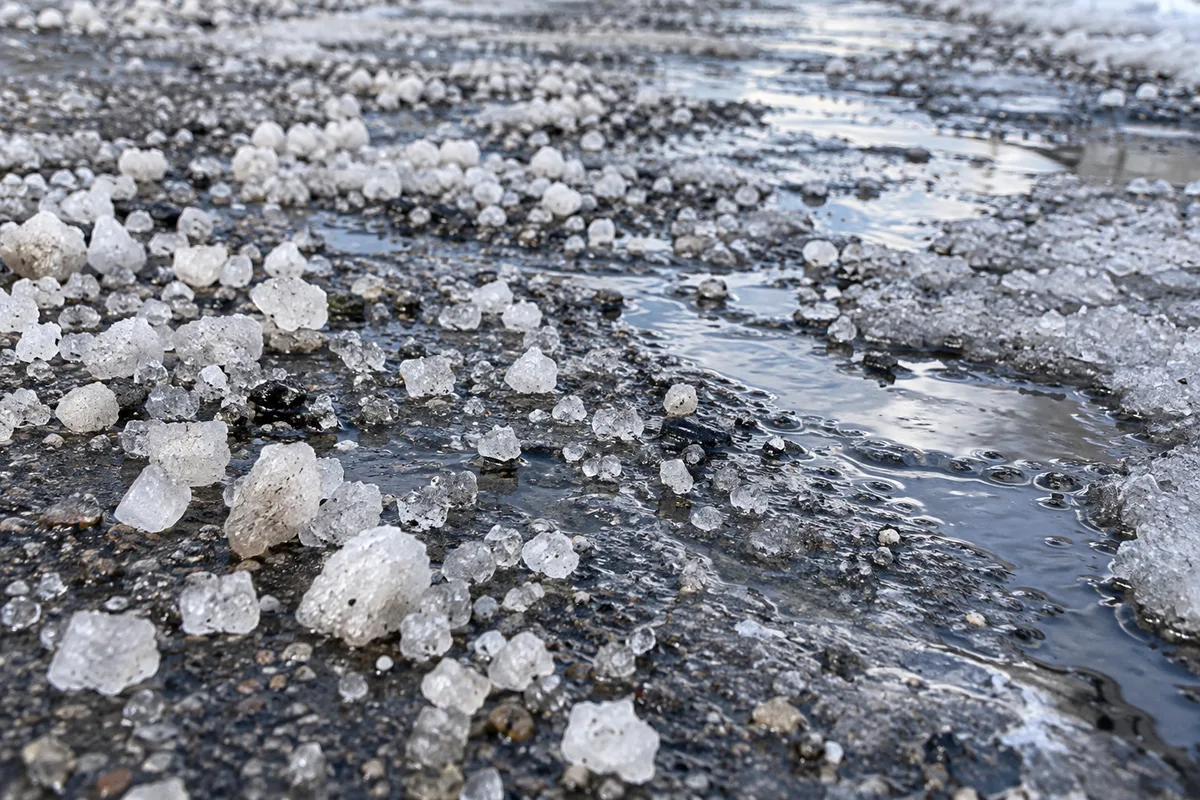
USGS's explanation of water density supports the approximate density contrast and the importance of temperature. The numbers are properties of the materials, not measurements from the illustrations on this page.
The molecular reason: hydrogen bonds
A water molecule contains one oxygen atom bonded to two hydrogen atoms. Its shape and uneven distribution of electrons make it polar: the oxygen side carries a partial negative charge and the hydrogen sides partial positive charges. Neighboring molecules can attract one another through hydrogen bonds.
These attractions are different from the strong covalent bonds holding each individual water molecule together. Freezing does not normally turn H₂O into a new chemical substance. Instead, it changes how separate H₂O molecules organize and move relative to one another.
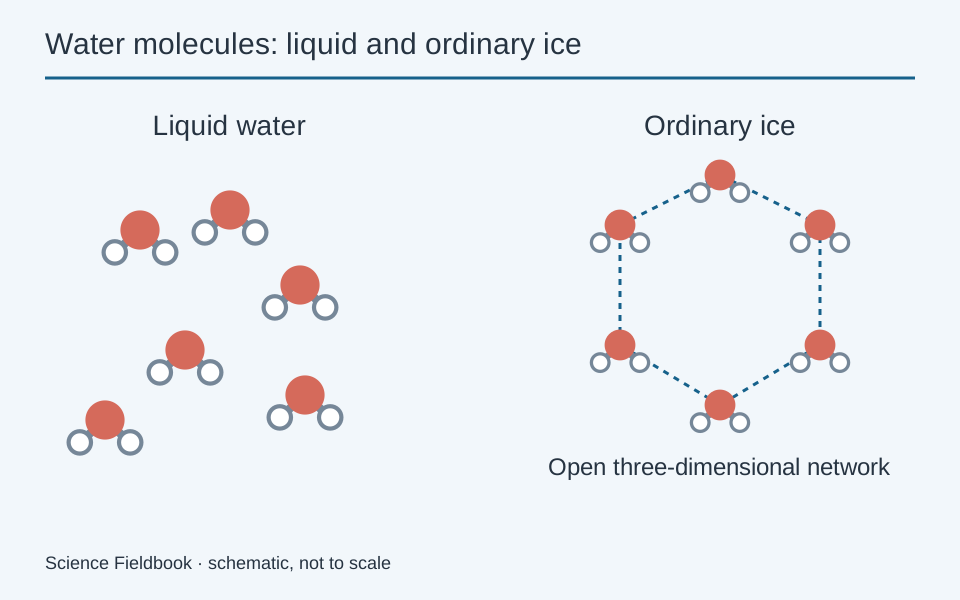
In liquid water, hydrogen bonds continually rearrange as molecules move. Some molecules can occupy spaces that would remain relatively open in a regular ice structure. The liquid is not a pile of disconnected particles; it has local organization, but that organization changes rapidly.
Ordinary ice forms a more persistent network in which neighboring molecules adopt an approximately tetrahedral arrangement. The resulting crystal contains open spaces. A flat hexagon diagram can show the idea, although the real structure is three-dimensional, not a single sheet of rings.
Why slower molecules do not always mean tighter packing
Cooling usually reduces molecular motion and allows a material to contract. Water follows that broad pattern over much of its liquid temperature range, but its hydrogen-bonded structure becomes especially important near freezing. The tendency toward a more open network eventually outweighs ordinary thermal contraction.
Think of the difference between people moving through a room and people instructed to hold a fixed formation. The moving crowd can sometimes pack into gaps. The organized formation may require more floor space even though everyone is moving less. This is only an analogy: molecules do not choose a formation, but their interactions favor particular arrangements.
The distinction also prevents a common mistake. Ice is not full of empty bubbles that must be present for it to float. Clear, bubble-free freshwater ice can float because the crystal itself is less dense than the surrounding liquid.
Buoyancy decides how much ice is underwater
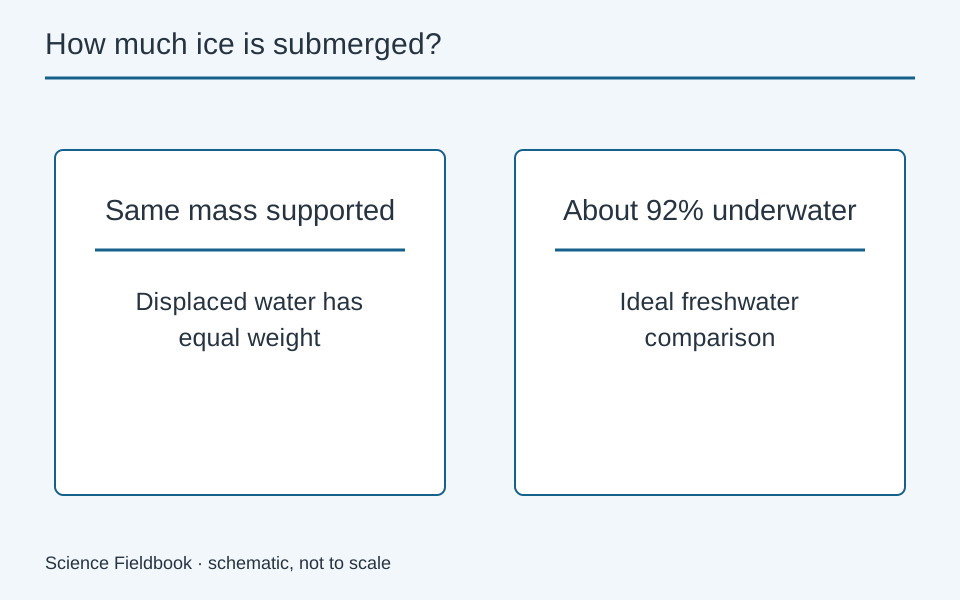
A floating object pushes water aside. The displaced water has weight, and the upward buoyant force equals that weight. An object settles at a level where the upward force balances its own weight, provided it can reach that balance before becoming fully submerged.
Using the rounded density values above, a uniformly dense piece of freshwater ice in freshwater would have about 92 percent of its volume underwater. Shape affects what the exposed part looks like, but it does not change that basic volume balance. A broad flat slab and a narrow irregular chunk can expose very different outlines.
The often repeated “one-tenth above water” description is therefore a rough guide, not an exact rule for every iceberg. Seawater is denser than freshwater, while snow, trapped air, melting, and cracks can alter an iceberg's average density. A real ice mass also has an irregular shape that complicates visual estimates.
Why a lake freezes from the surface
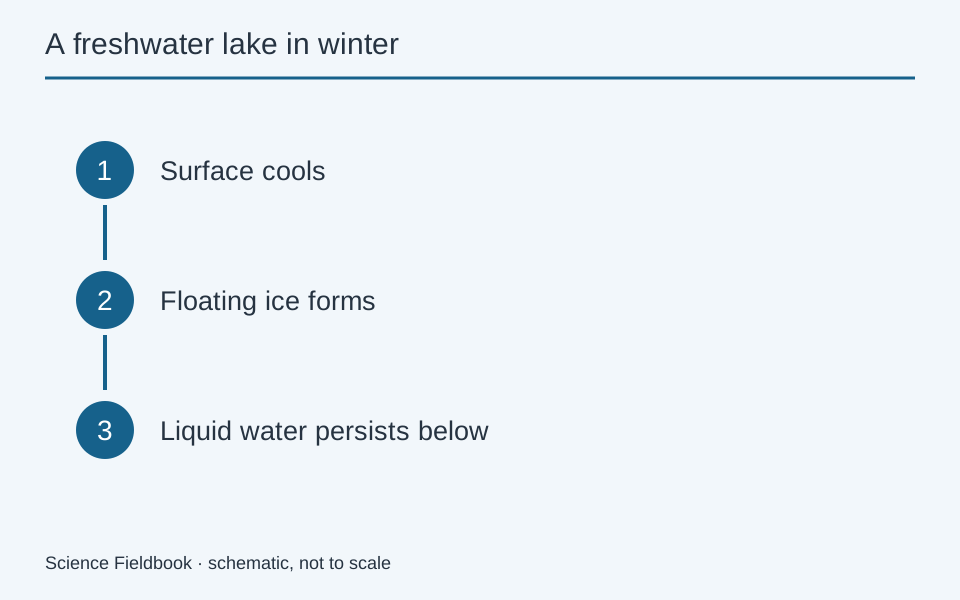
Freshwater reaches its greatest density at about 4°C, or 39°F, at ordinary pressure. As surface water cools toward that temperature, it tends to sink and mix with water below. Once the surface cools further, it becomes less dense and can remain above the denser water underneath.
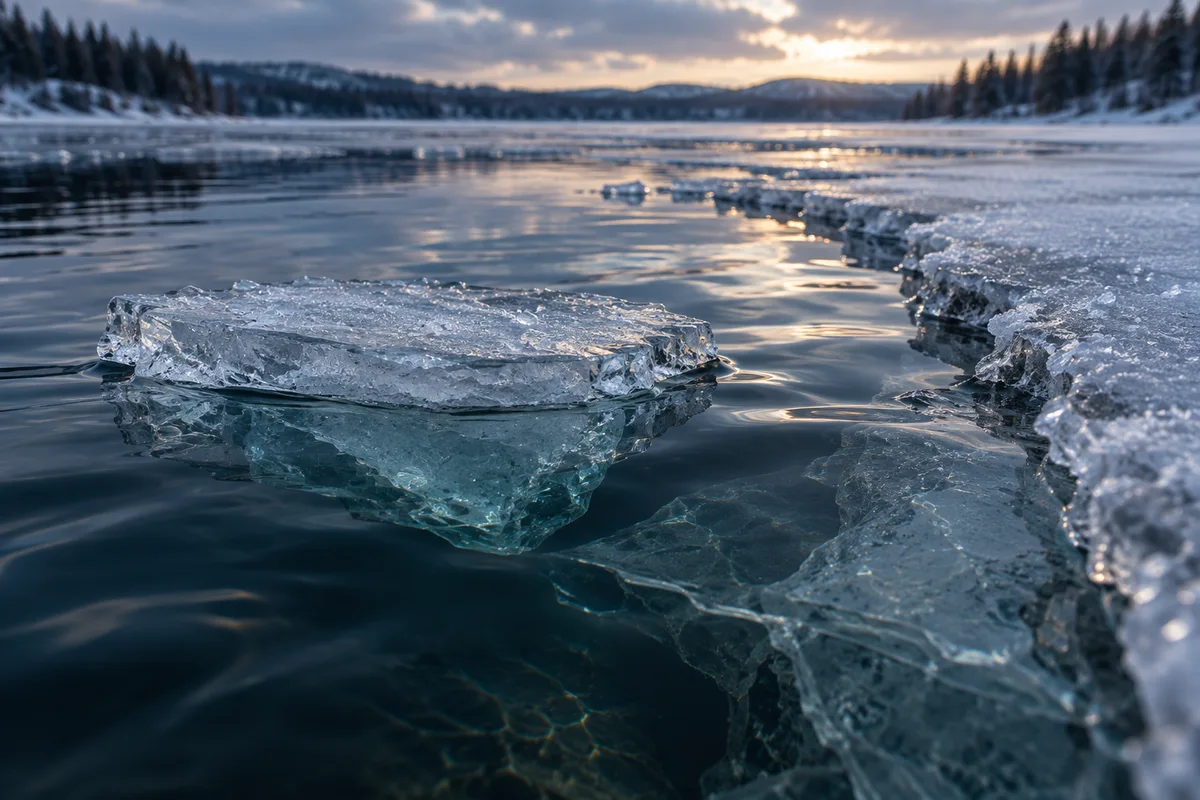
When that upper layer freezes, the ice stays at the surface. The ice and any snow above it slow further heat loss. They do not provide unlimited protection: shallow water can freeze extensively, and oxygen conditions beneath ice can become challenging. But floating ice helps prevent many deeper lakes from turning into solid blocks each winter.
Water below the ice is not necessarily at exactly 4°C everywhere. Wind, lake depth, dissolved substances, inflows, and the season all influence the temperature pattern. The useful principle is the density relationship, not an imaginary perfectly uniform winter lake.
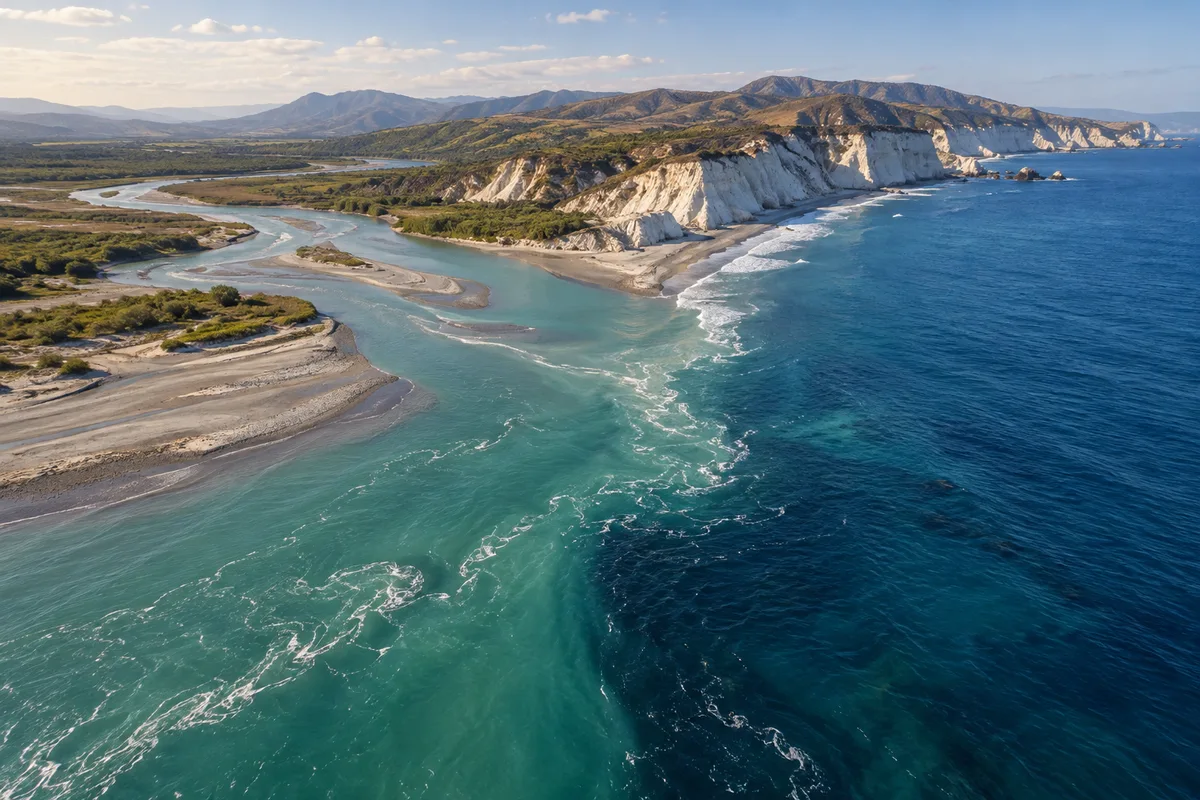
The same molecular behavior helps explain why salt changes how water freezes. Dissolved substances affect the liquid's properties, so an ocean does not freeze in precisely the same way as a freshwater pond.
What floating ice tells you—and what it does not
Ice floating in a drink is a demonstration of density and buoyancy, not proof that all frozen liquids float. Many substances become denser when they solidify. Even water has other solid forms under high pressure with different structures and densities. Ordinary household ice is only one part of water's broader phase behavior.
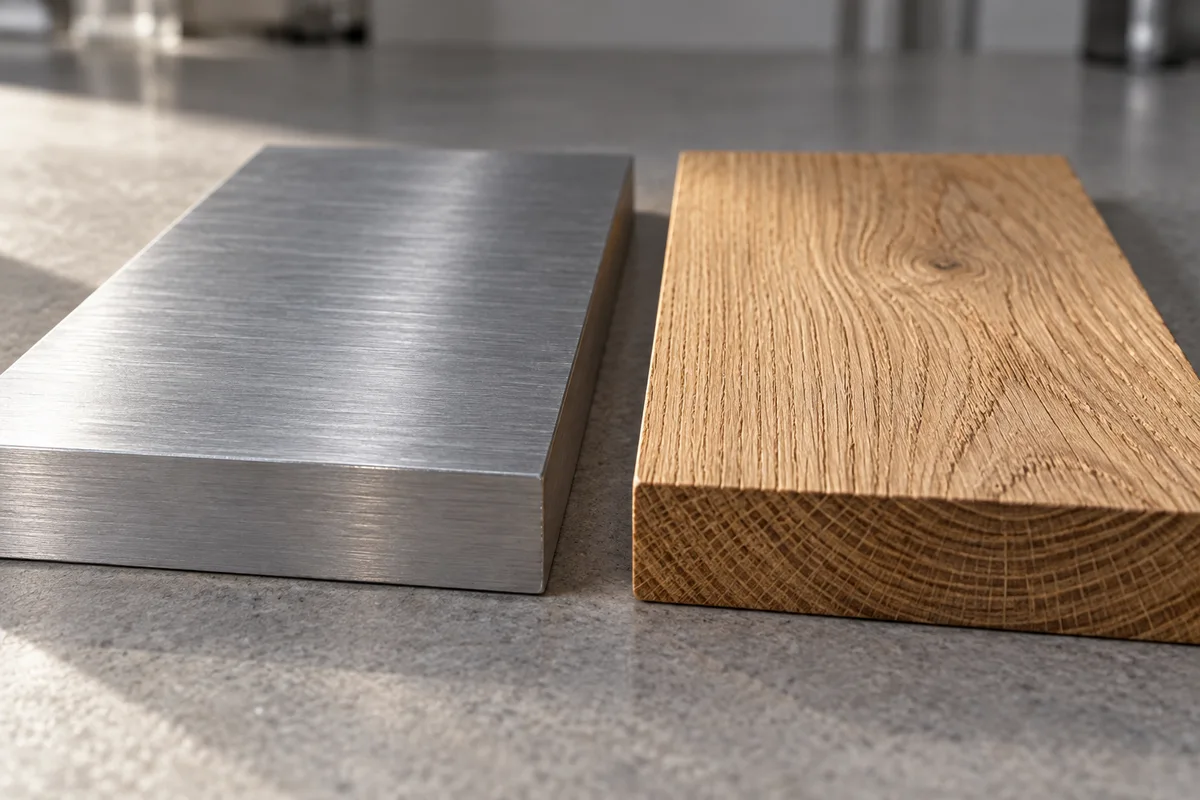
Floating also does not mean the ice contains little thermal energy or feels cold for a special reason. Temperature, stored energy, and heat flow are different questions. The distinction is similar to why metal can feel colder than wood at the same temperature: a familiar observation can involve more than one physical property.
For a simple, safe observation, place a small ice cube in a glass of room-temperature water and look at its waterline. Do not try to measure an exact fraction by eye: the cube's shape, surface tension, and trapped bubbles complicate the result. The demonstration illustrates flotation; it is not a precision density measurement.
Why a floating cube does not raise the water after melting
For a freely floating freshwater ice cube in freshwater, the cube initially displaces a mass of liquid equal to its own mass. After it melts, that same mass becomes liquid water. Under the idealized assumptions of equal final conditions and no spill or evaporation, the water level stays approximately where it was.
This is a buoyancy calculation, not a statement that all melting ice has no effect on sea level. Ice resting on land adds new water to the ocean when it reaches it. Floating ice and the water supporting it are a different initial system. Differences in salinity and density add further refinements to a real ocean calculation.
The example is useful because it follows mass through a change of state. Volume changes when ice melts, but the initially displaced liquid already accounts for the floating ice's weight. Counting only the part visible above the waterline misses most of the system.
The takeaway
Ice floats because ordinary water ice is less dense than liquid water. Hydrogen bonding explains the open crystal structure, and buoyancy explains why part of the ice rises above the surface. The same relationship connects the behavior of one cube to the survival of liquid water beneath winter ice.
For a wider look at water chemistry, explore where the ocean's dissolved salts come from. Freezing, melting, and salinity are different processes, but all depend on what water molecules and dissolved particles are doing.