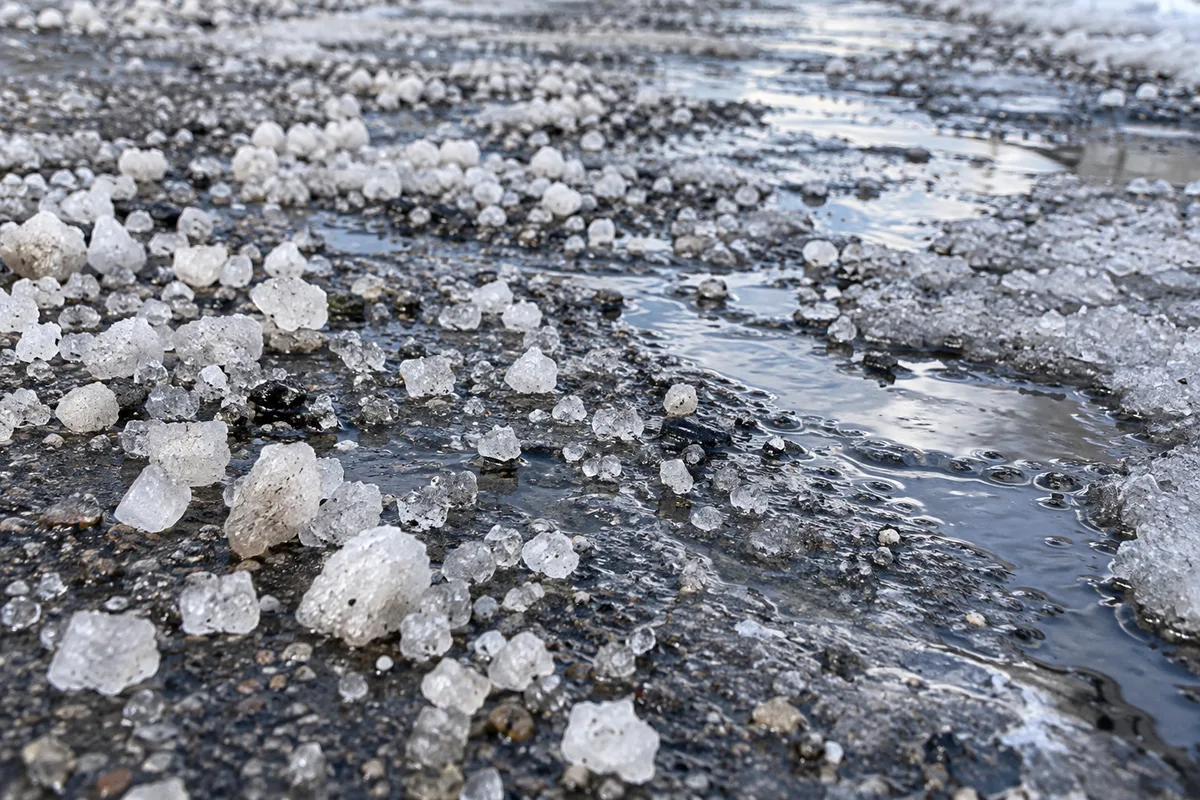
Salt melts ice by lowering the freezing point of the liquid water that forms at the ice surface. When salt dissolves, the resulting brine can remain liquid at temperatures where pure water would freeze. Under suitable conditions, more of the neighboring ice melts as the ice and solution move toward a new balance.
Salt is therefore not a portable heater that makes ice disappear at any temperature. It needs a liquid phase in which to dissolve, and melting still requires energy. Temperature, salt concentration, available heat, and the amount of ice all determine the outcome.
An ice surface is not completely motionless
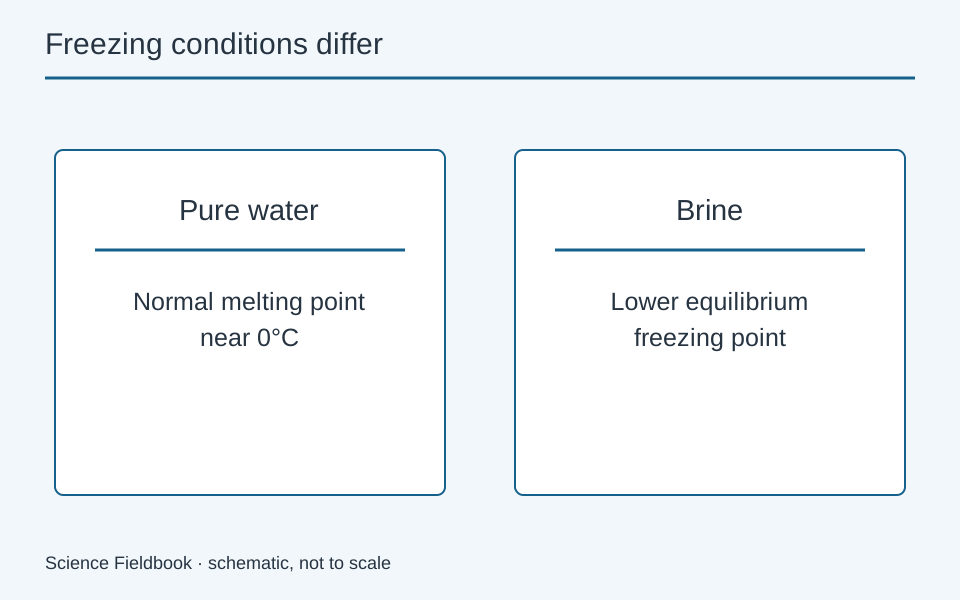
At the boundary between ice and water, molecules continually join and leave the solid. At equilibrium, those opposing processes balance. For pure water at ordinary pressure, the familiar melting and freezing temperature is about 0°C, or 32°F.
A thin liquid-like surface layer and small amounts of meltwater help a deicer begin dissolving. On a pavement, water may also be present from recent melting, precipitation, or a preapplied brine. Dry granules must interact with moisture before they can create a solution.
When the liquid contains dissolved salt, its thermodynamic properties differ from those of pure water. The condition at which ice and liquid can coexist shifts to a lower temperature. This is freezing point depression, one of the colligative properties introduced in OpenStax's discussion of solutions.
What dissolved ions change
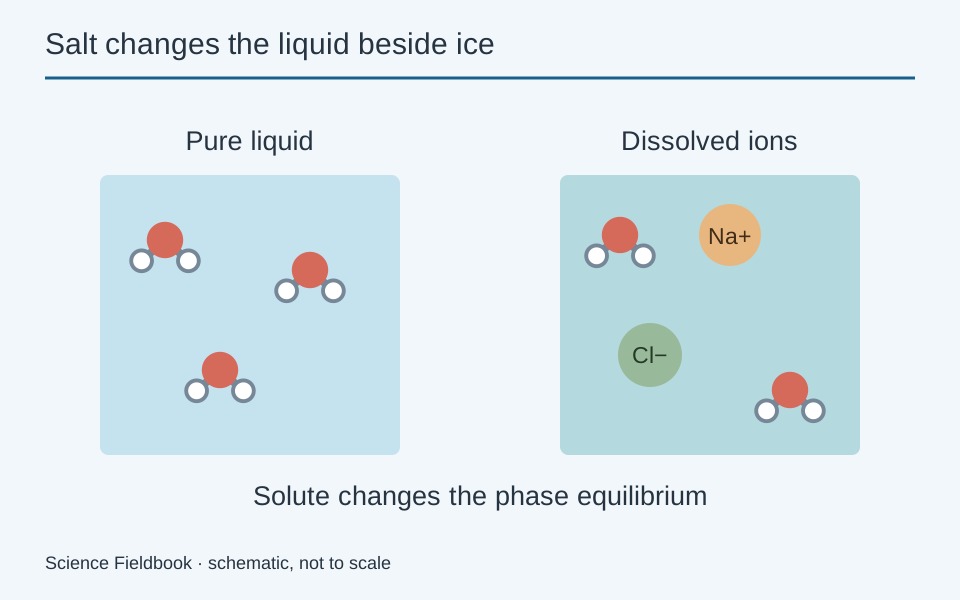
Table salt, sodium chloride, separates into sodium and chloride ions in water. Water molecules surround those charged particles. Dissolution does not simply wedge intact salt crystals into the ice or physically chop a crystal lattice into smaller pieces.
A useful introductory picture is that dissolved particles make it less favorable for water to leave the mixed liquid and become pure ice. A more complete explanation uses chemical potential and the entropy of mixing. The key result is the same: the liquid solution can be stable below pure water's normal freezing temperature.
This mechanism differs from why ice is less dense than water. Density explains flotation, while freezing point depression concerns the conditions under which solid and liquid phases are stable. One does not substitute for the other.
A small calculation, with a clear limit
For an ideal dilute solution, the freezing point depression can be approximated by ΔT = iKm. Here, K is a property of the solvent, m is the number of moles of dissolved solute per kilogram of solvent, and i accounts approximately for the number of dissolved particles produced per formula unit.
Using water's approximate constant of 1.86°C per molal and an ideal value of 2 for sodium chloride, a 0.1-molal solution would give a predicted depression of about 0.37°C. This is a worked example, not a measurement of road brine.
Real concentrated salt solutions do not follow that simple expression perfectly. Ions interact, and the balance between ice, liquid, and solid salts becomes more complicated. A dilute-solution calculation should not be extrapolated into a promise about the performance of a deicer on a winter road.
Melting does not create its own energy supply
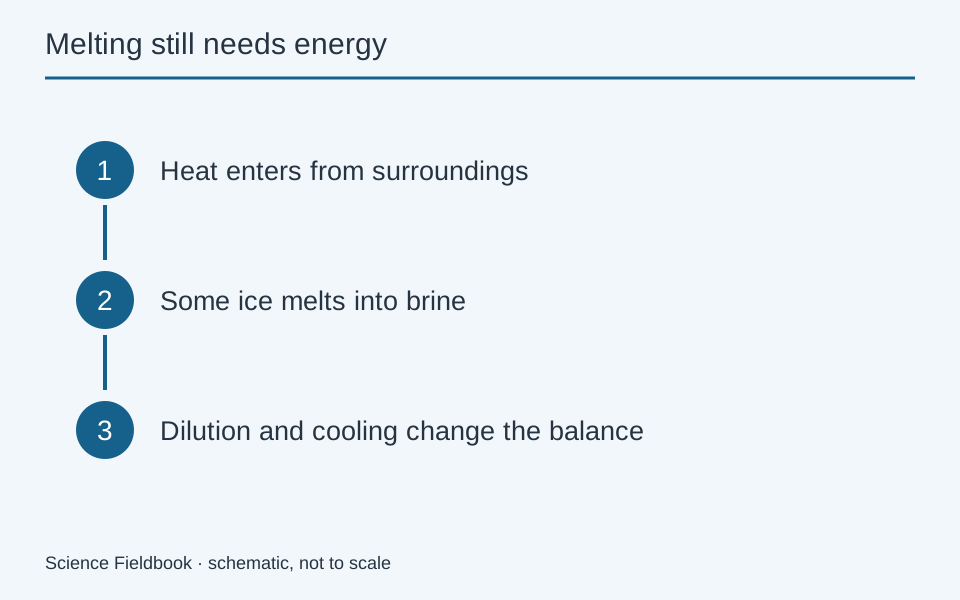
Changing ice into liquid requires latent heat. Energy may come from the pavement, the surrounding air, sunlight, nearby liquid, or the solution itself. As melting consumes that energy, the local temperature can fall.
That cooling is why an ice-and-salt mixture can help freeze another container of liquid, as in a traditional ice-cream maker. There is no contradiction: salt allows some ice to melt below 0°C, and the melting draws energy from the material being cooled.
Different deicing compounds also have different heats of dissolution. Some release noticeable heat when dissolving, while others absorb it or release much less. It is inaccurate to assume that every salt melts ice because dissolving the granules produces warmth.
Why salt stops working well when it gets very cold
Every salt–water system has temperature and concentration limits. For sodium chloride and water, the lowest equilibrium freezing region is around −21°C, or −6°F, near a particular brine concentration. That laboratory phase limit is not the same as a reliable practical working temperature on pavement.
The University of Washington's freezing point demonstration describes the strong depression available in concentrated brine. Outdoors, however, the solution may be too dilute, heat may arrive too slowly, or granules may dissolve too slowly to achieve a useful result.
As snow and ice melt, the new water dilutes the brine. Dilution raises the freezing point again. If conditions cool or enough extra water arrives, refreezing is possible. A surface that looks wet after salting therefore should not automatically be assumed ice-free or safe.
Deicing, anti-icing, and traction are different jobs
Deicing attacks ice that is already present. Anti-icing places a suitable material before or early in an event to make a strong ice-to-pavement bond harder to establish. Both can involve salt, but the timing and purpose are different.
Sand or grit can improve traction without substantially lowering water's freezing point. Conversely, a salt solution can change freezing behavior without instantly providing a rough walking surface. Confusing those roles makes it easy to overestimate what any one material can do.
Environmental conditions matter beyond a single thermometer reading. Pavement temperature can differ from air temperature, especially after sunshine or overnight radiative cooling. Wind and moving water can also remove heat and redistribute the solution. Winter maintenance decisions require local guidance rather than a single universal recipe.
Where the same science appears in nature
Ocean water contains dissolved salts and generally begins freezing below the freezing point of freshwater. As sea ice forms, much of the salt is excluded from the growing ice structure, although brine can remain trapped within the ice. The remaining surrounding water can become saltier.
That is one connection between this kitchen-scale chemistry and the origin and behavior of ocean salinity. It also explains why “saltwater ice” should not be treated as a perfectly uniform block containing the same mixture everywhere.
Heat flow remains important in both settings. Materials that conduct heat differently change how quickly energy reaches an icy surface, while a heat pump deliberately moves energy between locations. The chemistry sets possible phase conditions; energy transfer helps determine how quickly a change happens.
Why adding more salt is not an unlimited solution
At a fixed temperature, a solution can dissolve only a limited amount of a given salt before becoming saturated. Extra solid beyond that condition does not keep increasing the dissolved concentration in the same simple way. As water is added or removed, the mixture can shift between different combinations of solid and liquid.
That distinction matters when interpreting a pile of leftover granules. Visible salt does not prove that the liquid has reached an effective concentration everywhere, and it does not establish that enough heat is available to melt the surrounding ice quickly. Uneven contact and moving meltwater can produce different conditions a few centimeters apart.
Runoff also carries dissolved material away from the treated surface. The chemical mechanism that makes deicing possible is therefore connected to water-quality and material concerns elsewhere. A description of freezing point depression should not become a recommendation to apply an unrestricted quantity. Product instructions and local winter-maintenance guidance address practical use beyond this basic chemistry.
The takeaway
Salt can melt ice because dissolving it lowers the freezing point of liquid water. It does not remove the need for heat, and it does not work equally well at all temperatures or concentrations. The most useful explanation combines solution chemistry, available energy, and the changing conditions at the surface.