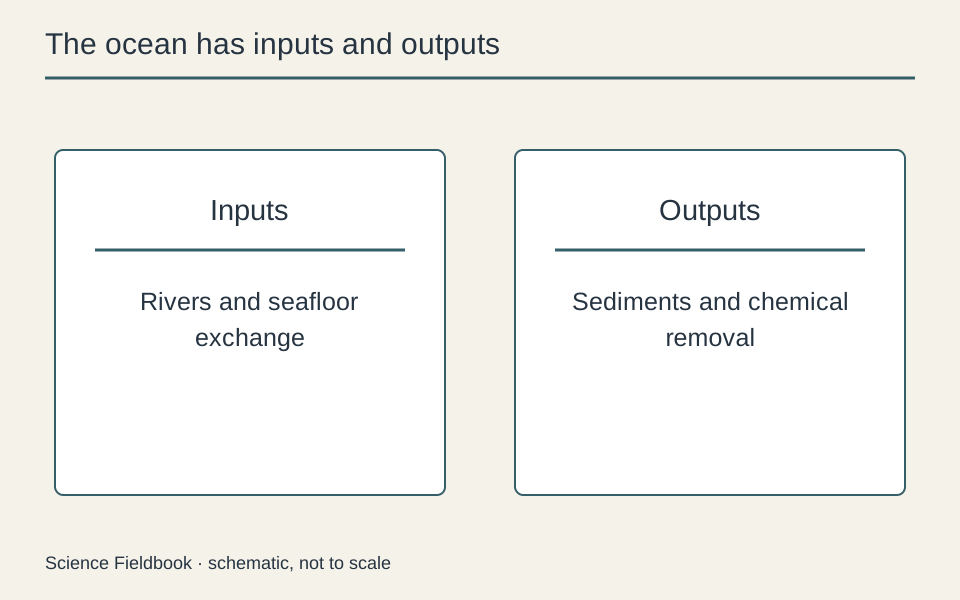
The ocean is salty because water carries dissolved ions into it, especially from the weathering of rocks on land, while other reactions exchange minerals between seawater and the seafloor. Water can leave the ocean through evaporation without taking those dissolved salts along. Over geological time, these processes have produced a large reservoir of salty water.
However, the ocean is not a bucket that simply becomes saltier forever. Minerals are also removed through sediments, chemical reactions, and biological processes. Understanding seawater requires following both the water cycle and the slower movement of dissolved materials.
“Salt” means more than table salt
Seawater contains a mixture of dissolved ions. Sodium and chloride are the most abundant pair, but magnesium, sulfate, calcium, potassium, and other constituents also contribute. The ions are dispersed through the liquid rather than floating around as tiny cubes of dry table salt.
Average ocean salinity is often introduced as about 35 grams of dissolved salts per kilogram of seawater, approximately 3.5 percent by mass. This is a useful broad value, not a fixed reading for every beach, depth, or season. Modern oceanographic salinity measurements involve carefully defined scales and are not simply kitchen measurements of dried residue.
The NOAA explanation of ocean salt identifies land runoff and seafloor sources and describes the dominance of sodium and chloride. An individual water sample still reflects its local history of mixing, evaporation, rainfall, river input, and freezing.
How rain and rocks supply dissolved material
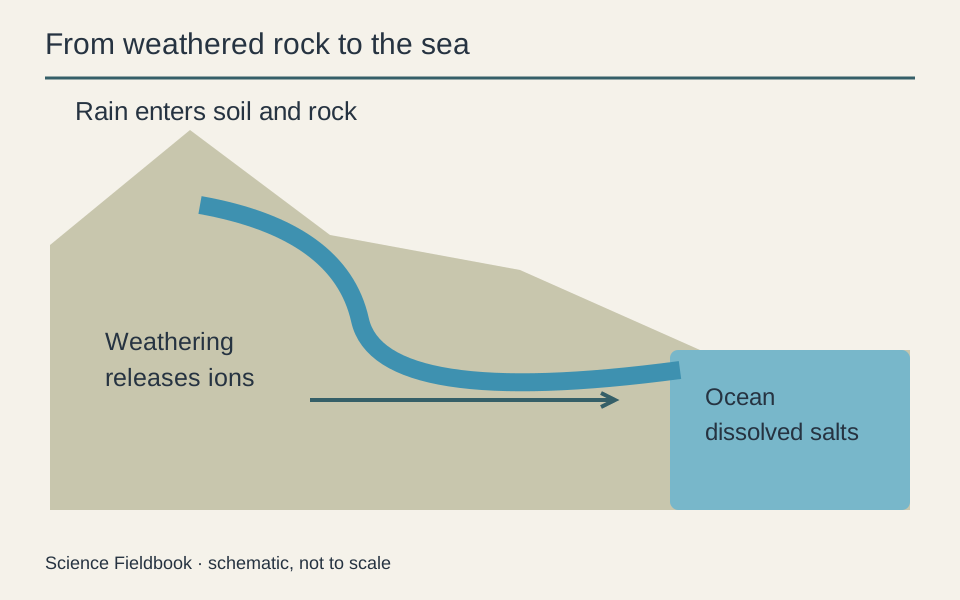
Rainwater picks up carbon dioxide from the air, and water moving through soils can encounter additional carbon dioxide from roots and decomposing organisms. The resulting weak acidity helps water react with minerals in rocks. Those reactions release dissolved substances that can enter streams and groundwater.
Weathering is not the same as breaking a rock into visible sand. Physical erosion moves pieces; chemical weathering changes minerals and transfers some components into solution. Both can happen together, but only the dissolved fraction directly becomes part of the water's dissolved ion inventory.
Rivers therefore contain salts even when their water is called fresh. “Fresh” means relatively low salinity, not absolute chemical purity. Continuous replenishment by rainfall and movement toward the sea usually keep river concentrations far below ordinary ocean concentrations.
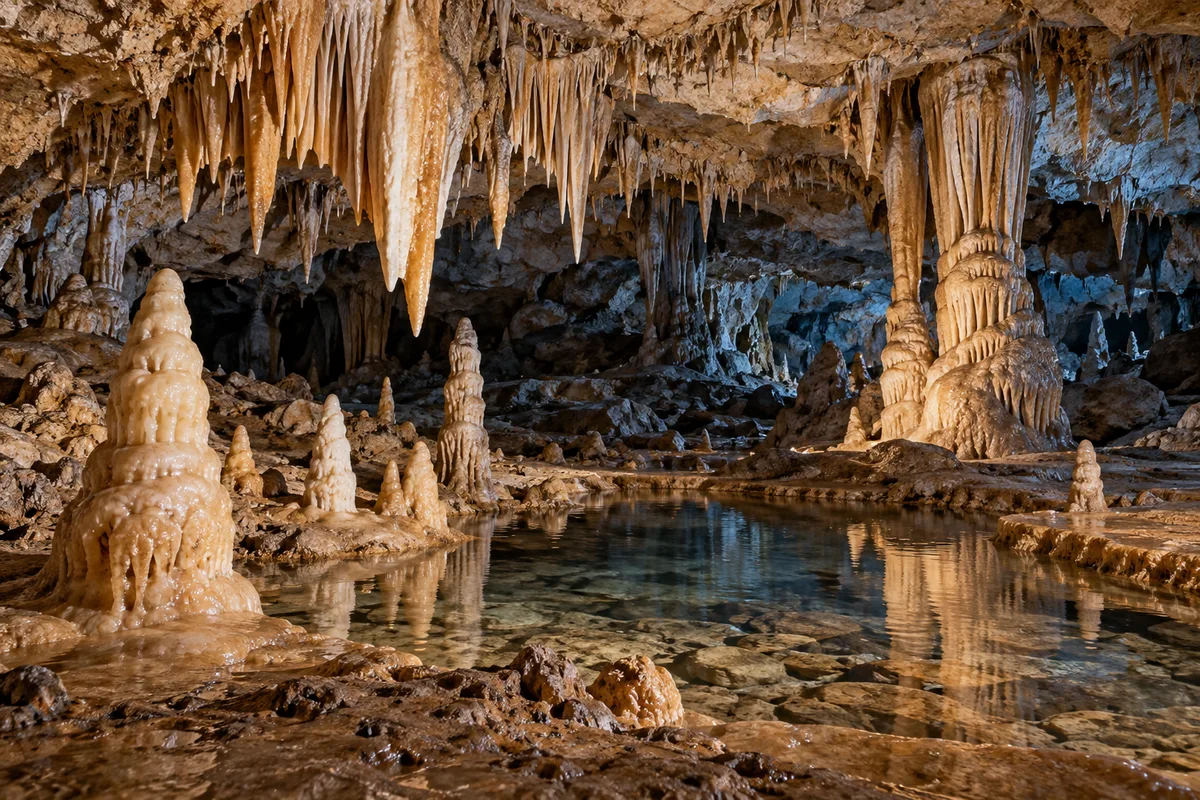
The process is closely related to how groundwater dissolves limestone to make caves. A river can carry the chemical consequences of reactions that occurred far upstream or underground, without those reactions being visible at the river mouth.
Why rivers do not all taste like the sea
Imagine a container receiving a slow flow of slightly salty water. If an equal flow of mixed water leaves, the dissolved material does not automatically accumulate without limit. A river is an open, flowing system of this kind, although its real sources and reactions are more complex.
Now imagine removing water as vapor while leaving most dissolved ions behind. The remaining liquid becomes more concentrated. This second arrangement resembles an important part of the ocean's water balance, and it shows why input concentration alone cannot predict the concentration in the receiving reservoir.
This comparison also clarifies why an inland lake with no surface outlet can become very salty. Water may escape mainly by evaporation, while dissolved substances have fewer exit routes. Other lakes discharge water and dissolved material downstream and remain relatively fresh.
The seafloor is a chemical exchange system
Seawater can circulate through cracks in oceanic crust, heat up near hot rock, and react with surrounding minerals. Hydrothermal fluids can then return to the ocean through vents. Some elements enter the water during this circulation; other components are removed or incorporated into new minerals.
The result is not simply “volcanoes pour table salt into the sea.” Seafloor reactions alter the composition of seawater in selective ways. Hot fluids mixing with cold water can precipitate minerals, forming deposits and the particles associated with some dark vent plumes.
Heat and chemical transport are coupled in these systems, but they are different quantities. A dark plume is not a direct visual measure of salt concentration. Its appearance often comes from fine particles that formed as the fluid mixed and cooled.
Evaporation concentrates salt but does not create it
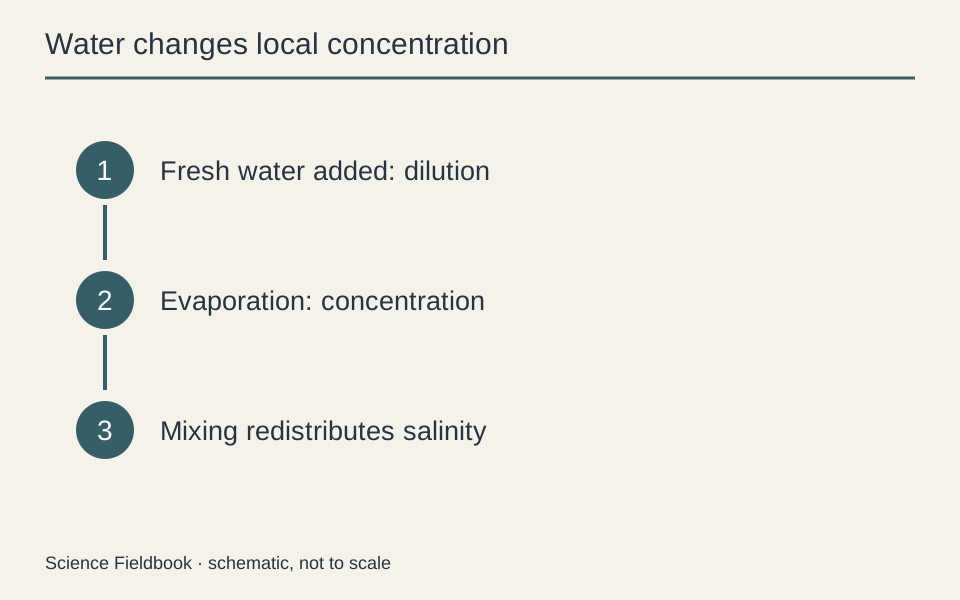
When seawater evaporates, water molecules enter the atmosphere. The dissolved salts mostly remain behind. As a result, a region with strong evaporation and limited freshwater replacement can develop saltier surface water.
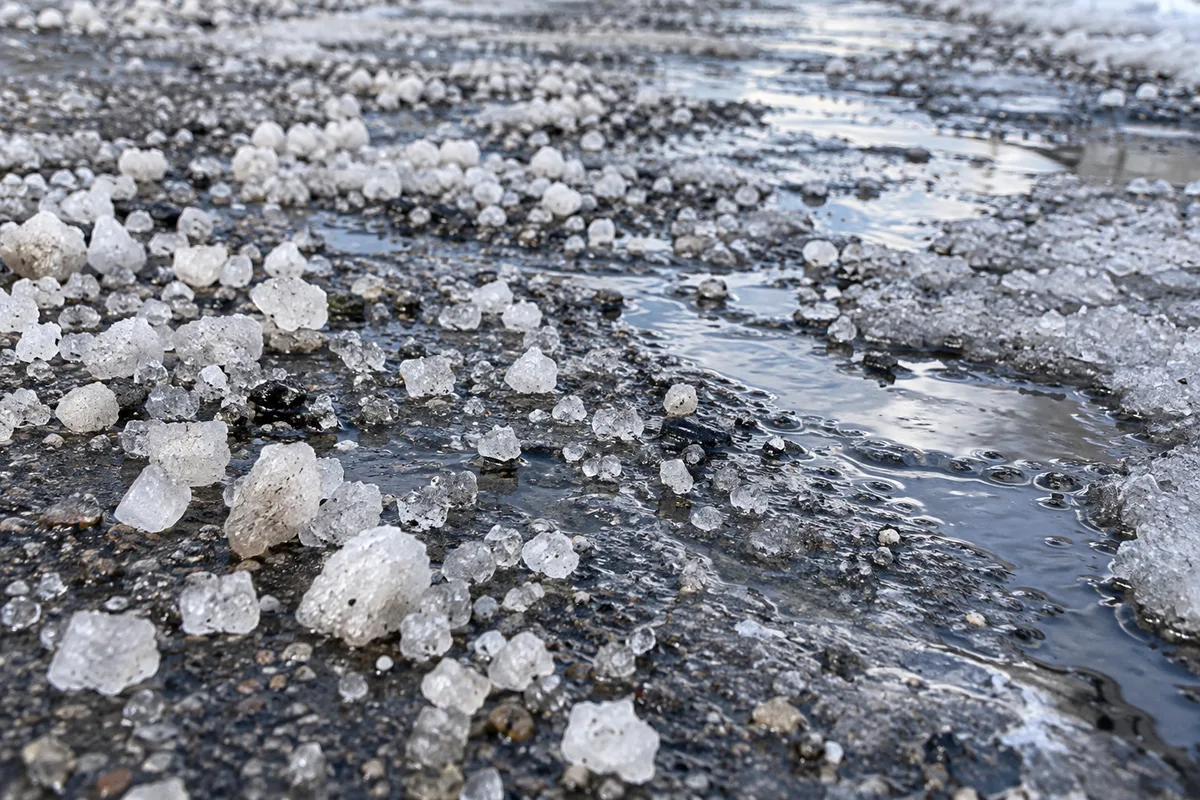
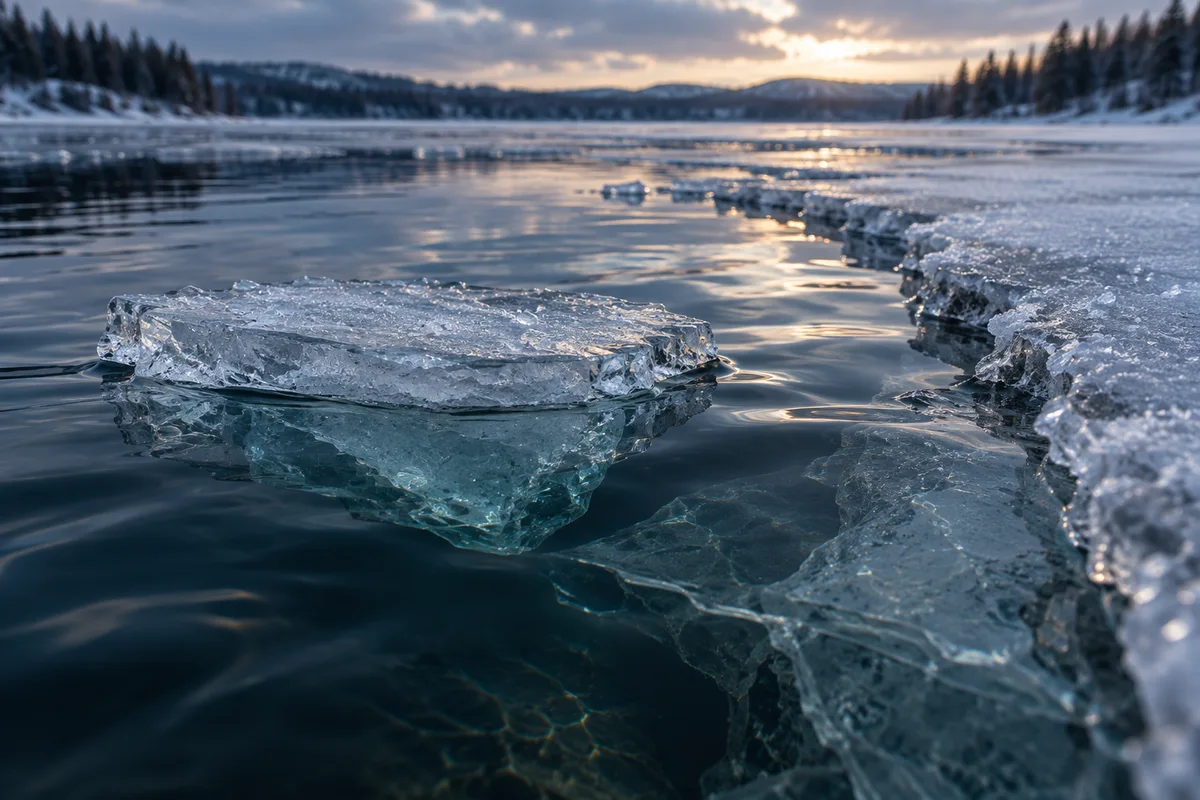
Rain and river runoff have the opposite local effect by adding comparatively fresh water. Ice formation also matters: much of the salt is rejected from growing sea ice, concentrating the surrounding liquid. Melting ice can freshen water near the surface.
That connects salinity to freezing point depression. Dissolved salts affect the temperature at which seawater begins to freeze, while freezing in turn redistributes salt. These are interacting processes rather than unrelated ocean facts.
An important limit is that ordinary evaporation is not the same as sea spray. Wind can physically lift droplets containing salt into the air. Those droplets can leave salt particles after their water evaporates, which is one reason coastal air can deposit salt on nearby surfaces.
Why salinity varies from place to place
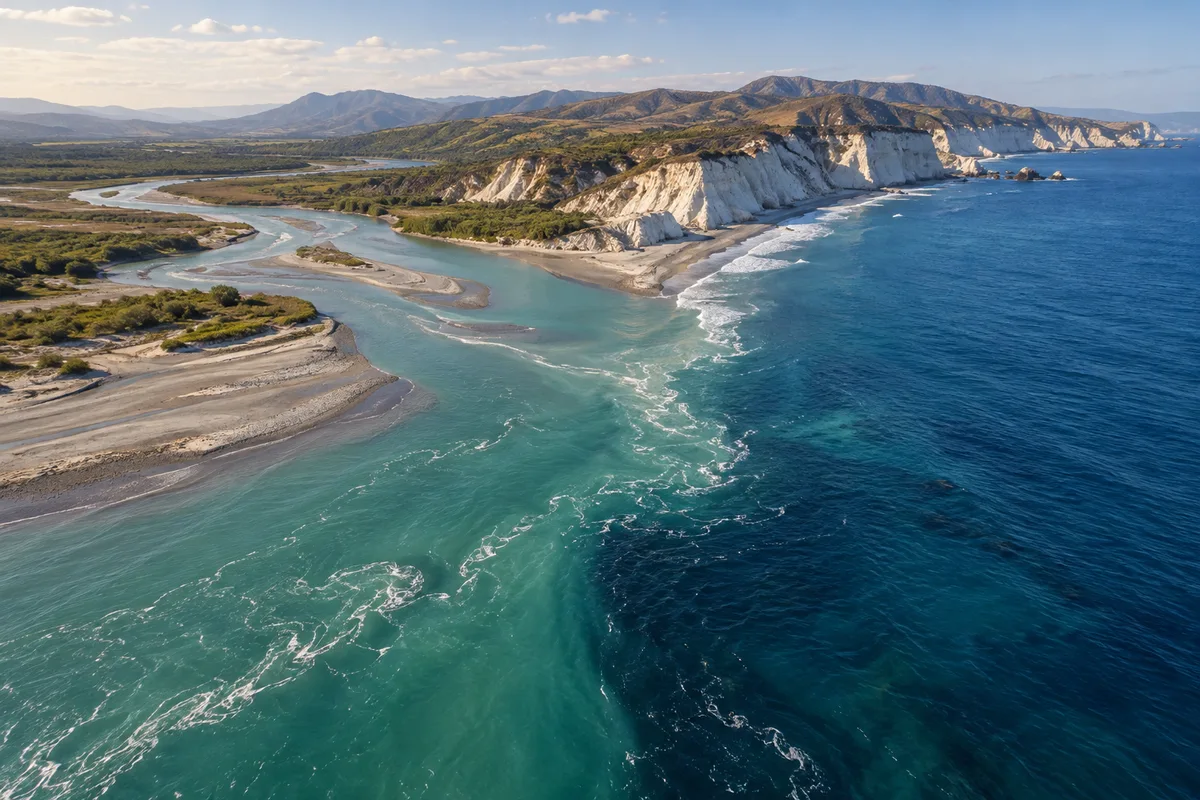
At a river mouth, freshwater spreads into seawater and mixes with it. The resulting estuary can have strong salinity gradients. Rainfall, tides, river discharge, and circulation continually reshape those gradients, so one shoreline reading does not necessarily represent the entire bay.
In open-ocean regions, surface salinity patterns reflect the balance between evaporation and precipitation as well as currents. Deeper water carries the chemical history of the regions where it formed. Mixing reduces contrasts but does not instantly erase them.
Salinity also contributes to density. Under comparable conditions, saltier water is generally denser than fresher water. Temperature matters too, so deciding which parcel sinks requires considering both properties. Why freshwater ice floats is a related density problem with a different molecular explanation.
Why the ocean does not become endlessly saltier
Ions have different residence times and removal pathways. Some become part of minerals or sediments. Marine organisms incorporate dissolved constituents into shells and other structures. Reactions with the crust can remove material, while burial keeps some of it out of immediate circulation.
The ocean's composition reflects the interaction of these inputs and outputs over long periods. It is not safe to estimate the ocean's age by dividing all the salt present by one modern river input number. Such a calculation ignores changing rates, multiple sources, and removal processes.
Similarly, the presence of a mineral in a river does not mean it remains dissolved in seawater indefinitely. The chemistry of mixing, biological uptake, and mineral precipitation can change its fate. Each element has its own part in the larger system.
A concentration example that separates salt from water
Consider an ideal container with one kilogram of solution containing 35 grams of dissolved salts. If 100 grams of water evaporate and no salt leaves, 35 grams remain in 900 grams of solution. The salt fraction rises from 3.5 percent to about 3.9 percent even though no new salt entered.
This is a deliberately simplified calculation. A real ocean parcel mixes, exchanges heat, receives precipitation, and may interact with ice or surrounding water. The example isolates one process so its direction is unmistakable: removing water can increase concentration without creating dissolved material.
Adding fresh water reverses that concentration effect, while removing a portion of well-mixed solution takes both water and salts away together. These three operations—evaporating water, adding fresh water, and exporting mixed water—are not chemically equivalent. Distinguishing them makes estuaries, dry-climate seas, and saline inland lakes easier to compare without assuming that every salty water body has the same history.
The takeaway
The sea is salty because weathering and seafloor processes supply dissolved ions, while the water cycle repeatedly moves relatively pure water into the atmosphere. Salinity varies as freshwater is added or removed, and geological and biological sinks prevent a simple story of unlimited accumulation.
For another example of the ocean's importance, explore how hurricanes draw energy from warm seawater. The same body of water carries heat, dissolved substances, and momentum, with different processes controlling each.