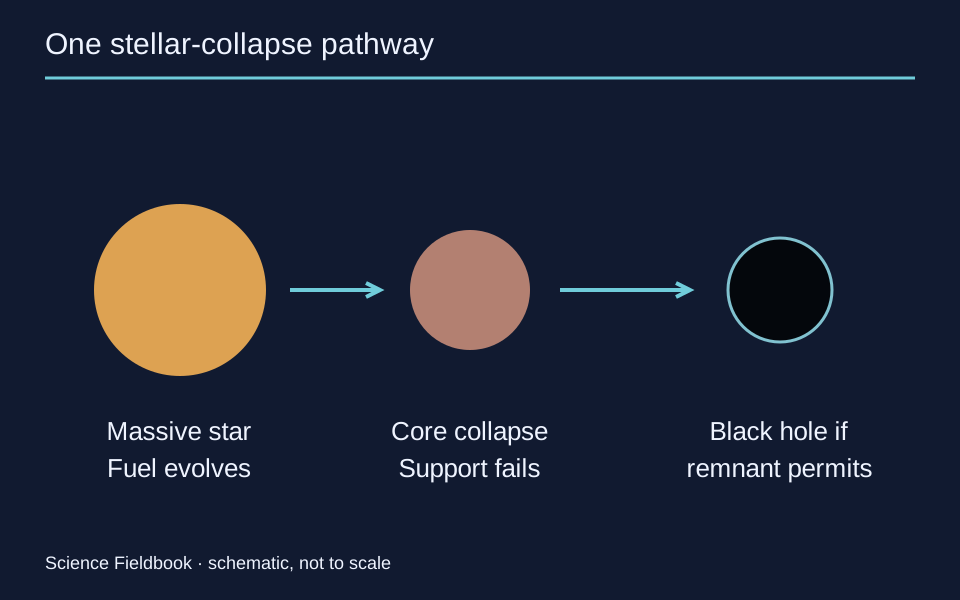
Many stellar-mass black holes form when the core of a massive star collapses under gravity and no remaining pressure can support the remnant. If enough mass becomes concentrated within a sufficiently small region, an event horizon forms: a boundary beyond which light and other signals cannot escape to distant observers.
That is a major formation pathway, not the origin story of every black hole. Mergers can build larger black holes, and the early growth of supermassive black holes involves additional, still actively investigated possibilities. Understanding the distinctions prevents the phrase “a dead star” from doing more explanatory work than it can support.
Why a star can resist gravity for so long
A star's own gravity pulls its material inward. Pressure within the star supports it against that inward pull. During much of a star's life, nuclear fusion supplies energy that helps maintain the temperature and pressure required for this balance.
Fusion changes the composition of the core over time. In a sufficiently massive star, successive stages of nuclear burning can create heavier elements in a layered structure. The final stages can proceed much more rapidly than the long hydrogen-burning phase.
This does not mean every star follows the same sequence or leaves the same remnant. Initial mass, mass loss, composition, rotation, and interactions with a companion all affect stellar evolution. The Sun is not massive enough to be expected to end its life as a black hole through the ordinary single-star pathway.
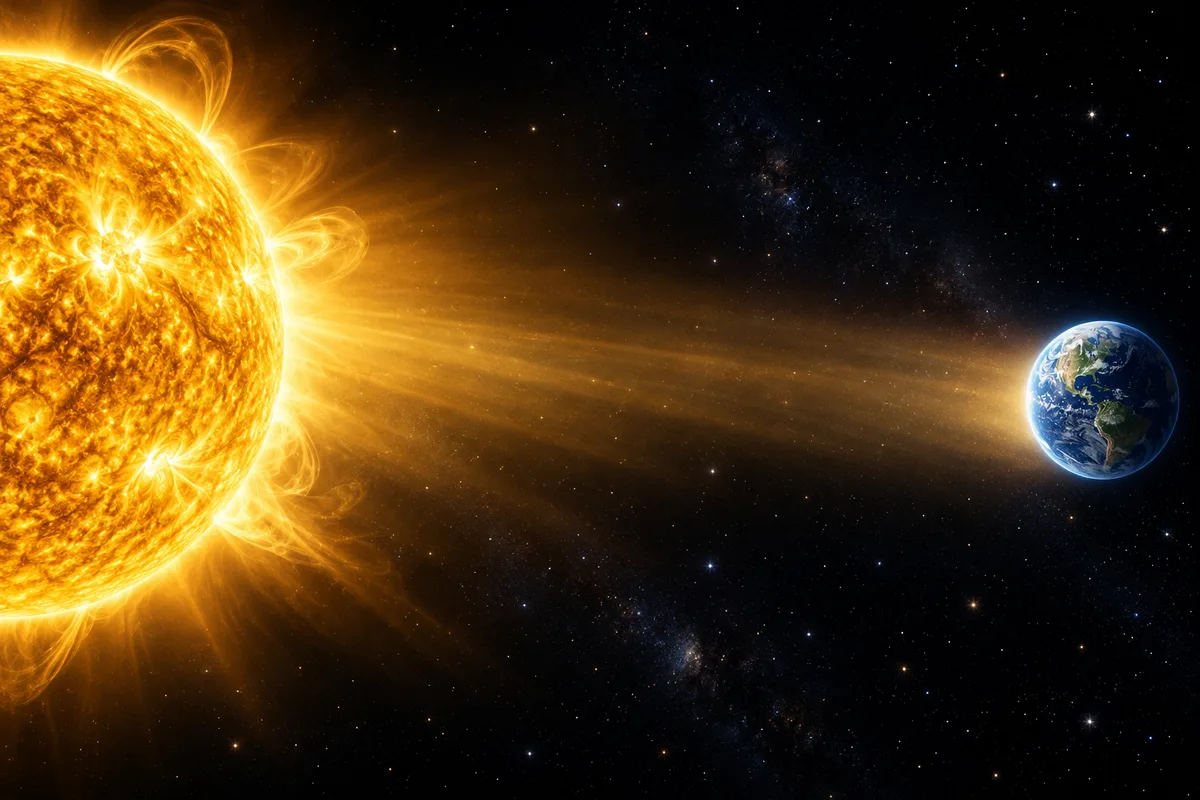
The NASA account of the Sun provides a useful comparison with a familiar star. Its internal energy source and eventual history differ from those of the much more massive stars relevant to many black-hole-forming collapses.
What changes when a massive core collapses
At advanced stages, the core can lose the support needed to resist gravity. Nuclear processes and changes in the core's matter and pressure contribute to a rapid collapse. The surrounding star may undergo a supernova, but the relationship between explosion and final remnant is not one simple universal script.
Some collapses leave neutron stars, incredibly compact remnants supported by the physics of dense matter. If the remnant is too massive for the available support, collapse can continue toward black-hole formation. Some black holes may also form through a weak or failed explosion rather than a conspicuous ordinary supernova.
There is no single initial stellar-mass cutoff that works independently of all the other variables. A star's birth mass is not the same as the mass left in its core after winds, eruptions, or companion interactions remove material. Quoting one number without explaining those distinctions creates false certainty.
A black hole is not an empty hole in matter
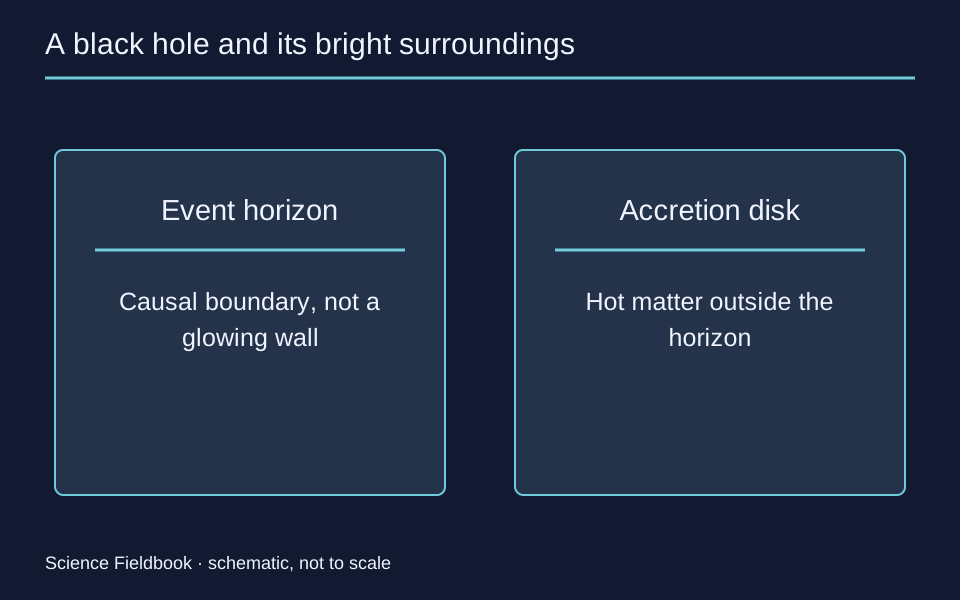
The term describes a region of spacetime with an event horizon, not a tunnel drilled into space or an opening with a material wall. The horizon is defined by which future paths can reach distant observers.
For a simple nonrotating, uncharged model, a characteristic radius is 2GM divided by c squared, where G is the gravitational constant, M the mass, and c the speed of light. This Schwarzschild radius scales with mass. The formula is useful for the idealized case, while real astrophysical black holes are generally expected to rotate.
The description also has limits. Classical general relativity predicts extreme behavior inside the horizon, but the complete physics of the deepest interior requires a theory beyond the simple classical account. An introductory article should not pretend that scientists have directly observed a material singularity at the center.
How a black hole affects its surroundings
Outside the horizon, a black hole's gravity depends on its mass and the surrounding geometry. It does not have an extra vacuum-cleaner force that reaches out and indiscriminately pulls in everything nearby. Matter can orbit a black hole rather than immediately falling into it.
Gas that does move inward often carries angular momentum. Interactions within the gas can allow some material to spiral closer, while friction-like dissipation and magnetic processes heat it. An accretion disk can then shine brightly even though the black hole itself does not let ordinary light escape from within the horizon.
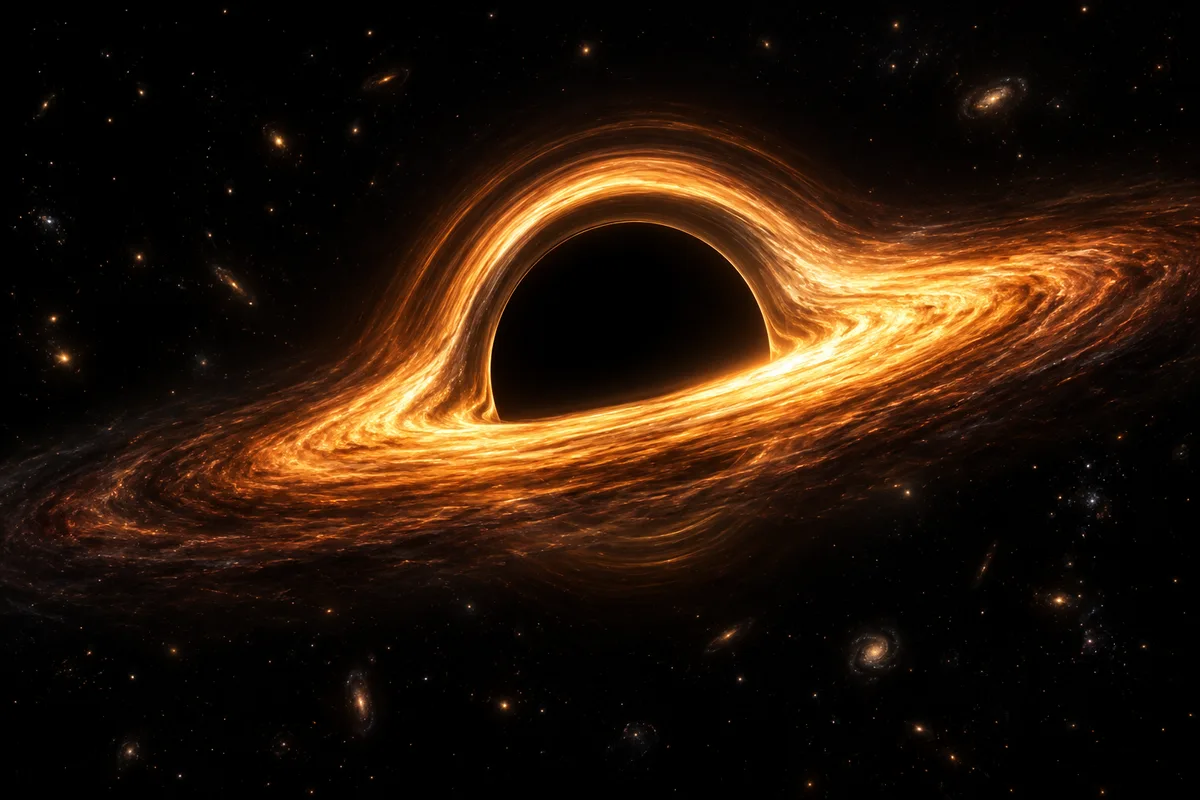
The bright rings in visualizations are therefore associated with nearby emitting material and the way gravity bends its light. They are not the event horizon glowing like a lamp. A black hole without a bright surrounding supply of gas may be much harder to notice.
Why stellar-mass and supermassive black holes need different stories
Stellar-mass black holes are associated with stellar evolution and with mergers involving compact remnants. Supermassive black holes, found in the centers of many galaxies, contain vastly more mass. Explaining how they acquired that mass requires following seed formation and subsequent growth.
Possible seeds include remnants of early stars and more massive objects formed through different collapse environments. Accretion and mergers can increase their masses afterward. The relative importance of these pathways, especially in the early universe, remains an active research problem.
NASA's overview of supermassive black-hole seeds presents light and heavy seed scenarios. These are not interchangeable with the simple collapse of an ordinary modern massive star. Observations of distant early objects test which scenarios can produce sufficiently rapid growth.
It is also important to distinguish a proposed formation channel from a complete observed biography. Astronomers often infer earlier stages from present properties and population patterns. Evidence can strongly favor a pathway without providing a continuous film of every stage.
How scientists detect something that does not emit light
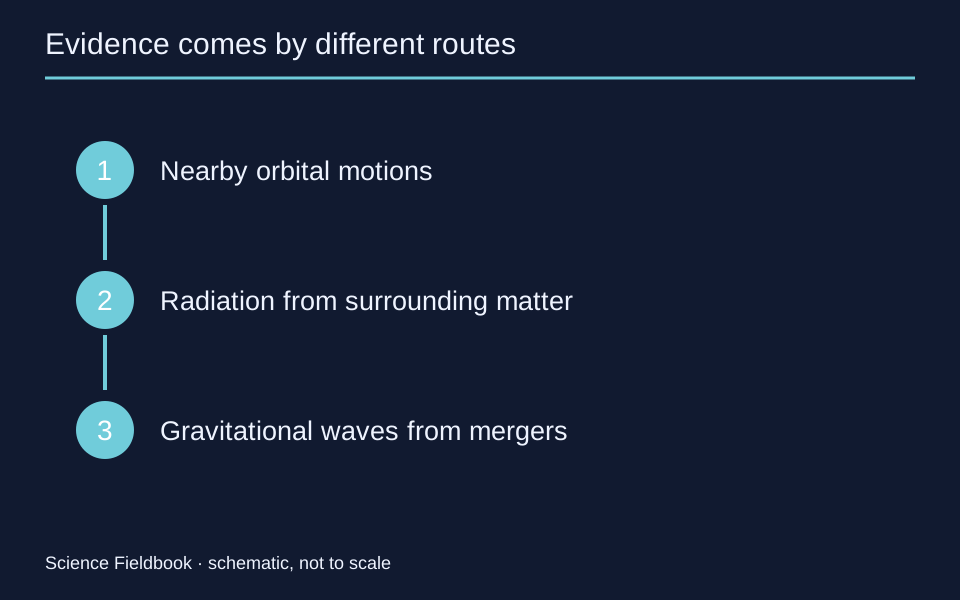
One approach measures the motion of nearby stars or gas. Their orbits can reveal the presence of a large, concentrated unseen mass. Interpreting those measurements requires a model and enough observations to distinguish a black hole from plausible alternatives.
Another approach studies high-energy radiation from hot material near a compact object. The emission comes from matter outside the horizon. Its timing, spectrum, and relationship to the system's other features can help identify the nature of the object.
Gravitational-wave observatories detect signals from accelerating masses, including merging black holes. The waveform can reveal information about the masses and motion of the merging system. This is a different observational channel from a photograph or an X-ray image.
Horizon-scale images add yet another view by measuring emission around a compact object's shadow. The dark region in such an image is not a photograph of the entire interior. It reflects the paths of light and the emitting environment near the black hole.
Why a simulation is not an observation
A simulation calculates an expected appearance or behavior using specified assumptions. It can help interpret measurements and explain why a lensed disk looks unusual. The calculated image alone does not establish that an actual object has every depicted feature.
An artist impression serves a different role again. The generated visualization on this page is an educational illustration, not telescope data, a numerical result, or a picture of a newly discovered black hole. Its caption makes that distinction explicit.
The same discipline matters when looking at Mars's color: an attractive image can introduce a subject, but a claim about composition or geometry requires relevant evidence and properly understood processing.
Why black holes are connected to the history of light
Astronomical information takes time to reach us. A distant black hole's surroundings are observed as they were when their radiation began its journey. The eight-minute sunlight delay is the nearby version of that general principle.
Near a black hole, gravitational effects also influence the frequency and paths of light. That makes interpreting signals more complicated than drawing a straight line and dividing a distance by speed. The basic limitation remains: observations are messages carried from specific regions along physically possible paths.
Common formation myths
Not every supernova leaves a black hole, and not every black hole needs to be accompanied by an easily visible supernova. The remnant depends on the physical outcome of the collapse, not merely on the fact that a star had a dramatic ending.
Nor does making a black hole automatically increase the total mass that existed before collapse. Energy and matter can be lost during the process. The resulting gravitational influence must be understood from the mass and configuration that remain.
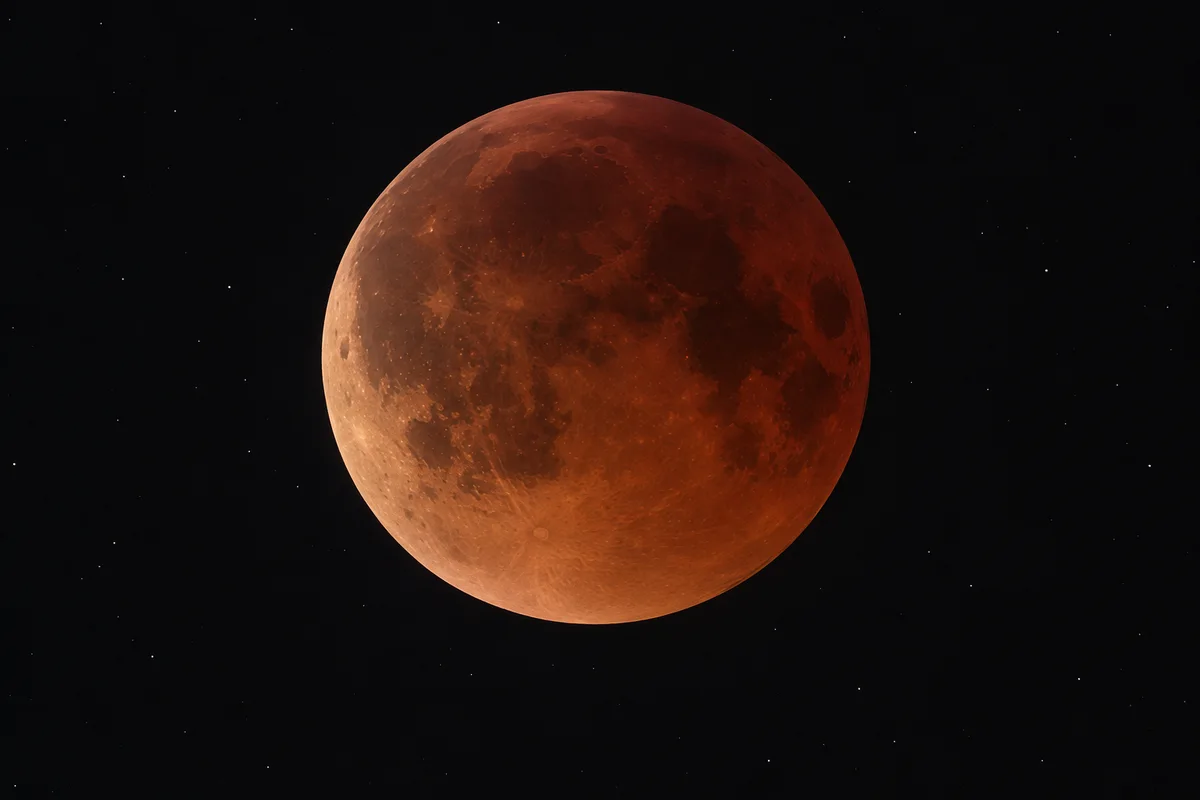
Finally, a black hole is not the same as the shadow that causes a lunar eclipse. Earth's shadow is a region receiving less direct sunlight; an event horizon concerns the ability of any outgoing signal inside a boundary to escape to distant observers.
What a merger adds to the formation story
Two black holes in a bound system can lose orbital energy through gravitational radiation and eventually merge. The final black hole is more massive than either original component, but generally less massive than their simple summed masses because some energy is carried away by gravitational waves.
That process can build larger remnants without requiring a new massive star to collapse at each step. It is one reason black-hole populations cannot be described solely by the mass distribution of individual dying stars. The surrounding stellar environment and previous interactions affect which compact objects can meet and merge.
Why a horizon is not a material surface
A material surface can collide with infalling matter and produce light in a way that an event horizon does not. The horizon instead marks a causal boundary in the spacetime geometry. Observational tests of compact objects therefore ask not only how massive they are, but how their surroundings behave near the inferred central region.
Descriptions of an object appearing to slow and fade near the horizon depend on the observer and the paths of the outgoing light. They should not be translated into a universal statement that nothing ever crosses a horizon. Different coordinate descriptions and local observations answer different questions. An introductory picture can show a dark boundary, but it cannot replace the relativistic definition.
The takeaway
Stellar collapse can make a black hole when a sufficiently massive remnant can no longer be supported against gravity. The event horizon is the defining boundary, while glowing gas and gravitational effects provide ways to detect the otherwise dark object. Larger black holes add further questions about seeds, accretion, and mergers that remain central to current astronomy.