Mars looks red mainly because fine dust containing oxidized iron minerals covers much of its surface and is repeatedly spread by wind. Those minerals absorb and reflect visible light differently from unaltered rock, giving large areas a rusty reddish appearance. The planet is not uniformly red, and its color is not simply the color of its atmosphere.
“Iron oxide” is a useful starting point, but it is not the whole mineral story. Scientists continue to investigate which iron-bearing phases dominate the dust and what their chemistry reveals about water and weathering in Mars's past.
Rust is a comparison, not one exact recipe
Iron can occur in different chemical states and mineral structures. On Earth, familiar rust forms when iron-bearing material reacts with water and oxidizing conditions. Several related oxides and oxyhydroxides can produce yellow, orange, red, or brown tones.
Mars contains iron-bearing rocks that have undergone alteration. Calling the result “rusty” communicates the broad change in iron chemistry, but it does not establish that every red grain has the same composition as rust on a garden tool.
Oxidation also does not prove that ancient Mars had an atmosphere rich in breathable oxygen. Geochemical reactions can oxidize iron through different pathways, including interactions involving water. A mineral can record a chemical environment without implying a modern Earth-like ecosystem.
Why the exact mineral still matters
Older simplified explanations often emphasized hematite, an iron oxide with a familiar reddish association. Other iron-bearing phases have also been discussed because dust particles are small, mixed with other materials, and difficult to characterize from a distance.
An ESA report on laboratory and spacecraft analysis describes evidence that ferrihydrite, a water-bearing iron phase, better reproduces important features of Martian dust than some previously favored mixtures. The result suggests a potentially wetter history for the material.
This is not a reason to replace every previous sentence about Mars with a newly absolute claim. Laboratory analogs, orbital spectra, and measurements at particular surface locations have different limitations. The robust broad explanation is oxidized iron in widespread dust; the detailed mineral mixture and formation history remain active research questions.
A red color is a clue, not a complete chemical analysis
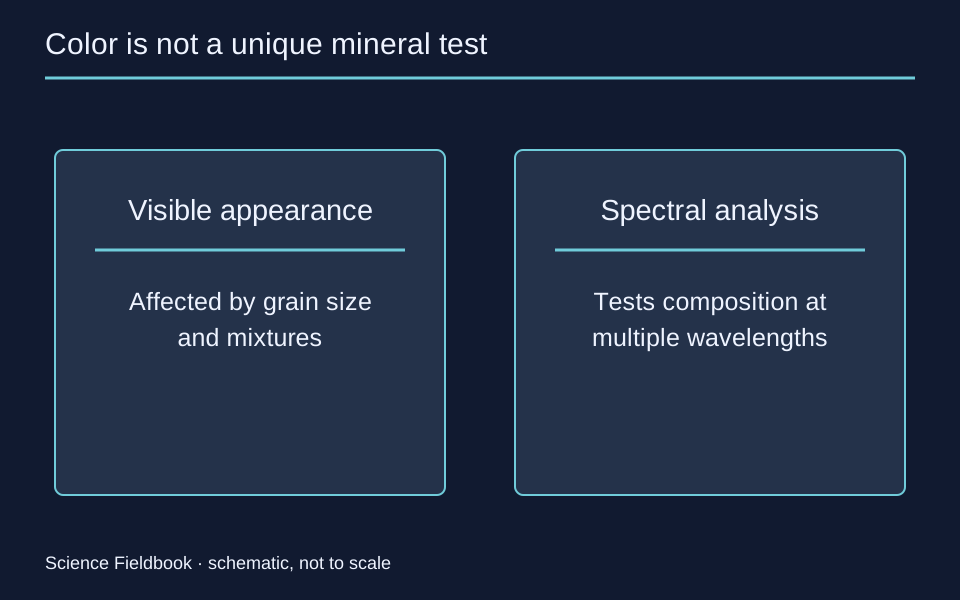
Different substances can have similar visible colors. Conversely, the same mineral can appear different when particle size, surface texture, illumination, or mixing changes. Matching a red photograph to a red sample is therefore not sufficient to identify a mineral.
Scientists use spectral measurements across multiple wavelengths and compare those observations with laboratory materials. Information beyond the human eye's visible range can help distinguish candidate compositions that look broadly similar in an ordinary image.
The distinction is similar to autumn leaf pigments: color can reveal that the mixture of light-absorbing substances changed, but it does not automatically give a unique ingredient list.
Dust spreads the color over darker ground
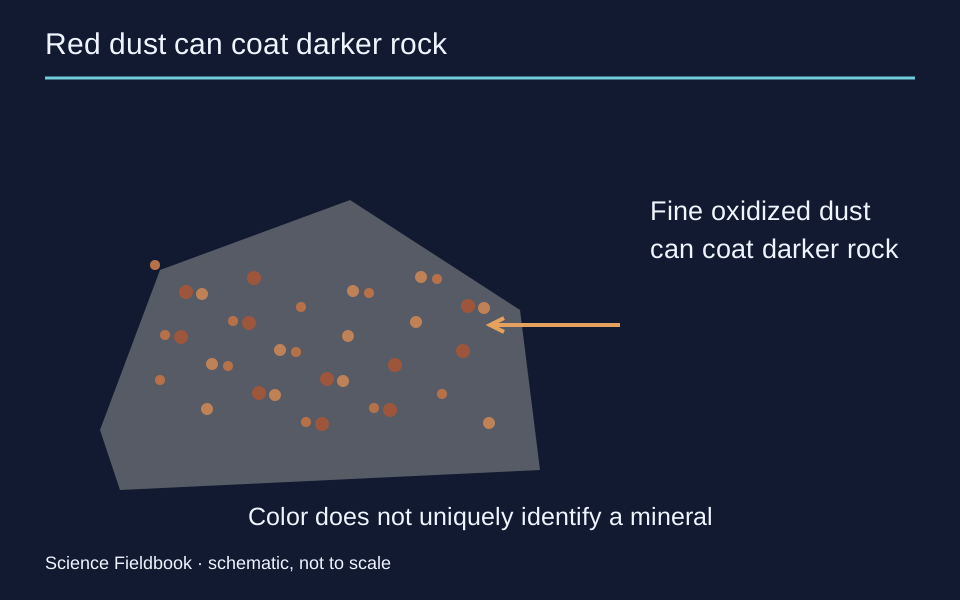
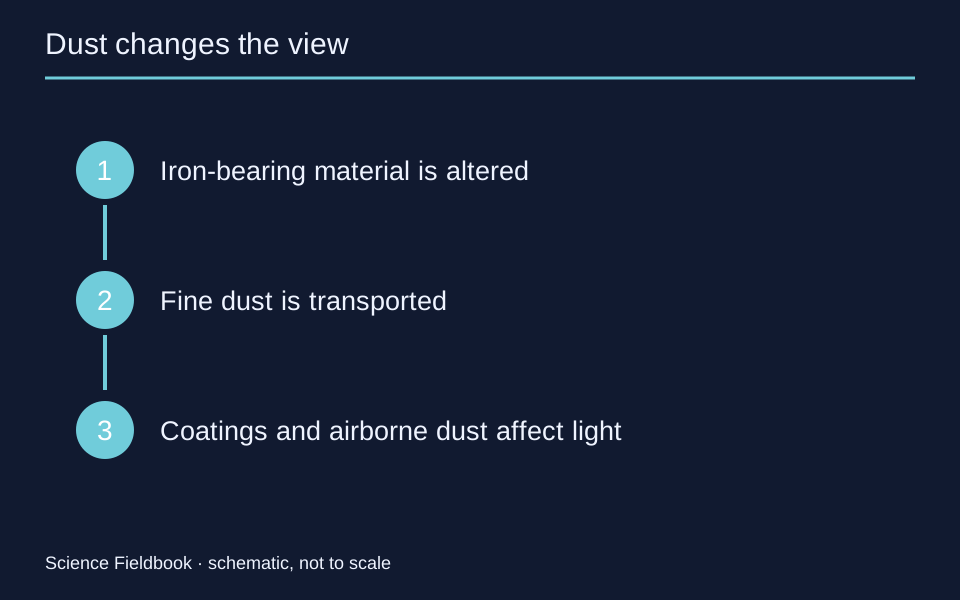
Many Martian rocks are volcanic and can look gray or dark when relatively clean. Fine red dust can coat those rocks, settle on dunes, and cover broad regions. Wind repeatedly lifts and redistributes it, making surface color partly a story of transport rather than just the rock immediately underneath.
An everyday analogy is a thin layer of flour covering a dark countertop. The coating can dominate the appearance even though most of the material beneath it is dark. The analogy concerns coverage, not chemistry: Martian dust does not behave exactly like flour or have the same particle properties.
Dust storms can alter how much surface detail is visible from orbit or from Earth. They also affect the lighting experienced by a surface camera. The planet's changing appearance is therefore not evidence that all its rocks repeatedly change mineral composition during a storm.
Reflected sunlight creates the visible color
We see Mars because sunlight reaches it and some of that light is scattered back toward the observer. Iron-bearing particles preferentially absorb and scatter different wavelengths, leaving a reflected spectrum that often looks reddish to human vision.
The process does not mean Mars emits red visible light like a heated stove burner. Its ordinary visible appearance is dominated by reflected sunlight. Thermal radiation from a planet is a separate question, largely associated with longer wavelengths under typical surface conditions.
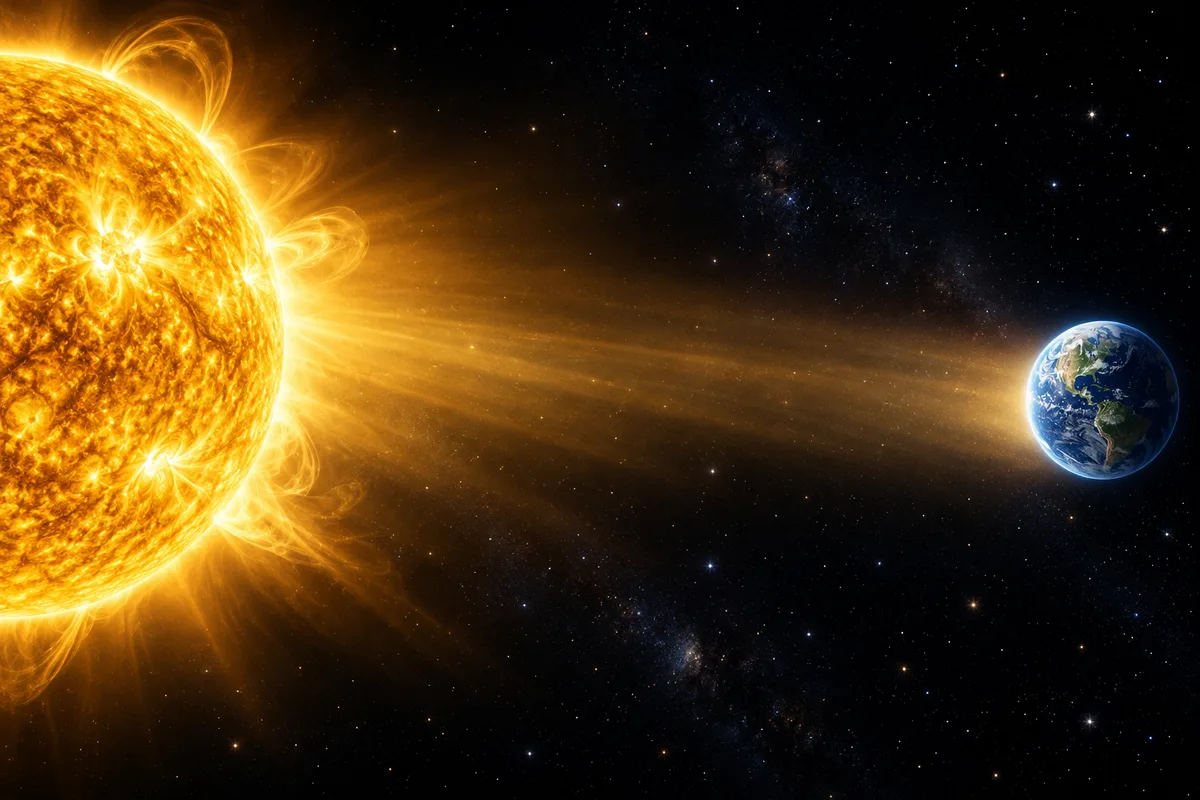
Light also takes time to travel through the solar system. The Sun–Earth light-travel time provides a familiar distance example, although the Sun–Mars distance and Mars–Earth separation are different and change with orbital position.
Surface color and sky color are different questions
Mars has a thin atmosphere, and suspended dust affects how sunlight is scattered through it. A dusty sky seen by a rover can have a different color from the underlying rocks. The lighting itself then changes how the surface appears in a photograph.
Images may also be processed for different scientific or presentation purposes. Some aim to approximate human visual appearance under particular conditions; others emphasize spectral differences that help researchers identify materials. A strongly enhanced image can be scientifically useful without being a literal view through an astronaut's eyes.
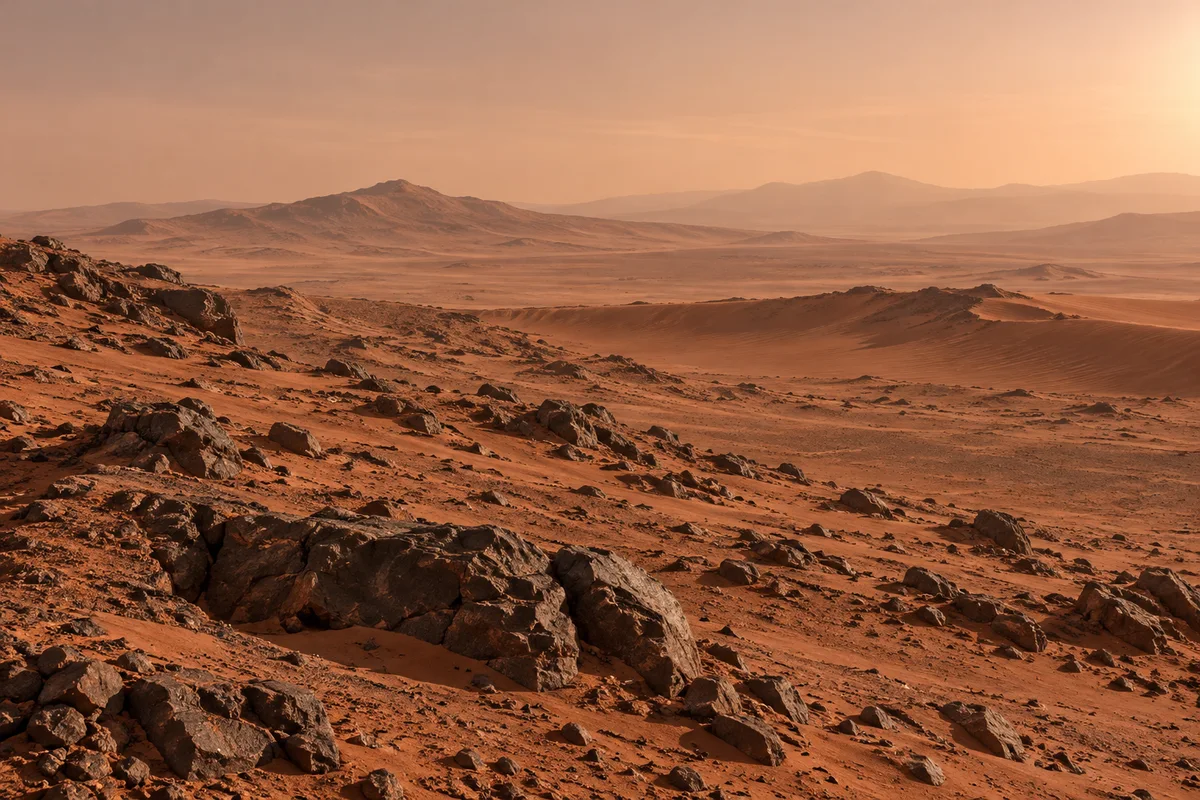
For that reason, a caption should identify an artist impression, an enhanced-color image, or an observational photograph. The generated landscape on this page illustrates the subject but is not a rover observation and cannot be used as evidence for a particular mineral exposure.
What Mars's red dust can reveal about its history
Minerals form under particular combinations of temperature, water activity, chemistry, and time. If a candidate dust component forms readily in cool water, finding it widely distributed would have implications different from a mineral that forms under dry conditions.
The difficulty is connecting a modern grain to its earlier environment. Material may have been altered, transported, mixed, buried, or exposed again. A color that covers an enormous area does not necessarily imply that all the material formed in the same place or at the same moment.
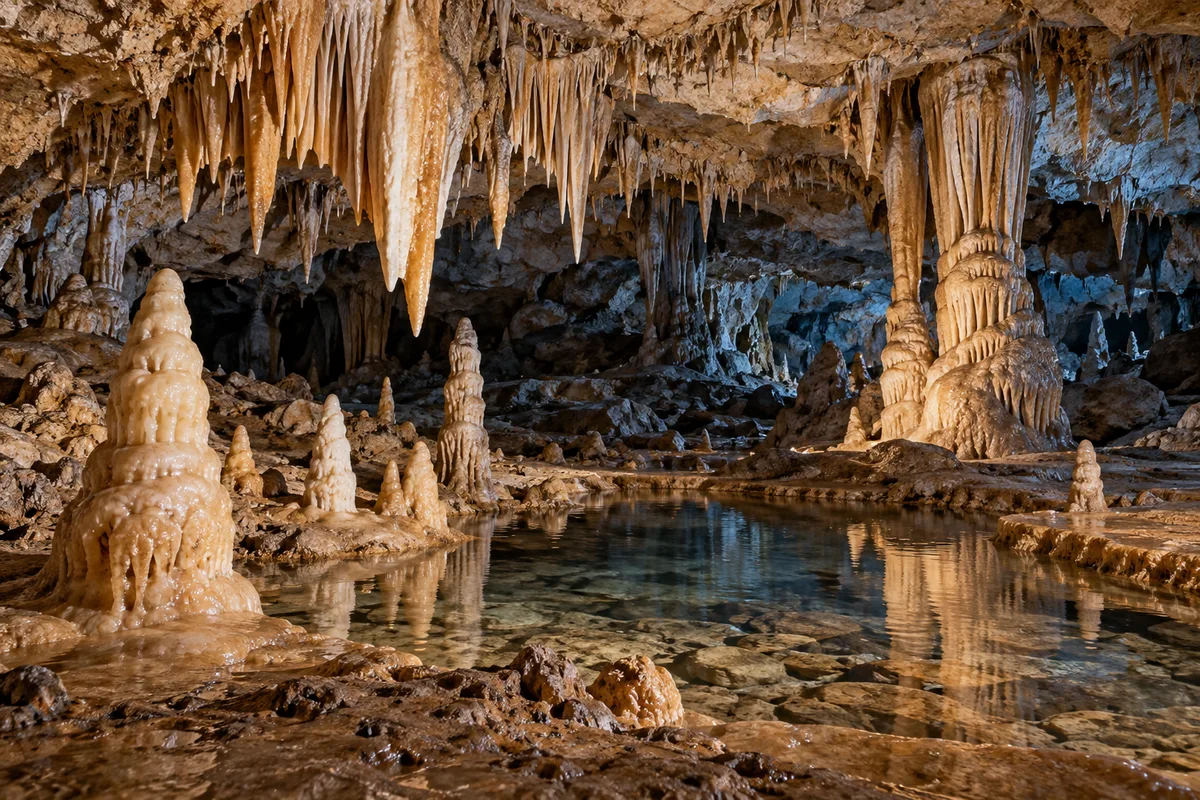
This is a familiar geological challenge. Cave formations record water and mineral reactions, but interpreting them requires context beyond their shape. On another planet, that contextual work depends heavily on instruments and carefully tested comparisons.
What the nickname “Red Planet” leaves out
Mars also has bright polar regions, dark dunes, exposed rock, and terrains with a range of tones. Distance blends those details into an overall appearance. A planet-wide nickname is a visual summary, not a claim of uniform chemistry.
The same caution applies to photographs taken with different cameras or displayed on different screens. Exposure, white balance, wavelength filters, and processing can all change the apparent redness. More saturated is not automatically more accurate.
Why grain size changes a mineral's appearance
A large crystal, a rough rock surface, and a fine powder of related material can scatter light differently. Fine particles present many interfaces and can mix optically with neighboring grains. The color of a hand-sized rock is therefore not a complete guide to the appearance of dust made from it.
On Mars, dust coatings can also be thin enough for underlying material to influence the returned light. Scientists must consider mixtures, surface texture, particle properties, and instrument wavelengths together. A red-brown powder in a laboratory can be a useful analog without being an exact replica of every Martian deposit. This is why the mineral interpretation is tested against multiple measurements rather than decided by a single side-by-side photograph.
The takeaway
Mars is red because oxidized iron-bearing dust influences how the planet reflects sunlight. Wind makes that dust widespread, while mineral chemistry offers clues to earlier environments. The broad explanation is well supported; identifying the exact dust mixture and reconstructing when it formed require evidence beyond color alone.