
People dream because the sleeping brain can generate conscious experiences while it processes information under conditions very different from wakefulness. Scientists know that dreams occur in both REM and non-REM sleep and that their content often relates to memories, emotions, and imagined situations. What has not been settled is whether dreaming itself serves one specific biological function.
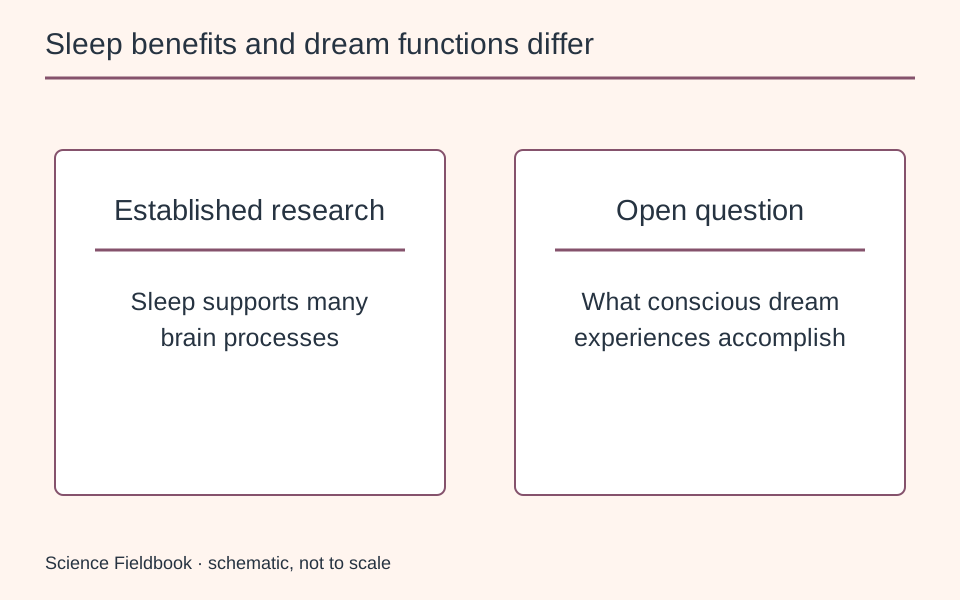
That distinction is important. Sleep has many well-supported roles, but demonstrating that sleep helps memory does not automatically prove that every remembered dream performs a particular memory task. Dreams are experiences within sleep, not a synonym for everything the sleeping brain does.
Sleep is a changing sequence, not a single shutdown
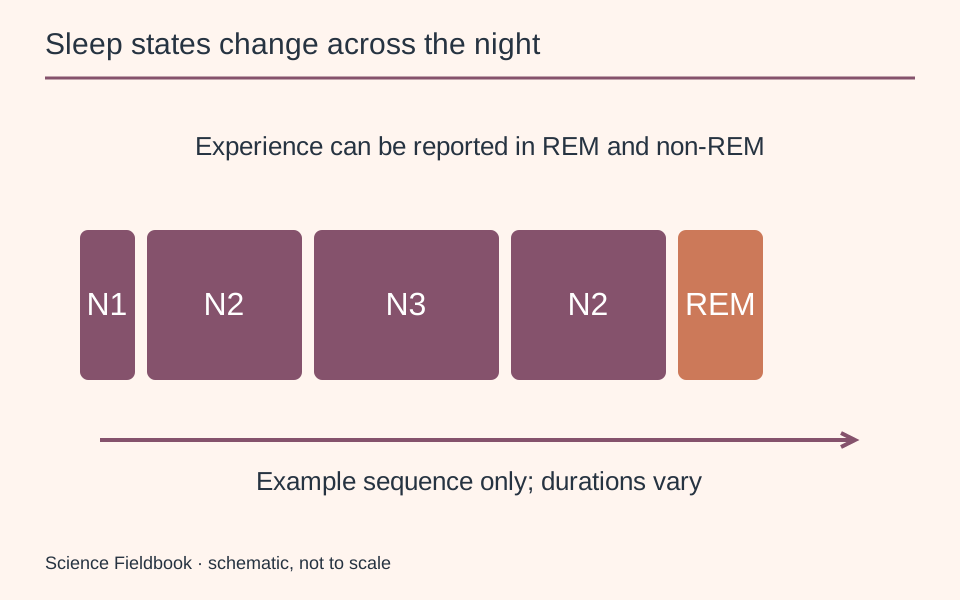
During a typical night, the brain passes repeatedly through non-REM and REM states. Non-REM sleep includes lighter stages and a deeper stage with prominent slow brain activity. REM stands for rapid eye movement, one recognizable feature of a state with a distinctive pattern of brain and body activity.
The proportions and timing change across the night. Deep non-REM sleep is usually more prominent earlier, while REM periods tend to become longer later. A diagram of perfectly repeated equal-length blocks is therefore only a teaching aid, not a literal universal schedule.
In REM sleep, many skeletal muscles have reduced activity through mechanisms that limit the acting out of dream movements. The brain is not inactive, and breathing and other physiological patterns differ from those in quiet wakefulness. “The body sleeps while the brain turns off” is a poor summary.
The NINDS explanation of sleep describes these stages and emphasizes that dreaming is not exclusive to REM. The relevant question is how experience varies with the brain's state, not whether one named stage contains all dreams.
REM dreams are common, but not the whole picture
Vivid, story-like dreams are often reported after awakening from REM sleep. That historical association made REM central to dream research. However, people also report experiences after awakenings from non-REM sleep.
Non-REM reports can range from brief thought-like content to richer scenes. There is considerable variation, so it is too simple to label every REM dream emotional and every non-REM experience dull. The sleep stage provides useful context, not a complete prediction of an individual's report.
A study of neural correlates of dreaming examined brain activity associated with reported experiences across sleep states. It supported the view that particular local activity patterns can matter beyond the broad REM/non-REM distinction.
Those results identify associations with reported experience. They do not provide a complete machine-readable explanation of every symbol, plot, or personal meaning in a dream. Measuring a correlate is different from decoding a private mental world in full.
Memory appears in dreams, but not as a perfect replay
Dreams often combine people, places, concerns, and fragments of recent or older experience. These elements may appear in unfamiliar arrangements rather than as faithful recordings. A familiar room can contain an impossible doorway, or a recent event can merge with a much older setting.
One major research idea is that dreaming is related to processes involved in memory reorganization or integration during sleep. The attraction of that explanation is that dream content and sleep-related memory processing sometimes overlap in meaningful ways.
The hard part is showing whether the conscious experience itself performs a necessary function or accompanies underlying processes that would occur anyway. A remembered scene is not a direct readout of all memory consolidation occurring in the sleeping brain.
Why an analogy can help without proving a theory
It is tempting to compare dreams with a computer sorting files. The analogy captures the possibility that previously stored information is being reorganized. But a brain is not literally moving labeled files between folders, and the dream story is not necessarily a progress report.
Likewise, a strange dream is not evidence that a hidden maintenance system made an error. Dream content can reflect how perception, memory, emotion, and self-monitoring operate under sleeping conditions. The mechanism requires biological evidence rather than a metaphor taken literally.
Similar caution is useful when discussing why yawning occurs. A plausible function can guide experiments, but plausibility and familiarity are not substitutes for a discriminating test.
Emotion, simulation, and other proposed functions
Some hypotheses emphasize emotional processing. Dream experiences may relate to how the brain responds to emotionally important material during sleep. Others focus on simulating threats, social situations, or possible actions.
These ideas make different predictions. A theory that dreams rehearse danger must explain the frequency and form of threatening content, but also ordinary, pleasant, and seemingly nonsensical dreams. A theory centered on social simulation must account for dreams without obvious interpersonal scenes.
There may not be one exclusive explanation for every feature. Different underlying processes could contribute to different kinds of experience, and some features may be consequences rather than adaptations. A scientific account should leave room for that complexity without becoming an unfalsifiable story that can explain any outcome after the fact.
It is especially important not to convert these hypotheses into a claim that a particular person's dream reveals a hidden diagnosis, predicts the future, or proves what they unconsciously want. Those interpretations go beyond the evidence discussed here.
Why some dreams feel vivid and others disappear
Dream recall depends partly on what happens around awakening and on how the experience is encoded and retrieved. Not remembering a dream does not establish that no experience occurred. The absence of a report and the absence of an experience are related but different possibilities.
Attention after waking can also matter. Moving immediately to another task may make details harder to retain. A person who writes a report promptly may provide more information than someone asked much later, even if the original experiences were similar.
Individual variation complicates comparison. People differ in recall habits, sleep patterns, interest in dreams, and the conditions under which they are asked. A researcher needs a clear collection method rather than relying on a general question such as “Do you dream much?”
How scientists study a private experience
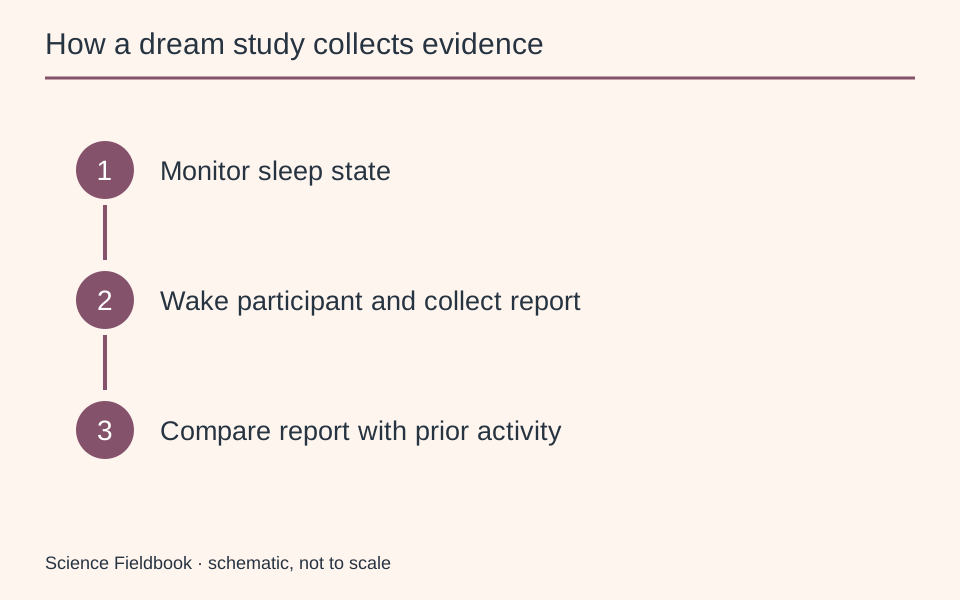
Laboratory work can combine sleep monitoring with planned awakenings and immediate reports. Electrical activity, eye movements, and muscle signals help characterize the sleep state. The report supplies information about what the participant remembers experiencing.
Each part has limitations. Monitoring cannot directly display the experience itself, while a report depends on memory and language. Asking repeatedly can also alter the night's sleep. Researchers therefore compare different methods rather than assuming one perfectly transparent window into dreaming.
Studies may analyze whether experience was reported, how vivid it was, or whether particular content categories appeared. Those are more precise questions than assigning a fixed meaning to a dream object. A boat can have different personal associations for different people and different roles in different stories.
What lucid dreaming does—and does not—show
In a lucid dream, the dreamer becomes aware that they are dreaming. That awareness can coexist with the dream experience rather than immediately ending it. It offers interesting opportunities to study consciousness and sleep, though it is not the usual condition for every dream.
Lucidity does not establish that dream events are happening in the external world. Nor does the ability to influence some dream content mean a person has complete control over all sleeping physiology. Awareness, control, and physical action are distinct features.
The same distinction between subjective experience and external measurement appears in the Moon illusion. An experience can be powerful and genuine as an experience without being a literal measurement of what exists outside the observer.
Keep sleep education separate from personal medical advice
This article explains general research questions. It does not interpret recurring dreams, diagnose a sleep disorder, or recommend treatment. Unusual dream experiences or sleep-related behaviors require appropriate individual context if they are being assessed clinically.
Dreams also occur in a body that continues regulating circulation, respiration, and temperature. Those processes have their own mechanisms. Thermoregulation provides an example of a measurable physiological system that can interact with sleep without explaining every aspect of dream content.
Does a dream need a hidden symbolic translation?
Science can investigate patterns in dream content and the experiences that may contribute to them. That does not establish a universal dictionary in which a particular object always means one particular emotion or future event. Personal associations, culture, recent concerns, and the dream's context all complicate such a mapping.
An interpretation may feel meaningful to the dreamer without becoming a scientifically validated measurement. The distinction is between using a remembered experience for personal reflection and claiming that a symbol objectively diagnoses a condition or predicts an event. The latter claims require evidence that a compelling story alone cannot provide.
Why research separates content from recall
Suppose two groups report different numbers of dreams in the morning. One explanation is a difference in how often they had experiences; another is a difference in how well those experiences were remembered. Differences in awakenings, reporting instructions, or attention could also contribute.
Researchers can narrow these possibilities with planned awakenings and standardized questions, but no method removes every limitation. Even a detailed immediate report is a memory-based account expressed in language. A participant may know that an experience occurred while being unable to recover its content.
This is why papers distinguish a dream report, a report of experience without remembered details, and a report of no experience. Those categories preserve information that would disappear if every night were classified simply as “dreaming” or “not dreaming.” The distinctions also help prevent an attractive brain-imaging result from being described as a direct film of someone's dream.
The takeaway
Dreaming is a form of experience generated by the sleeping brain, occurring in REM and non-REM states. Memory and emotion provide important research connections, but the precise functions of dreaming remain unresolved. A careful explanation separates the benefits of sleep, the mechanisms associated with dream reports, and the much harder question of why dream experiences have the forms they do.