The human body regulates temperature by balancing heat production with heat exchange. The nervous system integrates signals from the body and skin, then adjusts sweating, blood flow, muscle activity, and behavior. The hypothalamus is an important coordinating region, but thermoregulation is a distributed process involving many tissues rather than a single miniature household thermostat.
The goal is not to keep every part of the body at an identical, unchanging temperature. Core tissues and exposed skin can differ, and normal temperature varies with time, activity, measurement site, and individual conditions. What matters is maintaining a workable internal environment while responding to changing demands.
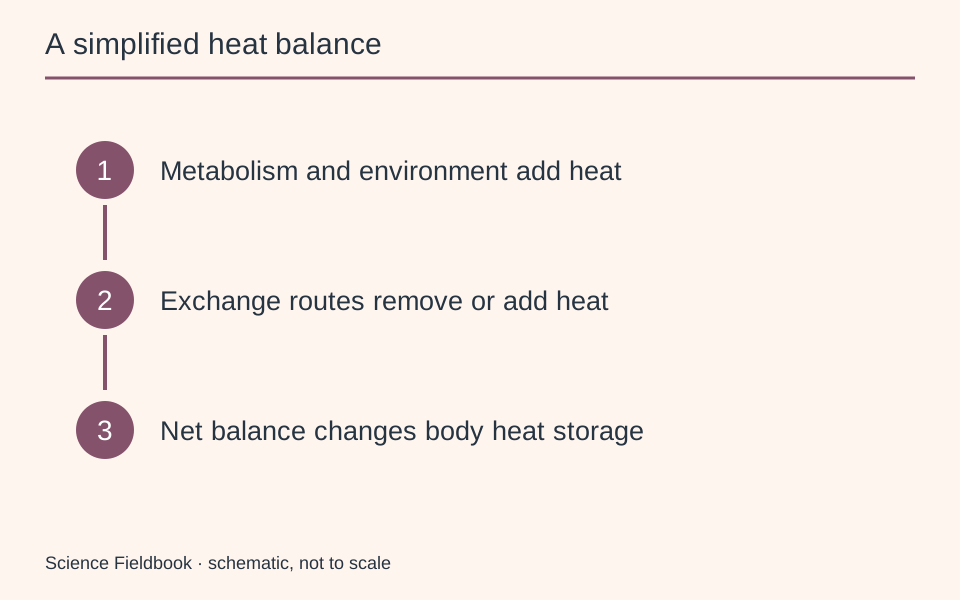
The body makes heat even at rest
Cells continually use energy to maintain their structure and perform work. Not all of that energy becomes useful external movement; a substantial portion appears as heat. Muscles produce more heat when active, so exercise can increase the load that temperature-control mechanisms must handle.
This explains why a person can become warm on a cool day while moving vigorously. The environmental temperature is only one term in the heat balance. Clothing, sunlight, wind, metabolism, and humidity also influence whether the body gains or loses heat overall.
The body is not a sealed container with one simple surface temperature. Blood transports heat between deeper tissues and skin, and different regions exchange energy with the environment in different ways. Local cooling and total-body heat balance therefore need to be distinguished.
Temperature signals and central coordination
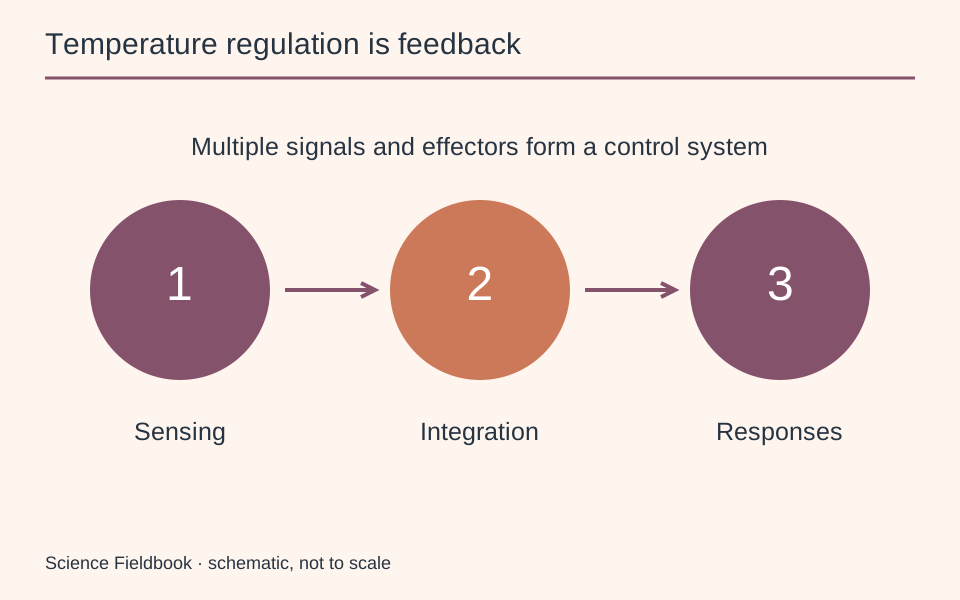
Temperature-sensitive pathways provide information from the skin and within the body. The central nervous system integrates those signals with other physiological information. Hypothalamic circuits play an important role in coordinating the resulting responses.
The NCBI overview of temperature regulation describes sensing, integration, and responses involving skin, sweat glands, muscles, and circulation. The thermostat analogy is useful only if it does not hide that multiple signals and response thresholds are involved.
A household thermostat usually switches one heating system on or off. Human regulation can activate several responses to different degrees and can incorporate behavior, such as seeking shade or changing activity. The controlled system also produces much of its own heat.
Sweating cools only when water evaporates
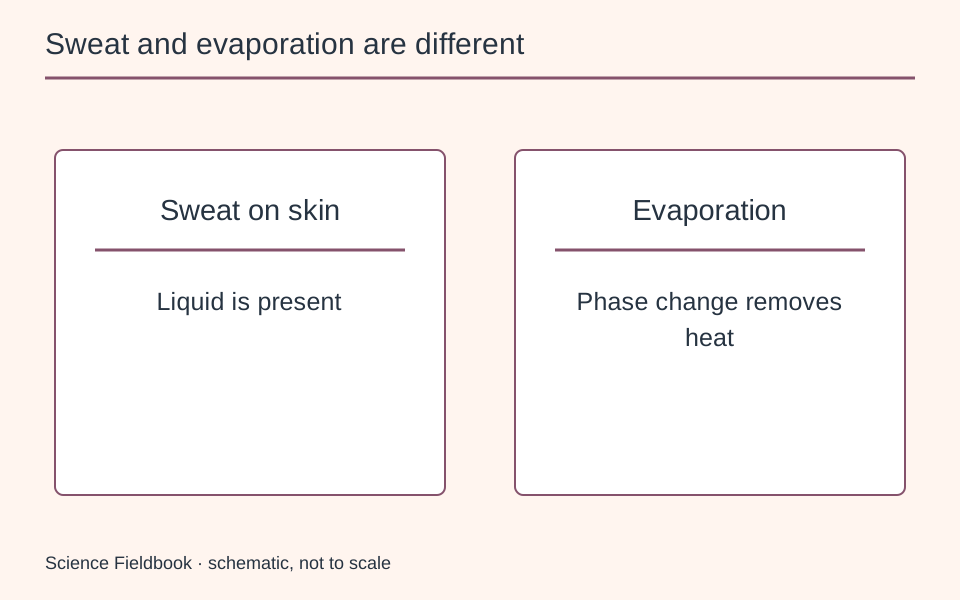
Sweat glands supply liquid to the skin surface. When some of that water evaporates, the phase change takes energy from the skin and nearby tissues. The loss of that energy is the cooling mechanism.
Liquid sweat merely sitting on the skin is not equivalent to evaporated sweat. A droplet that falls away carries some energy, but the especially important cooling effect comes from changing liquid water into vapor. Visible wetness is therefore not a direct measurement of cooling success.
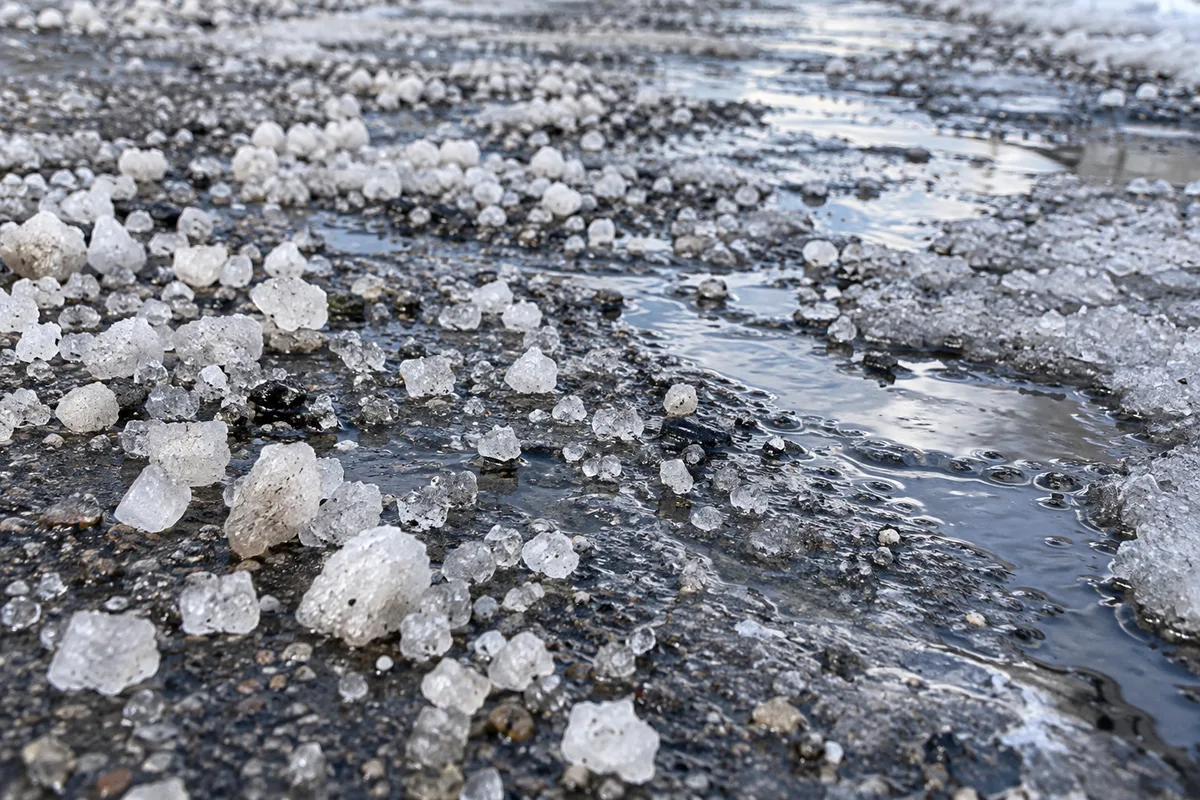
Evaporation is also why a wet surface can cool in everyday physical systems. The biology supplies and regulates the fluid, while the physical energy requirement comes from the behavior of water. That is different from salt changing ice's freezing point, although both involve water and energy.
Why humidity makes a difference
The ability of sweat to evaporate depends on the water-vapor conditions near the skin, along with airflow and temperature. Humid air can reduce the vapor-pressure difference that drives evaporation compared with drier air under otherwise similar conditions.
This is why an environment can feel oppressive even when its air temperature is not the highest temperature someone has experienced. A reduced capacity for evaporative heat loss changes the body's heat balance. Sweating more visibly does not guarantee that enough heat is leaving.
Air movement can remove the humid boundary layer near skin, but environmental heat and other conditions still matter. This general explanation should not be turned into one universal rule for the safe use of a fan or a specific person's heat exposure.
Blood flow changes the connection between core and skin
When heat needs to be released, increased skin blood flow can help carry heat toward the body's surface. When conservation is needed, narrowing of skin vessels reduces that transfer. The surrounding air and radiation environment determine whether the surface can actually lose the delivered heat.
Vasodilation and vasoconstriction therefore adjust a transport pathway; they do not create cold or heat on command. If the environment is hotter than the skin, some forms of heat exchange can move energy inward instead of outward.
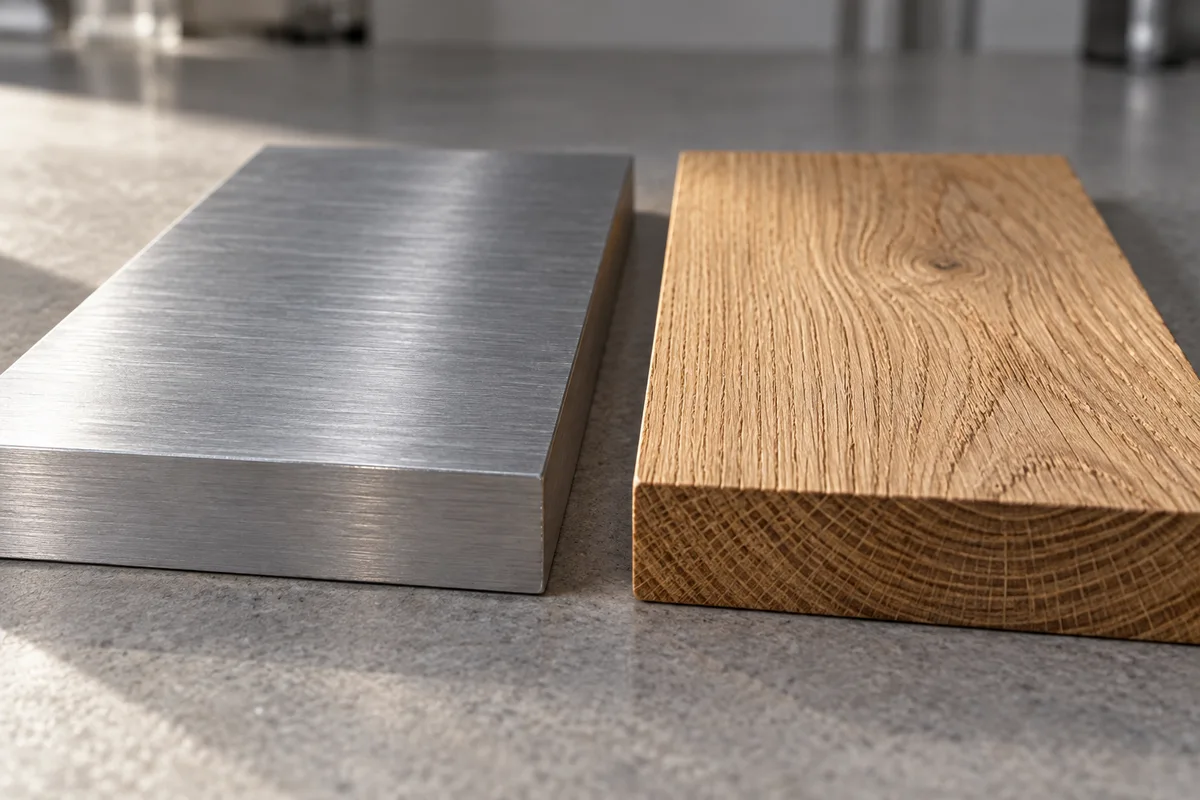
This distinction is similar to why metal can feel cold at room temperature. The direction of heat flow depends on temperature differences, while the rate depends on how effectively the system transports energy.
Shivering increases heat production
Shivering involves repeated skeletal-muscle activity that produces heat without the coordinated external work of walking or lifting. It is one response to cold conditions when additional heat production is needed.
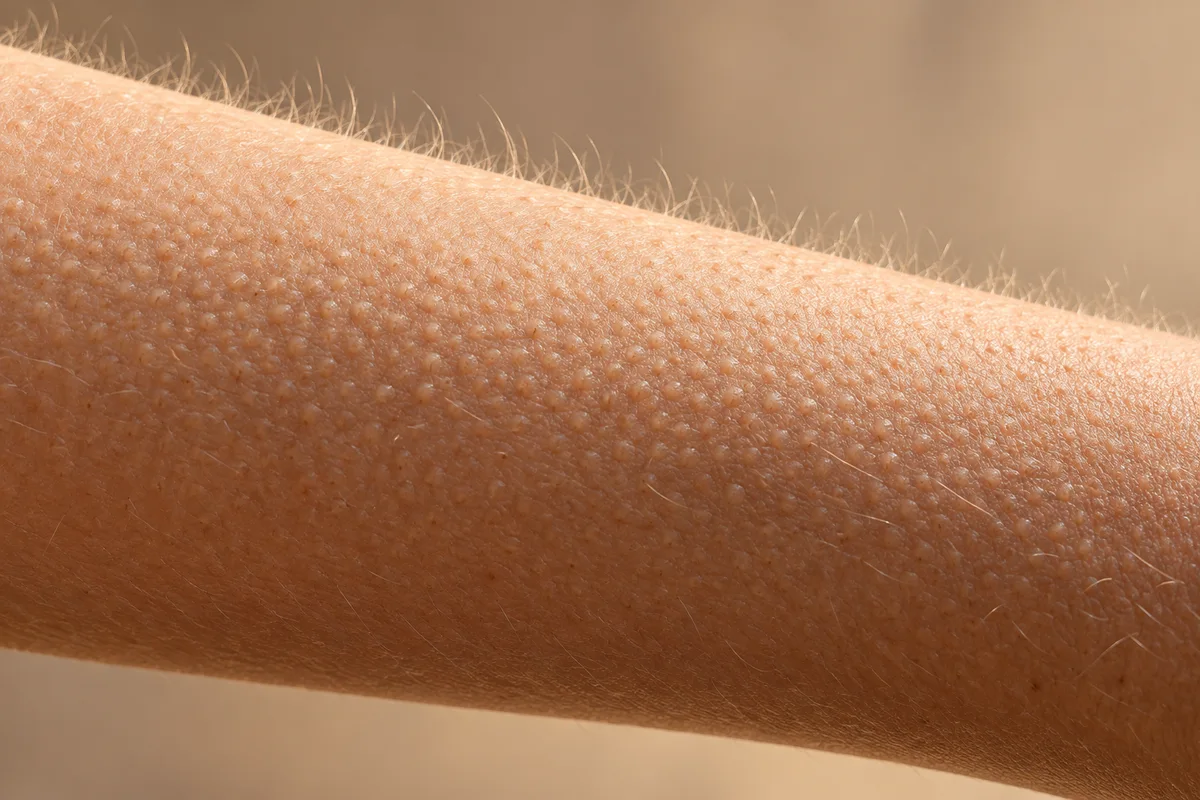
It should not be confused with goosebumps, which involve tiny muscles attached to hair follicles. Raising sparse human hair has a limited insulating effect compared with raising a dense fur coat. Both can occur during cold exposure, but their mechanisms and contributions differ.
Other metabolic processes also contribute to thermogenesis, and their importance varies with age and physiological state. A complete account is broader than “the muscles shake until the thermometer returns to normal.” Regulation uses multiple routes and is constrained by available energy and conditions.
Four routes for heat exchange
Conduction transfers heat through direct contact. Sitting on a cool surface or touching a warm object creates a conductive path. Its importance depends on the materials, contact area, and temperature difference.
Convection exchanges heat with moving air or water. Movement can carry warmed fluid away from the skin, but a hotter fluid can also transfer heat inward. Water immersion changes the conditions substantially compared with ordinary air exposure.
Radiation exchanges electromagnetic energy with surrounding surfaces and the sky. Direct sunlight can add heat even when the air is relatively cool. A shaded and a sunlit location can therefore impose different heat loads at the same reported air temperature.
Evaporation removes heat when water becomes vapor. It is especially important when other routes cannot provide enough net heat loss. The four processes act together; assigning a fixed universal percentage to each without specifying conditions would be misleading.
Behavior is part of the control system
People can change their environment and activity by adding or removing clothing, moving between sun and shade, or adjusting exertion. Those actions can alter the heat balance before a large internal temperature change occurs.
Clothing affects insulation and evaporation rather than simply supplying warmth. A fabric system that reduces heat loss in one setting can hinder heat loss in another. The relevant question is what pathways it changes under the actual conditions.
Buildings and technologies modify the surroundings too. Heat pumps can move thermal energy between indoor and outdoor spaces, but maintaining a room temperature and maintaining a body's internal temperature remain different control problems.
Fever and environmental overheating are not identical
During fever, immune-related signaling can alter the regulated temperature response. In environmental overheating, heat gain or production can exceed the body's ability to lose heat without the same kind of regulated change.
That broad physiological distinction does not diagnose an individual or establish how to manage a temperature reading. Measurement site, circumstances, symptoms, and clinical context matter. This article does not provide treatment instructions or a home test for distinguishing conditions.
Similarly, a normal-looking skin surface does not prove that internal heat balance is adequate. The body can compensate for a period while conditions remain challenging. An educational diagram cannot determine a specific person's safe exposure.
A worked heat balance without a universal temperature rule
Imagine a simplified situation in which metabolism adds 100 units of heat over an interval, sunlight and hot surroundings add 20, and combined evaporation and other losses remove 120. The net storage change is zero. If losses fall to 90 while the inputs stay the same, 30 units remain in the body over that interval.
The values are arbitrary units chosen to demonstrate accounting, not measured physiology or an exposure calculation. The example shows why changing humidity can matter even without changing metabolic activity or sunlight: if evaporation becomes less effective, the outgoing side of the balance changes.
Skin temperature is not interchangeable with core temperature
The skin is a boundary with the environment and can change relatively quickly with local airflow, contact, radiation, and circulation. Deeper tissue temperatures may change differently. A cool hand after touching a surface does not provide the same information as a properly interpreted core-temperature measurement.
Measurement methods also sample different sites and have different limitations. A number from one device should not be compared casually with a number from another method as though both represented the same location under identical conditions. Research and clinical work specify how the measurement was made.
The practical scientific point is to define the quantity before interpreting it. “Feels warm,” “skin surface is warm,” “the room is warm,” and “the body's internal temperature is rising” describe different observations. They can be related, but none is a universal substitute for the others.
The takeaway
Thermoregulation is a coordinated balance of heat production, internal transport, and environmental exchange. Sweating depends on evaporation, circulation changes the route to the skin, and shivering increases heat generation. Humidity, airflow, sunlight, clothing, and activity alter the same energy balance, which is why air temperature alone cannot describe the body's thermal situation.