The Moon often looks larger near the horizon because of a visual-perception effect called the Moon illusion. Its physical diameter does not grow as it rises or shrink as it climbs higher. Comparisons made with consistent camera settings show that its angular width changes very little during that part of a night's journey.
The broad conclusion is clear: the dramatic enlargement is primarily perceptual. The exact explanation for why the eye–brain system produces it is less settled. Landscape cues, apparent distance, context, and other aspects of visual processing have all been investigated.
Three different meanings of “bigger”
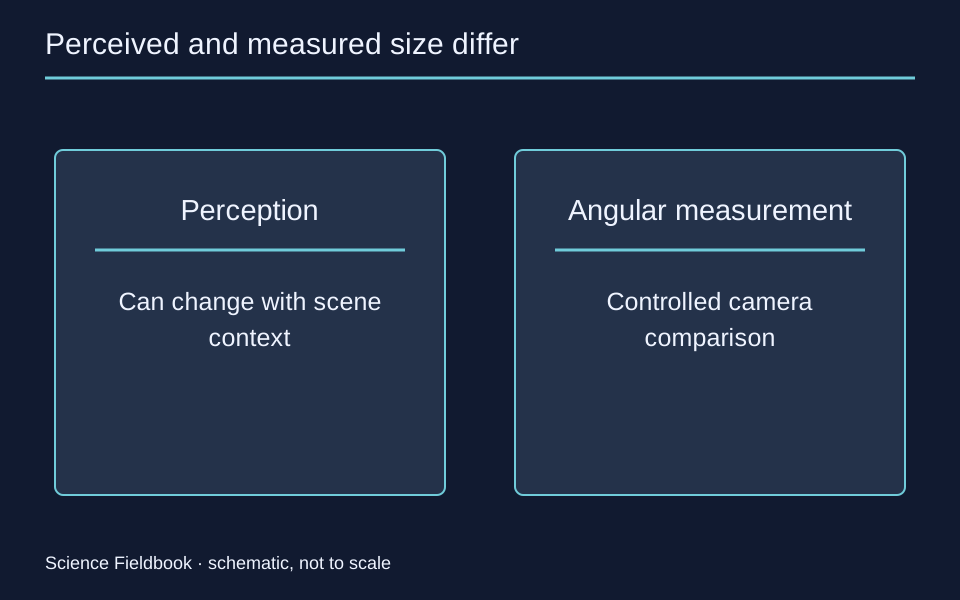
Physical size is an object's actual dimension, such as the Moon's diameter in kilometers. Angular size is the angle the object spans in your field of view. Perceived size is the impression constructed by your visual system.
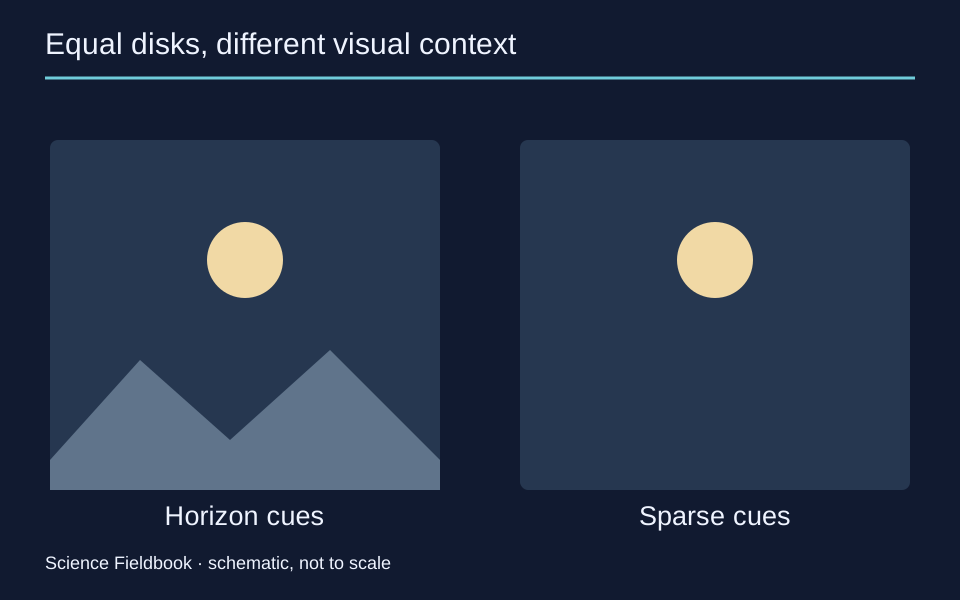
A coin can have one fixed physical diameter but occupy a larger angle when held closer to your face. Two circles can also occupy equal angles yet look different in size when surrounded by different visual context. Those are different situations, even if a person describes both by saying that one circle looks bigger.
The Moon illusion mainly concerns the third meaning. The startling impression near the horizon is much greater than any small geometric change during the observation. Confusing perceived size with a measured angle is what makes the effect seem astronomically impossible.
What a consistent photograph can show
Photograph the Moon near the horizon and later when it is higher, using the same focal length and image scale. Compare its horizontal diameter in the original frames rather than resizing one image to fill a display. The dramatic difference your eyes reported usually does not appear in the measurement.
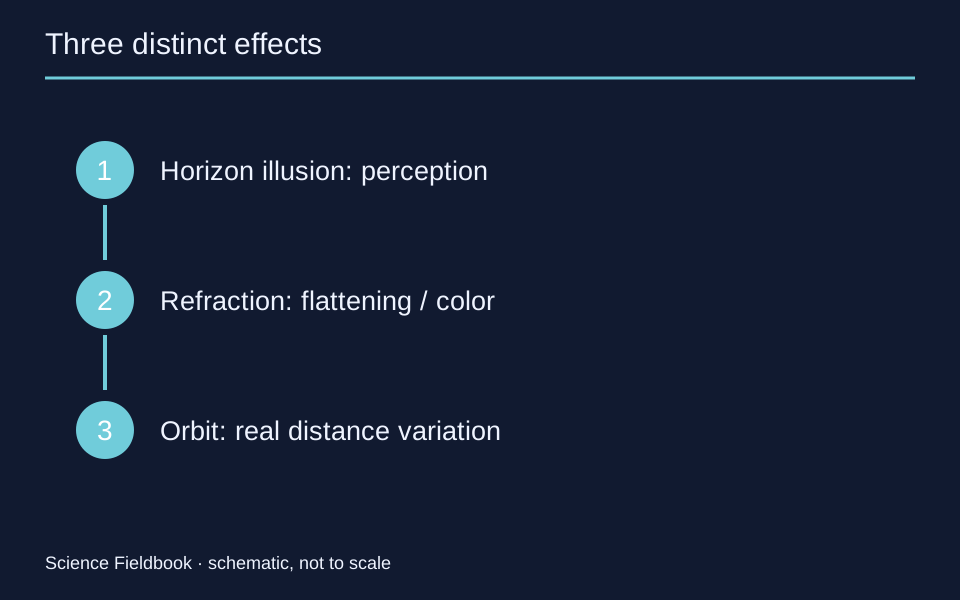
NASA's guide to photographing the Moon illusion illustrates a comparison of this kind. It also notes a distinction between horizontal and vertical size: atmospheric refraction can flatten the low Moon rather than enlarge it uniformly.
The test needs consistent equipment settings. Digital zoom, automatic cropping, different lenses, or separate screenshots displayed at different sizes can create an apparent change unrelated to the Moon. A photograph is useful evidence only when the comparison controls the relevant variables.
Why the horizon changes the visual context
Near the horizon, the Moon appears beside trees, buildings, mountains, and other objects that provide depth and scale cues. Higher in a relatively empty sky, many of those nearby references disappear. The scene changes even though the lunar disk still occupies approximately the same angular width.
One family of explanations proposes that the brain interprets the horizon as farther away and scales an apparently distant object accordingly. Other explanations emphasize the angular relationship between the Moon and nearby visual features or additional features of how we direct attention and gaze.
These proposals are not mutually exclusive in every formulation, and no single short analogy accounts for every observation. NASA's overview of the Moon illusion explicitly distinguishes the well-demonstrated illusion from the incomplete explanation of its underlying perception.
A comparison illusion is not a complete lunar model
Two equal lines drawn between converging railway-like lines can look unequal. That kind of demonstration shows that context can affect apparent size without changing the target. It does not prove that the Moon illusion is caused by exactly the same neural calculation.
The useful lesson is methodological: separate what an illustration demonstrates from the larger hypothesis it resembles. The same caution matters in research on why we yawn, where an observed association does not automatically establish the function of a behavior.
Why the atmosphere is not a giant magnifying glass
Near the horizon, light travels through more atmosphere on its way to the observer. Refraction bends the light, and scattering affects brightness and color. These effects help explain why the low Moon can look flattened, dimmer, orange, or reddish.
They do not explain the dramatic uniform enlargement associated with the illusion. If the atmosphere acted like a simple magnifying lens in the required way, a carefully controlled photograph would show that enlargement too. The comparison does not support that explanation.
Atmospheric effects also vary with local conditions. Haze, thin cloud, and temperature gradients can change the appearance from one evening to the next. A redder Moon and a larger-seeming Moon can occur together without having the same cause.
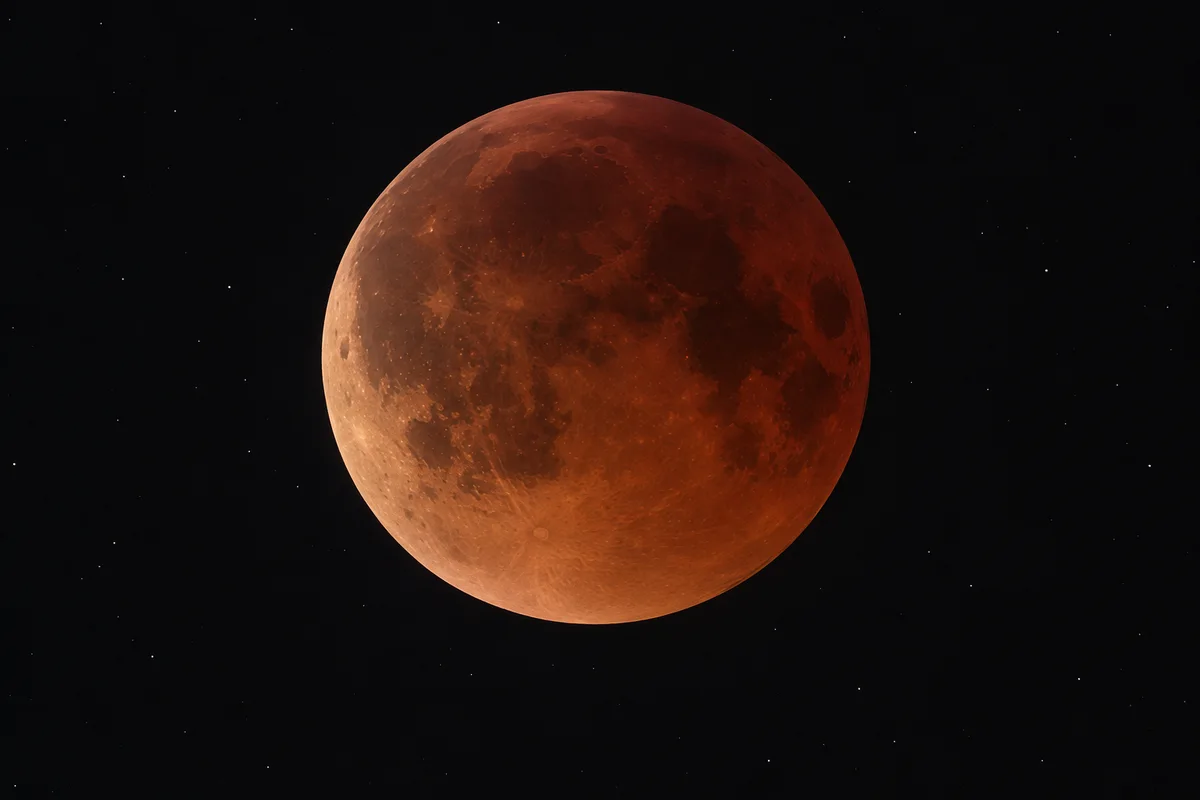
For comparison, the red color of a total lunar eclipse involves sunlight reaching the Moon through Earth's atmosphere while the Moon is inside Earth's shadow. That is a different geometry from simply observing a low Moon through a long atmospheric path.
The Moon's distance really does change—but differently
The lunar orbit is not a perfect circle, so the Earth–Moon distance changes over the month. A closer full Moon can have a larger true angular diameter than a more distant full Moon. That real orbital effect underlies the popular discussion of a “supermoon.”
It is separate from the strong perceived enlargement near a horizon on one evening. A Moon can produce the illusion even when it is not at the closest part of its orbit. Conversely, a genuinely closer Moon can appear high in the sky without looking as spectacular as a low Moon surrounded by landscape.
The observer's position on Earth's surface also introduces a small geometric difference. That does not turn the ordinary horizon illusion into a sudden large physical expansion. Distinguishing the timescale and magnitude of each effect keeps the explanation coherent.
Why some photographs show enormous moons
A long lens used from far away can frame the Moon beside a distant building or ridge. The building occupies a smaller angle as camera distance increases, while the Moon's angle barely changes because it is enormously farther away. A tight crop can then make the Moon look huge relative to the landmark.
That can be a genuine photograph with a carefully chosen viewpoint. It does not mean the Moon became larger that evening. It is a demonstration of perspective, focal length, framing, and the very different distances of the foreground and background.
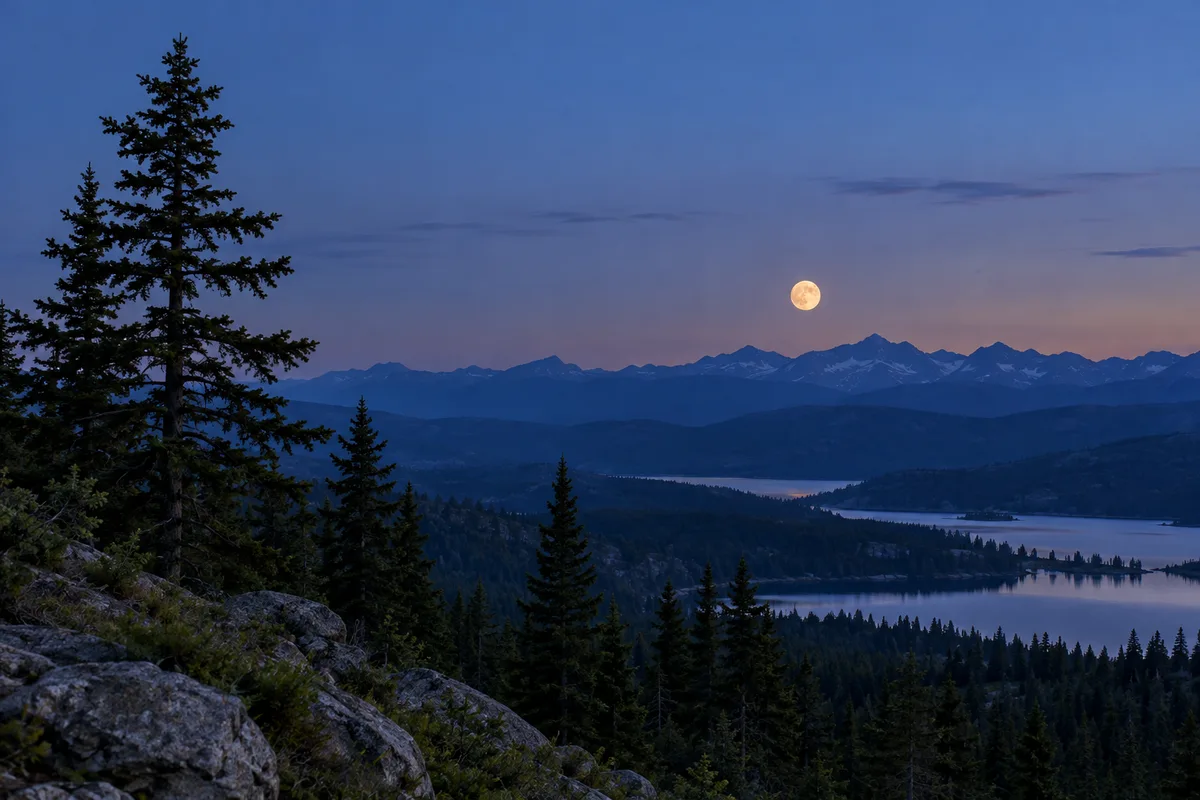
Other images may be composites or artist impressions. Those can be attractive illustrations if labeled honestly, but they cannot establish a measured change in lunar size. The landscape illustration on this page is generated and is not presented as an observational test.
A field comparison needs a fixed reference
An angular-size test works best when the camera's focal length and the display scale stay fixed. Comparing two original frames is different from comparing two images that a phone application independently enlarged to fill the screen. Automatic presentation can erase the very reference needed for the test.
Likewise, a landmark comparison should record the camera position. Moving closer to a building changes its apparent size substantially while barely changing the Moon's apparent size. A surprising ratio can therefore be created without altering the lunar disk at all. These controls do not eliminate the visual illusion; they distinguish it from changes introduced by the observation method.
The takeaway
The low Moon's dramatic apparent size is mainly an illusion of perception. Consistent photographs help separate that impression from angular size, atmospheric flattening, and the slower distance changes of the lunar orbit. Knowing the explanation's limits makes the sight more interesting: a familiar astronomical object reveals something about how human vision constructs a scene.
For another useful distinction between appearance and physics, explore why metal and wood can feel different at the same temperature. Sensation is informative, but it is not always a direct reading of the physical quantity we think we are judging.