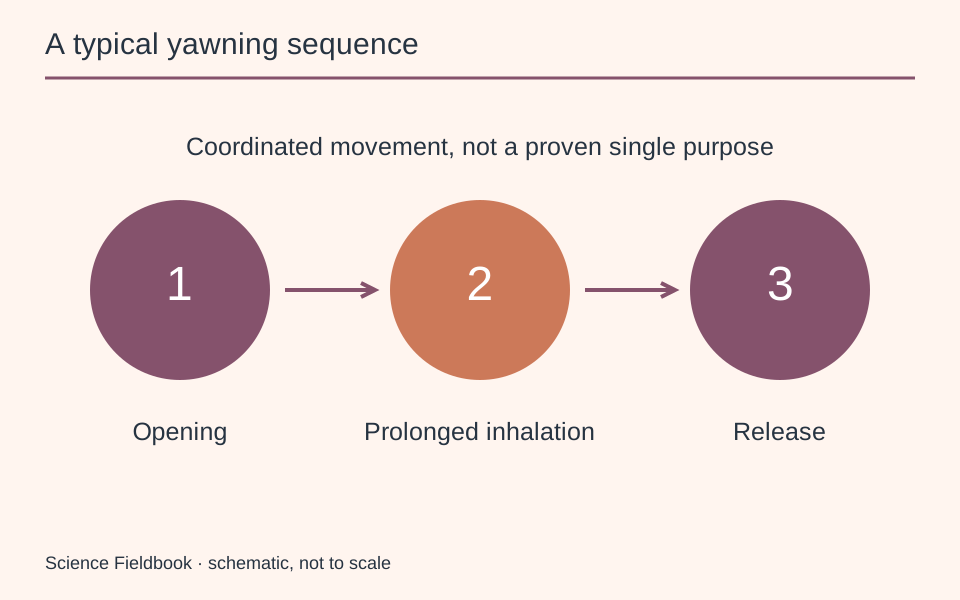
Yawning is a coordinated pattern involving a wide opening of the mouth, a prolonged inhalation, and related movements of the face and breathing muscles. It often accompanies sleepiness and transitions in alertness, but scientists have not established one complete explanation for its function. The idea that yawning simply supplies extra oxygen is not supported by classic experimental tests.
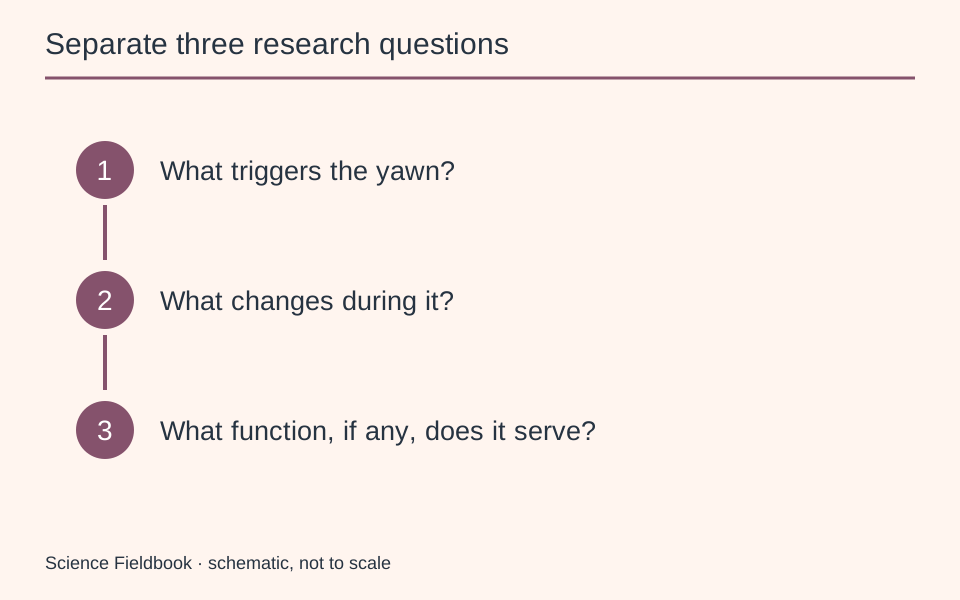
That uncertainty does not mean nothing is known. Researchers can distinguish the physical action, the situations that trigger it, its contagious form, and the hypotheses about what it accomplishes. Keeping those questions separate makes the evidence much easier to interpret.
What happens during a yawn?
A typical yawn develops through a recognizable sequence rather than an ordinary quiet breath. The jaw opens widely, inhalation is prolonged, facial and other muscles become involved, and the sequence ends with a shorter exhalation and relaxation.
Some people stretch or tear up during a yawn, but not every accompanying movement is essential to every event. The action is produced by coordinated nervous-system activity. It is not simply the mouth falling open because someone has lost interest in a conversation.
Spontaneous yawning occurs across many vertebrate species. That broad distribution suggests an old biological behavior, but it does not establish that its function is identical in every animal. Human social interpretation adds another layer that cannot be projected automatically onto all species.
A trigger is not necessarily the function
Yawning often occurs around waking, falling asleep, or changes in stimulation. An association with sleepiness is therefore real and familiar. But saying that tired people yawn does not, by itself, show whether yawning causes alertness, communicates a state, adjusts physiology, or accompanies another process.
Consider an analogy: seeing more umbrellas during rain does not prove that umbrellas cause rain. Similarly, finding more yawns in a particular state identifies a relationship that needs further testing. The relevant experiment must ask what changes when yawning occurs or when a proposed trigger is manipulated.
The distinction matters when comparing yawning with dreaming and sleep. Both are associated with changes in brain state, but an association with sleep is not a complete explanation for why a behavior or experience exists.
Why “the brain needs more oxygen” is too simple
A long inhalation makes the oxygen explanation sound intuitive. Yet breathing and yawning are not the same control system. An explanation based on low oxygen should predict how yawning responds when inspired oxygen or carbon dioxide changes.
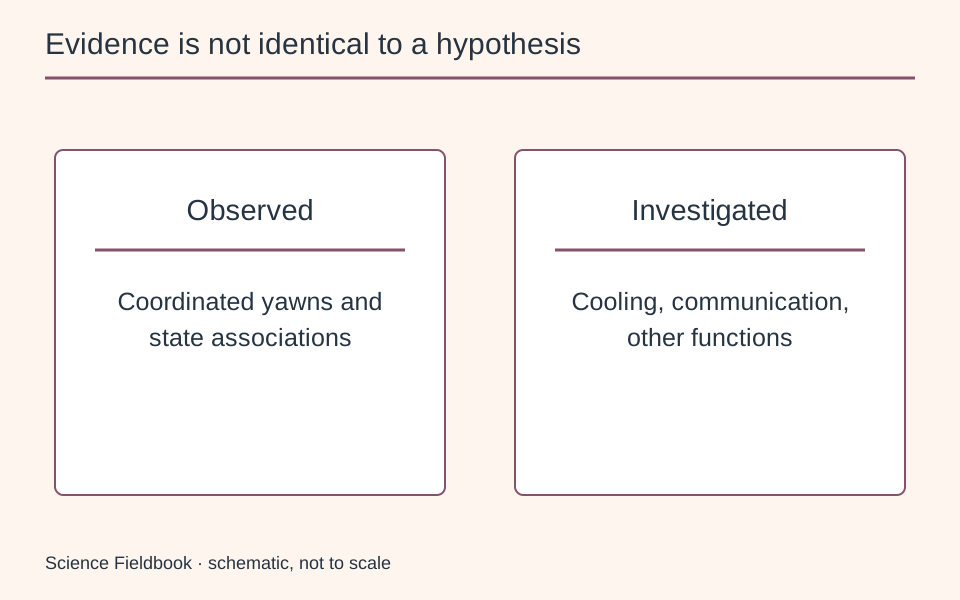
In a classic controlled study, changing inhaled oxygen or carbon dioxide and using exercise did not produce the expected relationship between breathing demand and yawning. That result challenged the common claim that yawning is simply a response to inadequate oxygen.
This does not imply that oxygen is unimportant to the brain or that breathing never changes during a yawn. It means the proposed purpose must match the observations. A conspicuous inhale is not sufficient evidence that extra oxygen is the behavior's main function.
The brain-cooling hypothesis
One proposed function is thermoregulation: yawning might influence heat exchange and help regulate brain temperature. Some comparative and experimental work has been interpreted as supporting that idea. Other researchers dispute whether the findings isolate cooling from related changes in alertness or other conditions.
The thermoregulatory review sets out supportive arguments. A different review of yawning physiology evaluates several hypotheses more skeptically. Reading the disagreement is more informative than selecting only the source with the most confident conclusion.
The appropriate description is that brain cooling is a scientific hypothesis with supporting and contested evidence. It should not be presented as a universally settled explanation for a familiar reflex. A claim about temperature needs actual physiological evidence, not merely a picture of a cool-looking blue brain.
Why experiment design changes the interpretation
A manipulation may affect more than one variable. For example, a temperature-related stimulus can also change comfort, attention, or sleepiness. If yawning changes, researchers must consider which pathway produced the effect.
Different species and study settings introduce additional limits. A relationship observed across species can suggest a pattern, while an experiment within one species tests something narrower. Neither design automatically answers every question about a person's next yawn.
This is a general feature of research, not a flaw unique to yawning. Good hypotheses make specific predictions and are revised as different methods test them. The uncertainty lies in selecting among explanations, not in denying that the behavior is measurable.
Why yawning can be contagious
Seeing, hearing, reading about, or thinking about yawning can trigger a yawn in some people. Contagious yawning is therefore different from a spontaneous event, even though the physical movement looks similar. The triggering information is part of the social or perceptual environment.
It is tempting to describe contagious yawning as a direct empathy meter. However, human studies show substantial individual variation, and the relationship with empathy is not a simple reliable one. A study of stable individual susceptibility emphasizes how much variation remains unexplained.
Failing to yawn when someone else does is not evidence that a person lacks empathy, attention, or a particular personality trait. One behavior under uncontrolled conditions cannot carry that diagnostic or moral conclusion.
Social communication and synchronization
Another family of ideas proposes that yawning communicates changes in state or helps coordinate activity within a group. The contagious response offers one reason to investigate those proposals. A group preparing to rest or become active could, in principle, benefit from shared cues.
However, a plausible social story is not proof of an evolutionary origin. Researchers must distinguish what yawns communicate today, what triggers imitation or contagion, and why the underlying movement evolved. These questions may have overlapping but different answers.
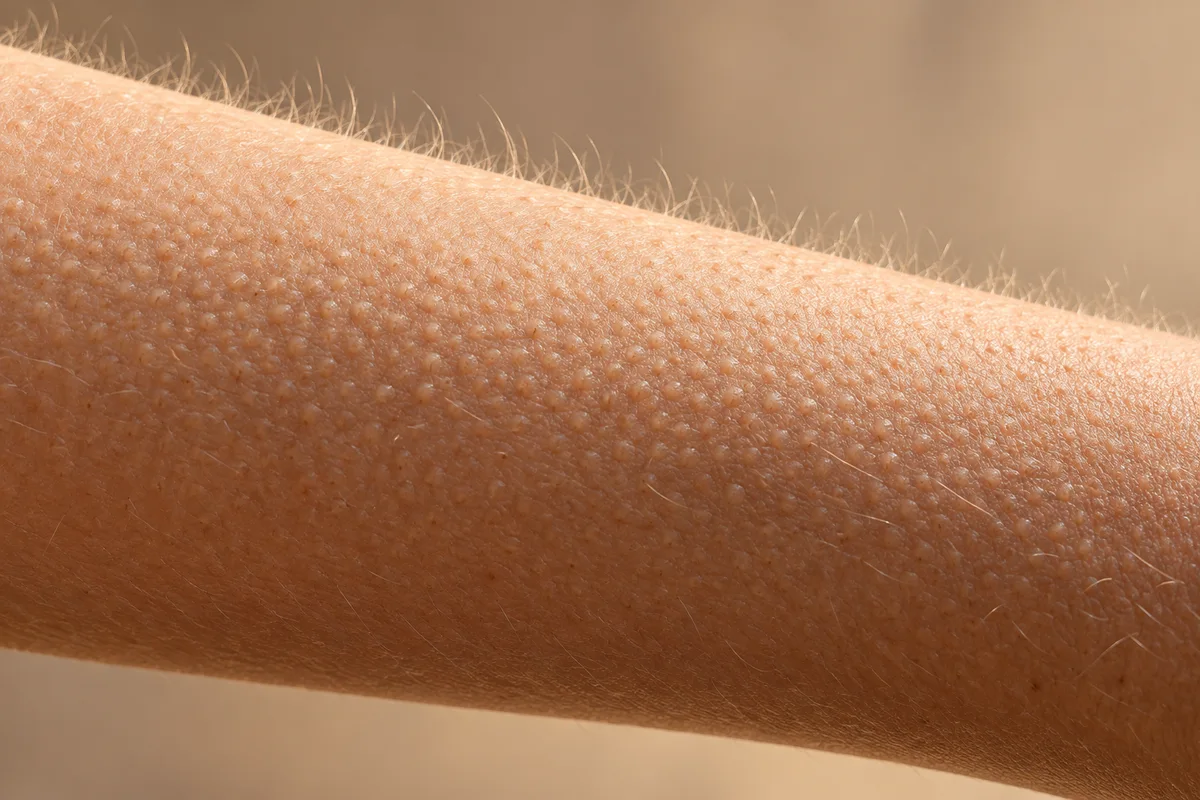
The contrast with goosebumps is useful. Goosebumps have a relatively clear immediate mechanism involving hair-follicle muscles, while their emotional triggers add broader questions. An observable mechanism and a complete functional explanation are different levels of understanding.
What not to infer from an ordinary yawn
A yawn during a meeting does not uniquely identify boredom. A person may be tired, changing activity level, responding to another yawn, or experiencing other influences. Interpreting one action without context is unreliable.
Likewise, this article cannot explain an individual's unusual or persistent yawning or distinguish a normal variation from a medical concern. It provides general physiology rather than diagnostic advice. Scientific uncertainty about the overall function should not be filled with unsupported health claims.
For a better-established temperature-control system, compare sweating, circulation, and shivering. Those mechanisms illustrate the kind of clear heat-flow accounting needed when evaluating a temperature-related hypothesis about yawning.
What would distinguish competing yawning hypotheses?
A good test must identify a prediction that differs between explanations. If a hypothesis says yawning changes brain temperature, measuring temperature-related outcomes is more informative than merely counting yawns when a room becomes warmer. If another proposes communication, the experiment should examine what an observer receives and whether that changes behavior.
Controls are needed because social cues, sleepiness, attention, and ambient conditions can interact. A study that changes several variables at once may show a real effect without identifying the pathway responsible. Replication using different methods helps determine whether a proposed explanation applies beyond one task or sample.
Why a familiar reflex can remain scientifically difficult
Yawning is common enough to observe but brief and irregular enough to complicate experimental timing. People can also suppress, exaggerate, or become unusually attentive to it when they know it is being studied. That changes the relationship between a laboratory record and spontaneous daily behavior.
The uncertainty is therefore not an invitation to choose the most entertaining explanation. It is a reason to keep the claim proportional to the method: describe the movement confidently, describe established associations clearly, and label the proposed function according to the evidence that actually tests it.
The takeaway
Yawning is a structured biological behavior strongly associated with changes in state, and it can also be socially triggered. The oxygen explanation is too simple, while cooling and communication remain subjects of investigation. The most accurate answer to “why do we yawn?” separates what the body does from what researchers have—and have not—established about its purpose.