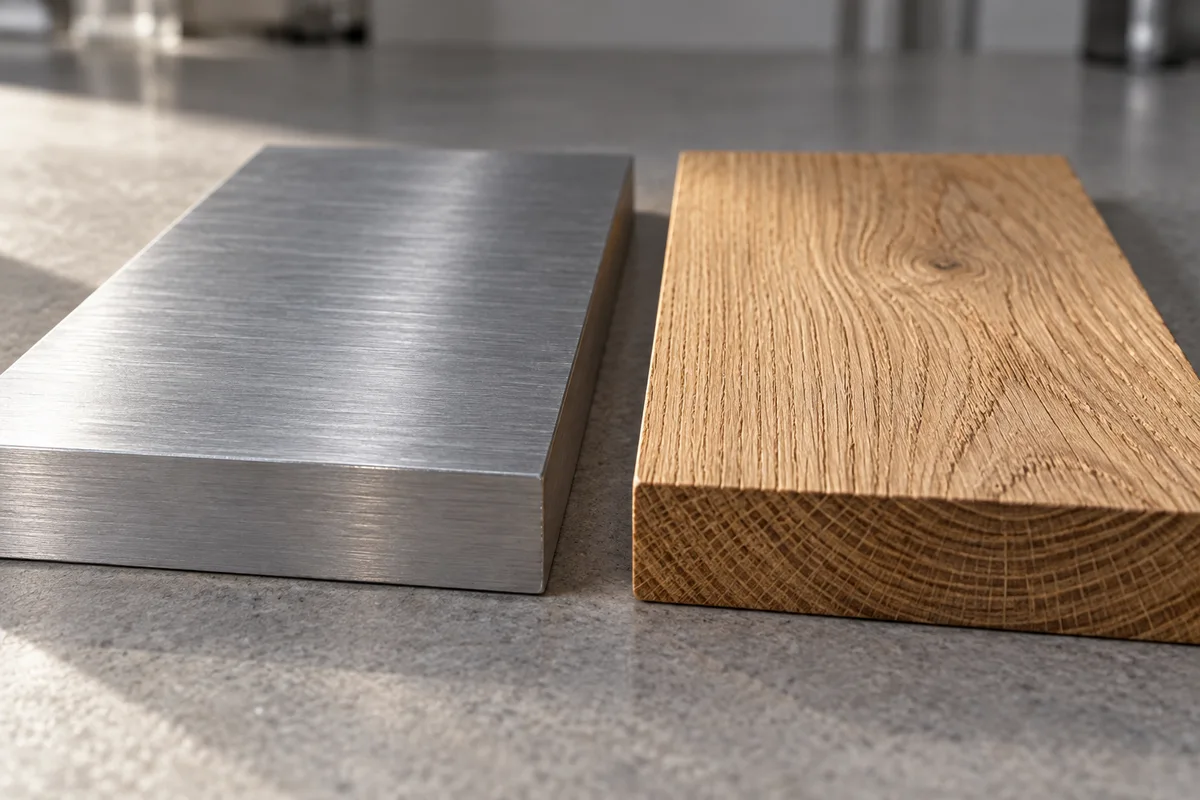
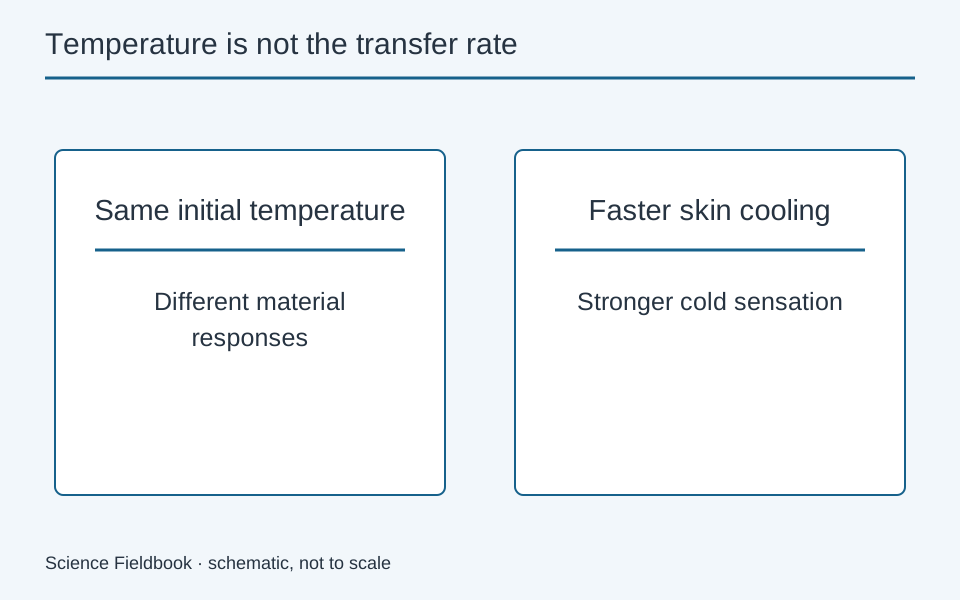
Metal feels colder than wood at the same room temperature because it usually carries heat away from your warmer skin more quickly. Your temperature-sensitive nerves respond to the cooling of the skin, so a faster transfer can feel like a colder object even when a thermometer would give the same initial reading for both materials.
This is a heat-flow effect, not a hidden supply of cold inside the metal. A spoon and a wooden utensil can reach approximately the same temperature after sitting in one room for a long time. Touching them creates a new situation: your hand becomes part of the thermal system.
Start with the direction of heat flow
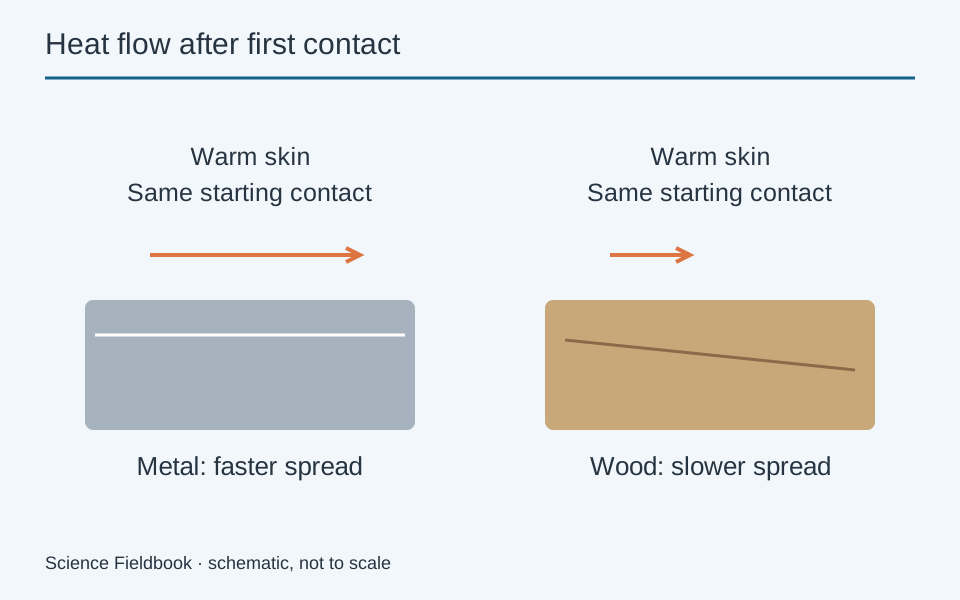
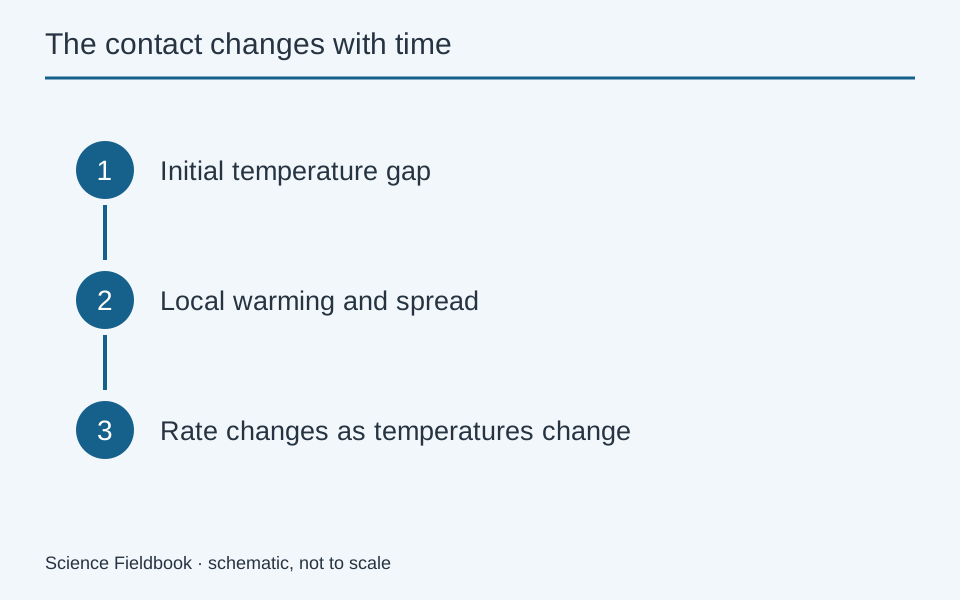
Heat is energy transferred because of a temperature difference. When your skin is warmer than an object, energy moves from your hand into that object. Your skin cools near the contact, and the object warms near the contact. Neither process is instantaneous throughout the whole hand or the whole object.
Suppose the room and its contents are near 21°C, or 70°F, while the skin on your hand is warmer. Both wood and metal can take energy from your hand. The key difference is how readily that energy moves away from the small patch you touch.
If the room were hotter than your skin, the direction could reverse. Then a metal surface could feel hotter than wood because it delivers heat to your hand more quickly. The material has not changed teams; the temperature difference changed direction.
Thermal conductivity explains much of the contrast
Thermal conductivity describes how readily energy travels through a material under a temperature gradient. In metals, mobile electrons contribute strongly to this transfer. Wood is a more complicated porous structure, with cell walls and air spaces that generally slow heat flow across a typical board.
Consequently, the metal beneath a fingertip can keep moving incoming energy into neighboring regions. Wood's small contact patch warms more locally, reducing the temperature difference at the skin. That helps a wooden handle feel less cold in the same room.
The American Wood Council's discussion of thermal conductivity points out that structural wood conducts heat much less readily than common metals. Species, moisture, grain direction, and metal alloy all matter, so there is no single exact conductivity for “wood” or “metal.”
Conductivity is not the whole story
Initial touch also depends on density and specific heat capacity: how much thermal energy a volume of material can absorb while its temperature changes. A useful combined property is thermal effusivity, which relates to conductivity, density, and heat capacity. Materials with high effusivity can strongly influence the contact temperature.
This explains why thickness and construction matter. A thin metal film over insulating foam does not behave exactly like a heavy solid block of the same metal. The film can change temperature quickly because it contains little material, and the backing limits the supply or removal of energy.
Likewise, a tiny metal coin may stop feeling cold fairly quickly as your hand warms it. A large metal countertop can continue drawing heat from the contact region for longer. The initial surface temperature alone does not describe the entire experience.
Your hand is not a reliable room thermometer
Thermoreceptors in the skin provide information about local temperature and changes in temperature. The signal also depends on recent experience. A hand that has been in cool surroundings can experience the same surface differently from a hand that has just held something warm.
That does not make touch useless. It is a rapid protective sense, particularly when an object transfers heat fast enough to harm tissue. But it is poorly suited to deciding whether two different materials have reached thermal equilibrium with a room.
To compare temperatures, use an appropriate thermometer and a consistent measurement method. Even instruments need care: infrared devices can misread shiny metal because surface emissivity and reflected radiation affect their readings. A bright thermal-looking illustration should therefore never be presented as measured evidence unless it came from a documented measurement.
Why handles, floors, and blankets feel different
A metal pan often has a wooden or polymer handle because an insulating material reduces conduction toward the hand. The handle can still become hot through prolonged use, contact with a flame, or the surrounding air. “Insulating” means slower transfer, not a guarantee of safe touching.
A tile floor and a carpet can also have similar initial temperatures but feel different on bare feet. Tile typically draws energy from the contact region more readily, while carpet traps air and reduces effective contact. The same general distinction appears with a metal chair and a wooden chair on a cool morning.
A blanket is not a source of heat in the way an electric heater is. It slows the loss of heat your body produces. That connects material properties to how the body regulates its temperature, where circulation, sweating, and shivering act alongside clothing and surroundings.
A simple comparison without extreme temperatures
Leave a metal spoon and a wooden utensil together indoors, away from sunlight and heaters, long enough for their temperatures to settle. Briefly touch each with the same part of your hand. A difference in sensation is consistent with different heat-transfer rates, even though the surroundings are shared.
This is a qualitative comparison. Different surface areas, finishes, moisture levels, contact pressures, and utensil thicknesses all influence the outcome. A classroom experiment would control these variables rather than attributing every difference to conductivity alone.
Do not repeat the comparison with objects from an oven, a freezer, electrical equipment, or unknown outdoor metal. Extreme temperatures introduce injury risks and do not improve the explanation. There is no need to make the sensation dramatic to understand it.
Common explanations that get the physics backward
“Metal contains more cold” treats cold as if it were a substance moving into the hand. The more useful description follows energy: a warmer hand loses heat into a cooler surface. That keeps the explanation consistent when the surface is hotter and the transfer reverses.
“Wood has no heat conduction” is also incorrect. Wood conducts heat; it generally does so more slowly than metal under comparable conditions. A thick wooden object can warm through eventually, while moving air and thermal radiation can transfer energy around it.
Finally, “same temperature” does not mean “same total thermal energy.” A large block and a small utensil can have equal temperatures but very different masses, heat capacities, and energy changes during contact. Temperature is one variable in the problem, not the entire heat budget.
The takeaway
Your hand senses the consequences of heat transfer. Metal often feels colder because it removes energy from the skin faster than wood, not because it starts at a lower temperature. Conductivity, heat capacity, geometry, and the contact itself all help determine that transfer.
The broader principle also explains how heat pumps move energy and why ice changes density when it freezes is a separate question from how cold an ice cube feels. Everyday sensations become clearer when temperature, structure, and energy flow are kept distinct.