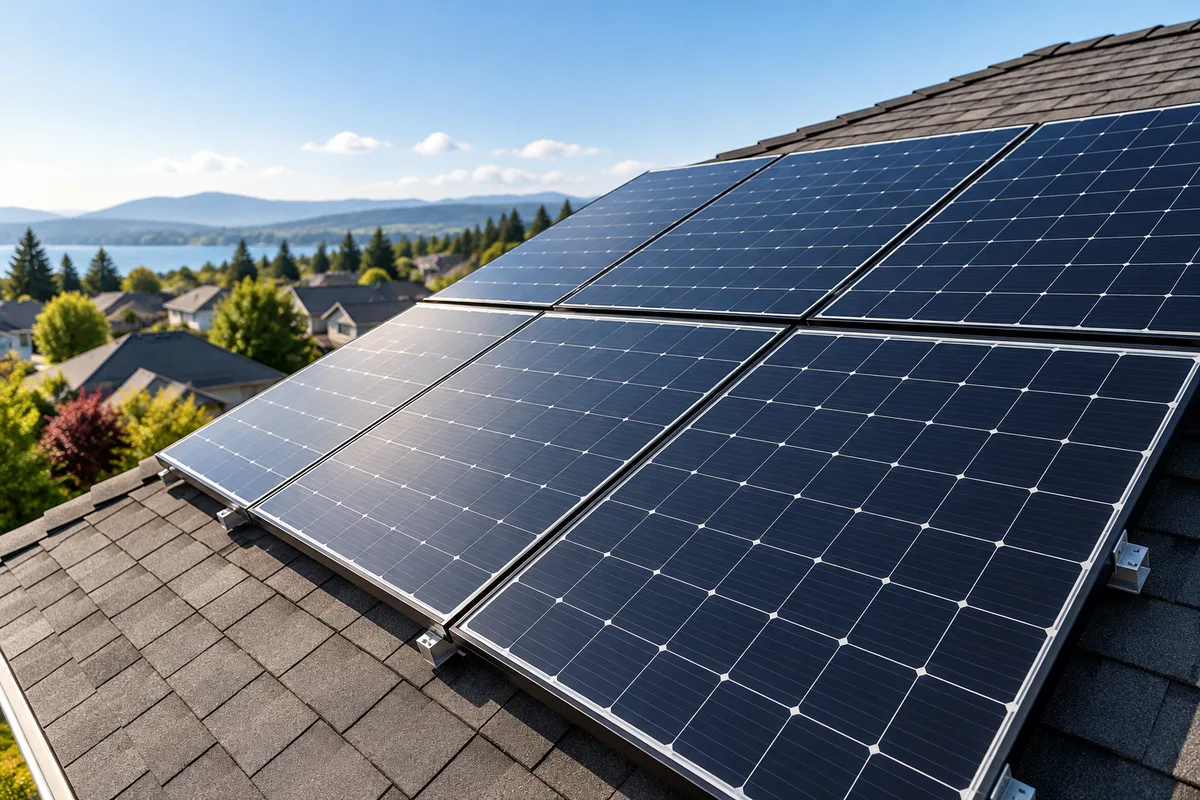
Solar photovoltaic panels turn sunlight into electricity using semiconductor cells. Absorbed light gives energy to charge carriers, and the cell's internal structure helps separate and collect them. Connected through an external circuit, those charges can deliver electrical power. An inverter commonly converts the resulting direct current into alternating current for a building or electrical grid.
The process is photovoltaic, not simply a panel becoming hot enough to run a generator. Heat affects a panel's performance, but the useful conversion starts with light interacting with an engineered material. Solar water heating and concentrating solar-thermal plants use different arrangements.
From sunlight to an energized charge carrier
Sunlight consists of electromagnetic radiation across many wavelengths. Describing it in terms of photons helps explain how energy is absorbed by a semiconductor. A photon with suitable energy can excite an electron into a state where it can contribute to electrical conduction.
In the semiconductor description, that excitation also leaves a hole, a missing electron state that behaves as a positive charge carrier. An electron–hole pair is not a newly created pair of tiny battery terminals. The cell must still separate the carriers and provide a useful route for their movement.
Not every arriving photon becomes electrical output. Some light reflects away, some passes through, and some absorbed energy becomes heat. Carrier recombination can also prevent energy from being collected through the external circuit.
The Department of Energy's cell overview describes this basic semiconductor conversion. Its importance is the sequence—absorb, separate, collect—rather than the idea that sunlight merely knocks electrons loose and sends them randomly down a wire.
Why a junction helps create useful electricity
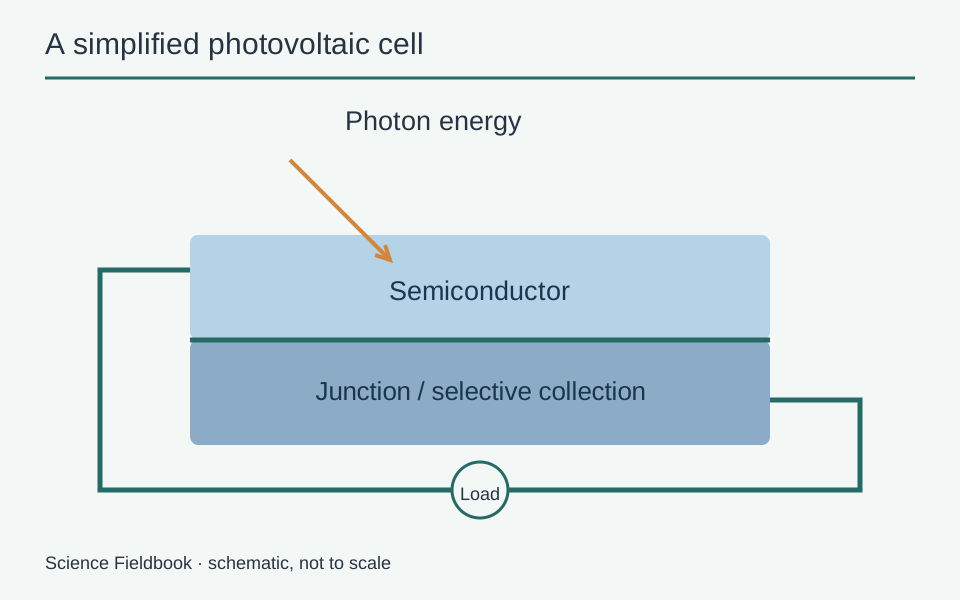
Many silicon cells use regions engineered with different electronic properties. At the junction, the resulting electric field helps separate light-generated carriers. Selective contacts and the overall device structure then allow current to be collected in an external circuit.
The full behavior involves semiconductor energy levels, diffusion, and internal fields. A simple cross-section can show the principal roles without pretending that each electron follows one fixed arrow through a microscopic maze.
The process does not consume silicon in the same way a fuel burns. A working cell can continue converting incoming light while the material remains part of the device. It still ages through physical and chemical degradation, so “not consumed as fuel” does not mean “lasts forever.”
Voltage, current, power, and energy
Voltage describes an electrical potential difference. Current describes the rate at which charge passes through a circuit. Electrical power is the product of voltage and current under the usual circuit description, while energy is power accumulated over time.
A hypothetical panel supplying 300 watts for three hours would deliver 900 watt-hours, or 0.9 kilowatt-hours, if its output stayed constant. That is a worked arithmetic example, not a prediction for a particular rooftop. Actual output changes with the light and operating conditions.
Confusing watts with kilowatt-hours makes solar performance seem more mysterious than it is. A panel's rated power is not the energy it produces every hour of every day. Night, cloud, shading, orientation, and system behavior all change the total.
Why cells become modules and modules become arrays
One cell provides a limited voltage and current. Manufacturers connect cells and protect them in modules, the units commonly called solar panels. A system can then connect multiple modules to achieve a suitable electrical output.
Series and parallel connections affect voltage and current differently. The design must match the inverter and other electrical components. It also includes protective devices and wiring arrangements that are not shown in a simple educational picture.
This article explains the principles, not installation instructions. Solar systems can involve hazardous voltages even in daylight when other equipment is switched off. Work on an actual array requires the applicable professional practices and local requirements.
What the inverter does
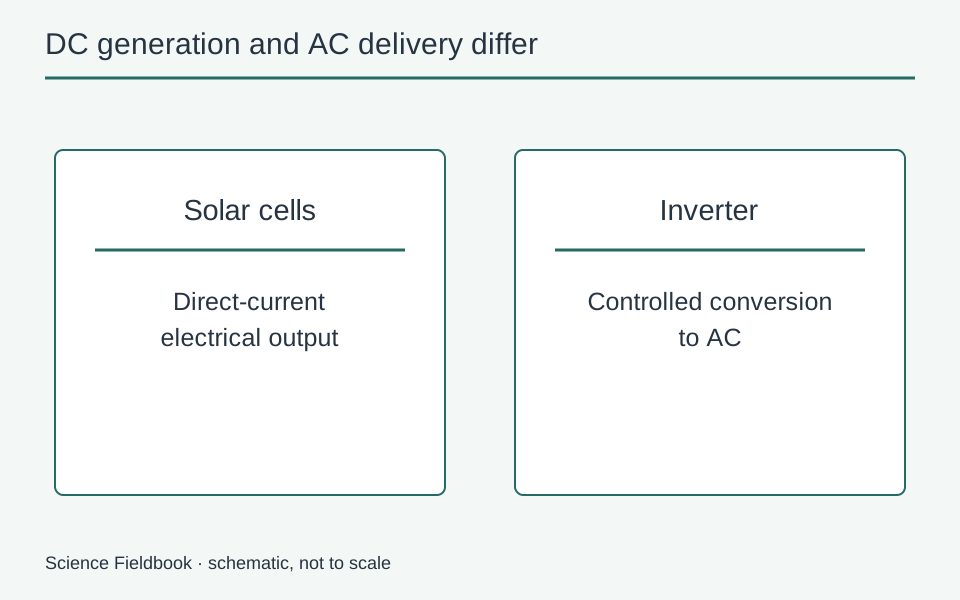
Photovoltaic cells produce direct current, with charge flowing in one overall direction through the external circuit. Household and grid circuits commonly use alternating current. An inverter uses power electronics to convert and control the electrical output in the required form.
The inverter may also help the array operate near an appropriate maximum-power point as light and temperature change. A grid-connected system has additional requirements for synchronization and protection. Those functions are not just an adapter changing the shape of a plug.
Power electronics also appear in electric cars, where an inverter controls the relationship between a DC battery and an electric drive. The hardware and operating purpose differ, but the distinction between conversion and storage remains useful.
Why shade and heat reduce output
Shading reduces the light reaching affected cells. Because cells are electrically connected, a shaded region can also influence the behavior of other cells in the same circuit. Bypass arrangements and module-level electronics can mitigate some effects, but they do not create sunlight that is missing.
Higher cell temperature can reduce voltage and overall conversion performance in common silicon devices. Bright sunlight and a hot panel therefore create competing influences: more light can increase available input while higher temperature can reduce efficiency.
The Department of Energy's performance explanation discusses wavelength, reflection, recombination, and temperature. It is more accurate to follow those mechanisms than to assume that “hotter day” automatically means “better solar day.”
Where the electricity goes after it is generated
In a building, solar output may supply local loads, charge a compatible battery, or flow to the grid when the system and connection permit it. The available paths depend on the equipment and electrical arrangement.
A battery stores energy for later use; the panel itself does not store a sunny afternoon for the evening. Battery charge management and conversion losses affect how much of the generated energy is later available. A system without storage is not automatically able to supply a home during a grid outage.
That distinction also applies to wireless charging: a charger transfers energy, while a battery stores it through chemical changes. The everyday word “power” often hides several separate stages.
Photovoltaic and solar thermal are different technologies
A solar-thermal collector captures solar energy as heat, for example to warm water. A concentrating solar-thermal plant can use mirrors to collect radiation and supply heat to a power-generating system. Neither is the same direct semiconductor conversion used by a photovoltaic cell.
Both approaches use sunlight, but their components, temperatures, and energy paths differ. A dark rooftop box is not enough information to identify the mechanism. Knowing whether the desired output is electricity, hot water, or heat for another process is the better starting question.
The distinction resembles how a heat pump works: moving thermal energy and converting light to electrical energy are different tasks, even when both can contribute to a building's energy use.
Why the load changes the operating point
A solar cell does not supply every possible voltage and current combination simultaneously. Its current–voltage relationship depends on illumination, temperature, and device properties. The external circuit determines an operating point on that relationship.
Near a short circuit, current can be substantial while voltage is small. Near an open circuit, voltage can be present while current through the external load is negligible. Neither extreme necessarily gives the greatest electrical power, because power depends on both quantities together.
Maximum-power-point control adjusts the operating conditions to collect useful output as the environment changes. This is an engineering control problem, not a way to exceed the available sunlight or eliminate semiconductor losses. A real system's tracking and conversion also consume or dissipate some energy.
Why a panel's appearance does not reveal its output
A dark panel may absorb much of the arriving light, but absorption alone does not establish high electrical efficiency. Some absorbed energy becomes heat, and electrical losses occur after absorption. Material, cell design, wiring, and the operating point all matter.
Likewise, the panel area in a photograph does not provide a reliable generation estimate without irradiance, orientation, shading, and system information. A marketing image cannot replace a rated specification or a measured energy record. Even a measured day's production needs weather and operating context before it can be generalized to a year.
The useful comparison defines the boundary and interval: incident solar energy, DC output from modules, AC output after conversion, or energy actually delivered to a load. Each is a legitimate quantity, but switching between them mid-calculation creates misleading efficiency claims.
The takeaway
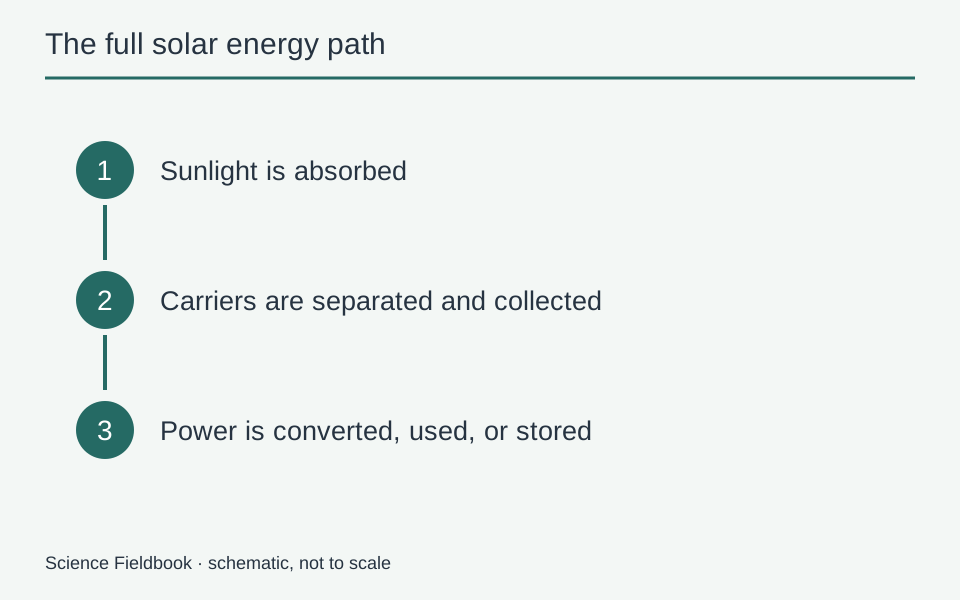
A photovoltaic system absorbs light in semiconductor cells, separates and collects charge, combines cell outputs, and converts the electricity as needed. Its real energy yield depends on the full system and environment. Following that chain explains why sunlight, temperature, shading, inverters, and storage each matter without treating them as interchangeable features of a “solar panel.”