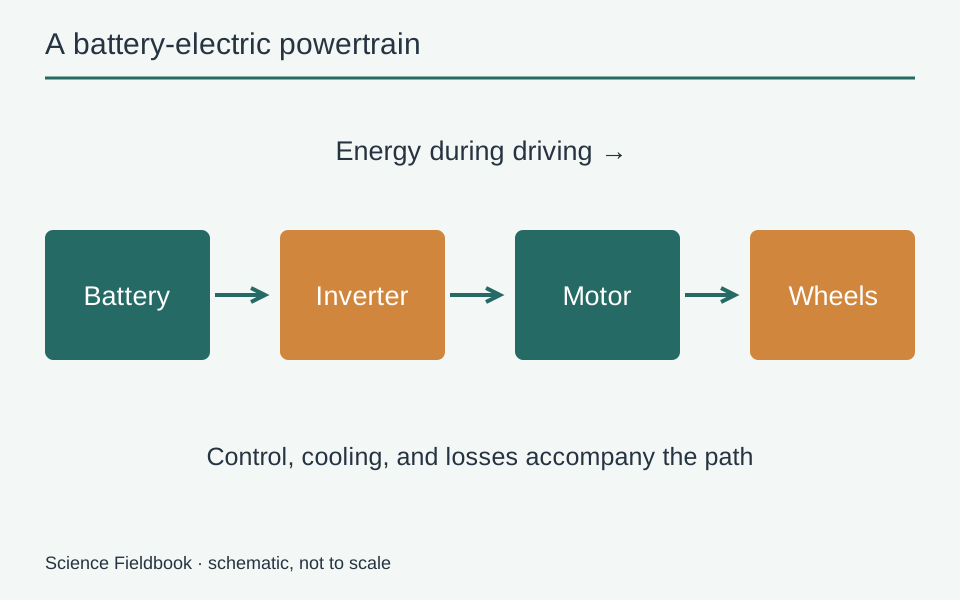
A battery-electric car stores energy in a traction battery and uses power electronics to drive one or more electric motors. The motors turn the wheels through a drivetrain. During some kinds of slowing, the same electric machine can act as a generator, converting part of the car's motion back into electrical energy through regenerative braking.
That energy path differs from burning fuel inside an engine, but an electric car is still a complete mechanical and thermal system. It needs brakes, tires, cooling, controls, and a way to replenish the battery. Understanding the separate components is more useful than calling it a battery with wheels.
The traction battery stores chemical energy
The main battery pack contains many cells arranged to provide the required voltage, energy capacity, and power capability. During driving, electrochemical reactions allow the cells to supply electrical energy to an external circuit. Charging drives the storage process in the other direction within the battery's operating limits.
Battery capacity is commonly described in kilowatt-hours, an energy unit. Motor or charging power is commonly described in kilowatts, a rate of energy transfer. A 60-kilowatt-hour pack is not the same quantity as a 60-kilowatt motor or charger.
In a simplified arithmetic example, using 15 kilowatt-hours to travel 100 kilometers would mean that 60 usable kilowatt-hours correspond to 400 kilometers if the rate stayed constant. Real range depends on usable capacity, conditions, reserve policies, and many other variables. The example is a unit conversion, not a vehicle specification.
The US Department of Energy's component guide distinguishes the traction battery from the lower-voltage auxiliary battery. That smaller system powers accessories and control functions rather than directly replacing the main pack's propulsion role.
The inverter controls the motor's electrical input
The traction battery supplies direct current. Many vehicle motors use controlled alternating currents in their windings, so an inverter converts and regulates the electrical output. Its switching patterns control the magnetic fields that produce torque.
The inverter is not simply a box that turns a fixed current on at full strength. It works with the vehicle's control system to adjust torque and other operating conditions. Different motor designs and operating strategies use different details.
The term also appears in solar photovoltaic systems. In both cases, power electronics change and control electrical energy, although a vehicle's motor drive and a grid-connected solar inverter have different loads and requirements.
How an electric motor creates wheel torque
An electric motor uses interactions between magnetic fields and electrical currents to create mechanical torque. In common designs, a stationary part called the stator produces a controlled magnetic pattern that interacts with the rotor. The rotor's turning motion is transmitted to the wheels.
Some designs use permanent magnets, while others rely on induced currents or other arrangements. It is therefore inaccurate to describe every electric-car motor as one specific magnet configuration. The broad conversion from electrical input to mechanical work is shared, but the hardware varies.
Many battery-electric cars use a relatively simple reduction gear rather than a conventional multi-speed gearbox. That is not a universal rule for every electric vehicle. The transmission must still match motor speed and torque to the needs of the wheels.
Why acceleration and efficiency are different questions
Electric drives can deliver substantial torque across useful operating ranges, and control electronics can adjust that torque rapidly. But quick acceleration is not the same as low energy use. Moving a larger mass or accelerating more aggressively still requires energy.
At higher road speeds, aerodynamic resistance becomes especially important. Tire losses, slopes, weather, and accessories also contribute. A highly capable motor does not make the rest of the vehicle's energy budget disappear.
This is the same reason one should distinguish a component's efficiency from a whole system's consumption. The battery, conversion electronics, motor, drivetrain, cabin systems, and road conditions all form part of the journey.
Regenerative braking reverses part of the energy path
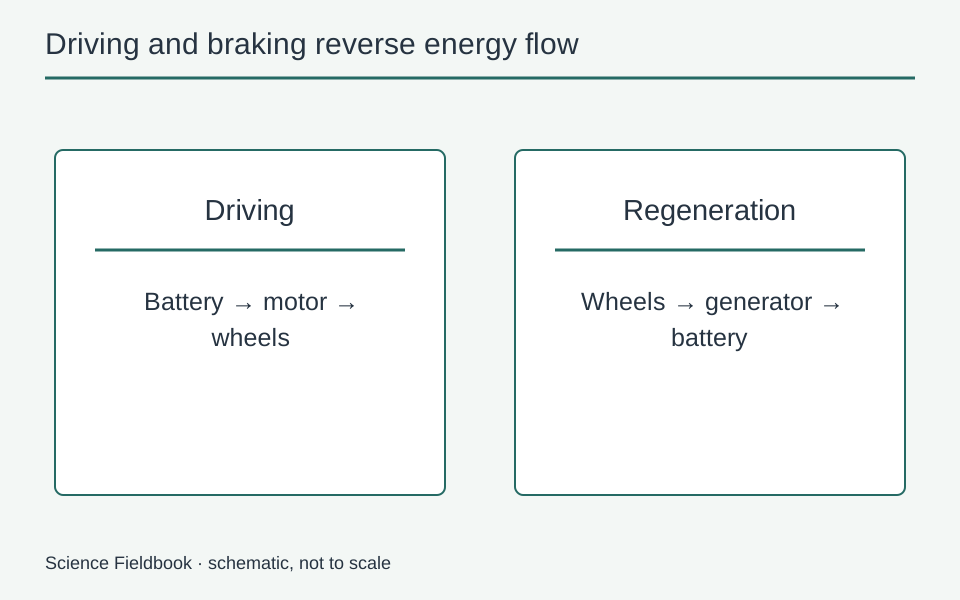
During regenerative braking, the wheels drive the electric machine, which produces electrical output while applying a resisting torque. Power electronics route suitable energy back toward the battery. The vehicle slows because some of its kinetic energy is being transferred rather than because an extra energy source appeared.
The DOE description of regenerative braking illustrates this recovery principle. Although that example is shown in a hybrid system, the motor-as-generator mechanism also explains regeneration in battery-electric vehicles.
Regeneration cannot recover all the energy used earlier. Conversion losses, tire and air resistance, and other effects remove energy from the recoverable path. Repeatedly accelerating and braking cannot charge a car indefinitely; it produces a net loss.
Why friction brakes remain necessary
The battery and drive system cannot accept unlimited regenerated power. A very full pack, temperature conditions, low speed, or traction and stability requirements can limit regeneration. The exact limits depend on the vehicle.
Friction brakes provide a complementary means of slowing, turning mechanical energy into heat at the brakes. Control systems may blend the two methods. A driver should follow the vehicle's instructions rather than assume that one pedal behavior or regeneration setting applies to every model.
This article is a mechanical explanation, not driving instruction. Braking response, safe following distances, and road conditions need the appropriate real-world guidance. A diagram cannot establish how a particular vehicle will behave in an emergency.
Charging: AC and DC paths
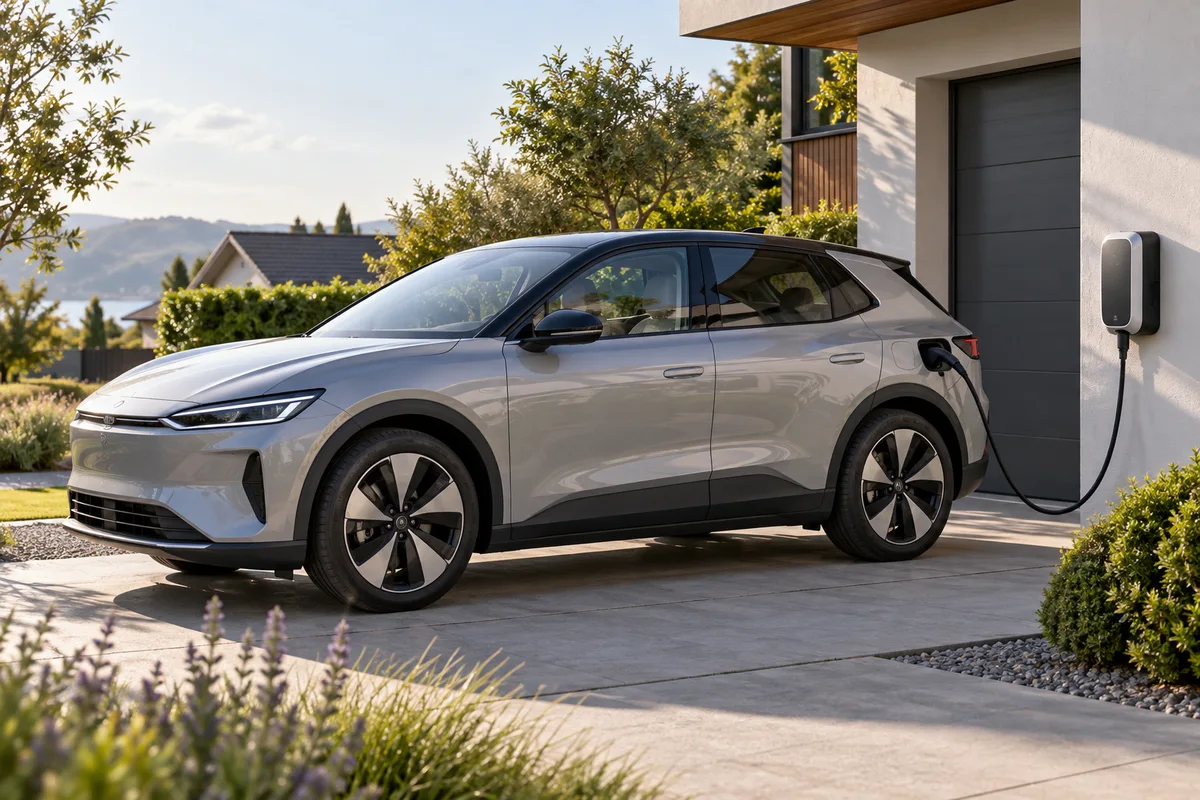
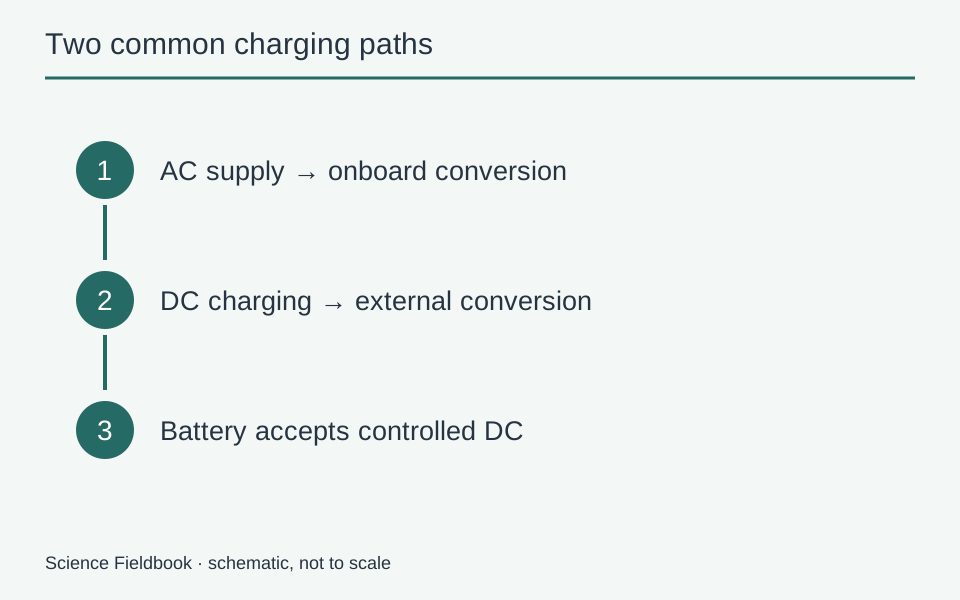
With AC charging, electricity entering the vehicle is converted to suitable DC by an onboard charger before reaching the battery. With DC fast charging, much of that conversion occurs in external equipment, which supplies controlled DC through the compatible charging connection.
The maximum charging rate depends on both the equipment and the vehicle. Battery state of charge and temperature also affect the rate. A charger labeled with a high peak power cannot force the car to accept that power continuously.
Charging time therefore is not always capacity divided by the largest advertised power number. That calculation can introduce the basic units, but real sessions include limits, changing rates, and losses. A complete estimate needs the actual charging curve and starting and ending conditions.
Why cooling and cabin systems affect range
Batteries, motors, and power electronics generate heat during operation and have intended temperature ranges. Thermal management moves heat where needed using air, liquid, refrigerant systems, or combinations of these approaches.
Cabin heating and cooling also require energy. Some vehicles use heat pumps to move thermal energy efficiently under suitable conditions. Others use different arrangements or combine methods depending on temperature and demand.
Cold and hot weather influence more than passenger comfort. They can change battery behavior, thermal-management demands, and charging conditions. A single range number cannot represent every season or route.
Battery-electric does not mean zero impact everywhere
A battery-electric vehicle has no tailpipe combustion exhaust during driving. That is an important operational distinction, but it is not a complete lifecycle assessment. Electricity generation, vehicle and battery manufacturing, tire wear, infrastructure, and end-of-life processes also matter.
Comparing technologies responsibly requires defining the boundary and conditions. A specific emissions or cost claim needs location, electricity supply, usage, and other data. This mechanism article does not invent a universal percentage reduction or purchase recommendation.
Future charging approaches may use magnetic induction in compatible systems, but the core energy accounting remains the same. Energy must enter from a source, be stored, and pass through real components with losses.
Why regenerative braking depends on the battery's condition
Recovering motion-derived energy requires somewhere for that energy to go. If a battery is near its intended upper charge limit, or its temperature and control settings restrict charging power, the drive system may accept less regenerated energy. Friction brakes can provide the remaining required slowing within the vehicle's design.
The same logic applies on a long descent. The vehicle's motion and gravitational energy create an opportunity for recovery, but the battery, electronics, traction conditions, and thermal limits constrain the available path. “Downhill charges the battery” is therefore an incomplete description unless the system can accept the power involved.
Energy per distance is a whole-journey quantity
Two routes of equal distance can require different amounts of energy. One may involve higher speed and more aerodynamic drag; another may involve repeated climbs, stops, or cabin heating. Regeneration can recover some energy during slowing but cannot undo all the losses of the preceding acceleration.
An efficiency comparison should therefore specify the test cycle or route conditions and whether energy is measured at the battery or at the electrical supply. Charging losses make those boundaries different. A vehicle using a certain amount from its pack can require more energy at the wall to replenish it.
These details do not obscure the basic mechanism; they explain why real-world results vary without contradicting it. The motor still converts electrical energy to motion, but the entire trip includes air resistance, rolling losses, gradients, accessories, storage, and conversion. A single best-case number cannot summarize every combination.
The takeaway
An electric car converts stored battery energy through controlled power electronics and a motor into wheel motion. Regeneration sends some motion-derived energy back to the battery, while charging replenishes the rest. Range and performance emerge from the full vehicle and its conditions, not from one battery capacity or motor rating alone.