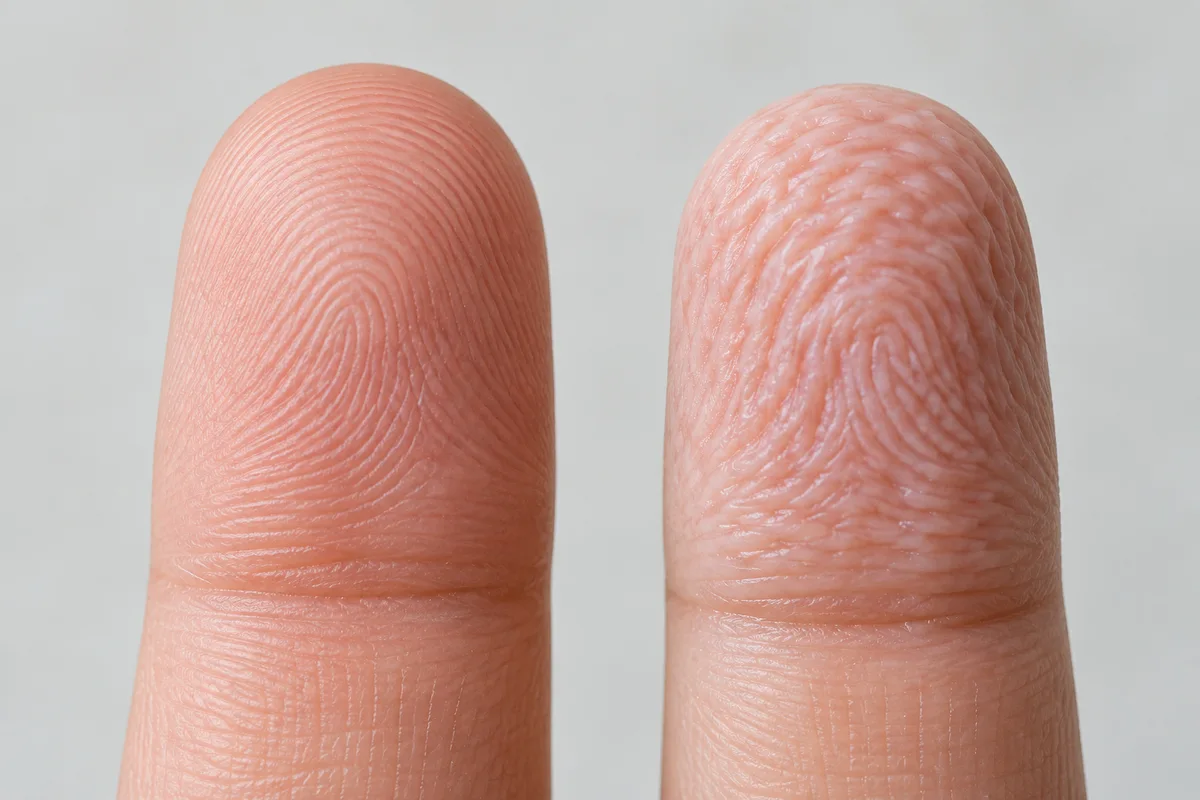
Fingers wrinkle in water partly because immersion triggers an active response involving the autonomic nervous system and blood vessels in the fingertips. Constriction of small vessels reduces the volume beneath the skin, helping pull the surface into folds. The familiar explanation that the skin simply soaks up water and swells is incomplete.
Researchers have good evidence that nerves and circulation matter, but the detailed triggers and possible evolutionary function are still being studied. In particular, the idea that wrinkles improve wet grip is plausible and supported by some experiments, yet it should not be presented as a settled universal explanation.
Why fingers and toes show the effect so clearly
The pads of fingers, palms, and soles have specialized hairless skin. Their structure and interaction with underlying tissue differ from those of many hair-covered areas. After sustained water exposure, that skin can develop conspicuous temporary folds.
Those folds are different from ordinary fingerprint ridges, which are present before immersion. They are also different from long-term wrinkles associated with aging. One word, “wrinkle,” covers several changes that do not share the same immediate cause.
The effect does not occur on an identical schedule for everyone. Temperature, the solution's composition, and individual physiology influence its development. A casual comparison between two people's hands therefore cannot isolate one biological variable.
The evidence that nerves matter
An important observation is that normal water-induced wrinkling can be reduced or absent when the relevant nerve supply is disrupted. That is difficult to explain with a model based only on water passively entering the skin's outer layer.
Research on sympathetic innervation and immersion wrinkling helped establish the nervous system's role. The sympathetic branch is part of the autonomic system, which regulates many processes without requiring conscious commands.
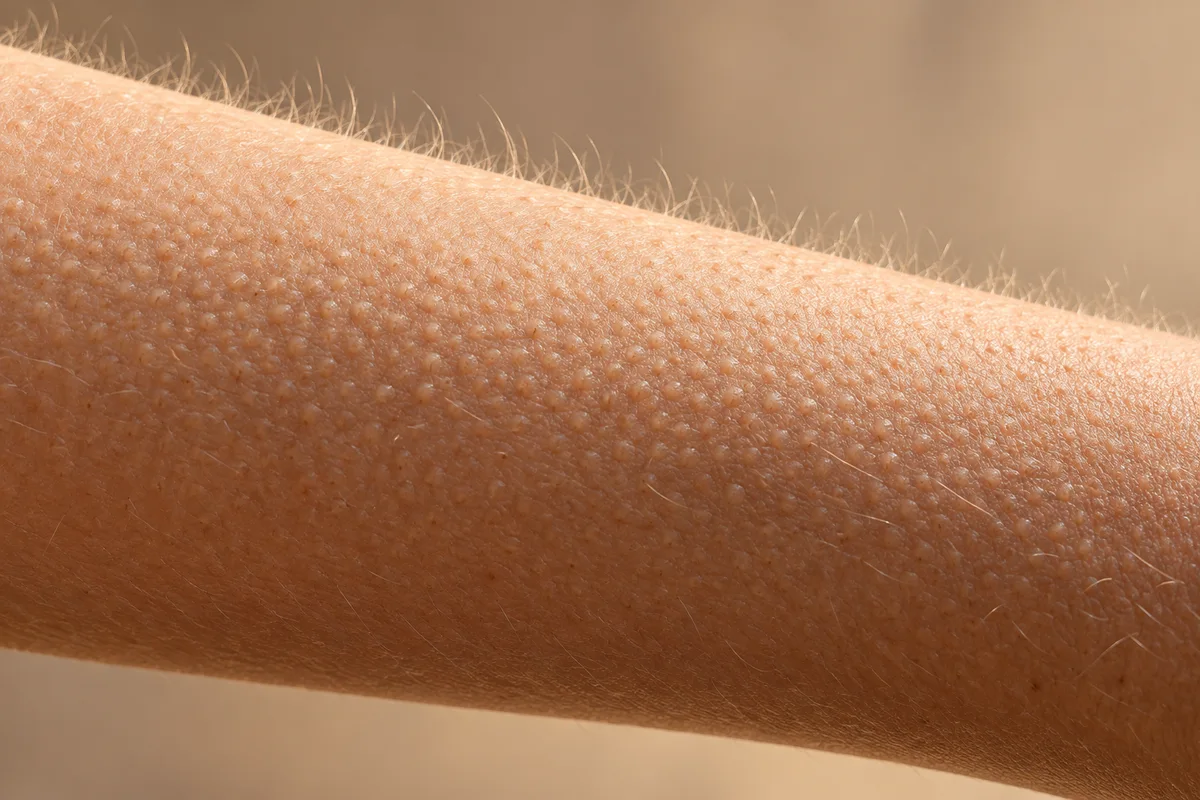
This does not mean a person deliberately decides to wrinkle their fingertips. It means that the response involves a regulated physiological pathway. Similar distinctions help explain goosebumps, another visible skin change involving autonomic activity, though the muscles and mechanics are different.
How changes in blood flow can fold the surface
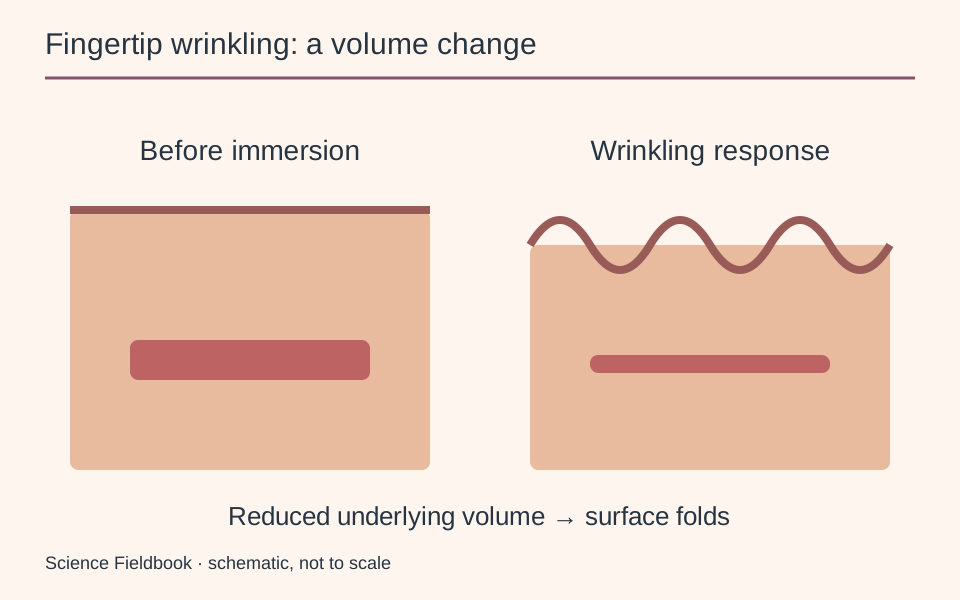
Small vessels in the fingertip can narrow during the response. Reduced blood volume in the underlying tissue changes the support beneath the skin. The surface can then buckle into folds as that volume changes.
A study measuring blood flow during water-induced wrinkling associated the response with vasoconstriction. Subsequent work has developed the explanation in terms of altered digit volume and the pull on overlying tissue.
The diagram is a simplified cross-section, not an anatomical measurement. It separates skin, soft tissue, and vessels to make the mechanism understandable. Real fingertips contain a much more complicated arrangement of connective tissue, nerves, sweat structures, and circulation.
Does water absorption play no role at all?
Water certainly interacts with the outer skin barrier. Prolonged soaking can change that barrier and the material properties of the surface. Rejecting a purely passive explanation does not require claiming that water has no physical effect on skin.
The point is that absorption by itself cannot account for all the observations about nerve function and blood flow. Biological explanations often combine material properties with active regulation rather than choosing only one or the other.
The precise chain from immersion to vascular response remains more complex than “the brain sees water and sends a wrinkle command.” Proposed contributions include interactions involving sweat ducts, skin chemistry, and local physiology. A useful explanation should not replace one oversimplification with another.
Do wrinkled fingers improve grip?
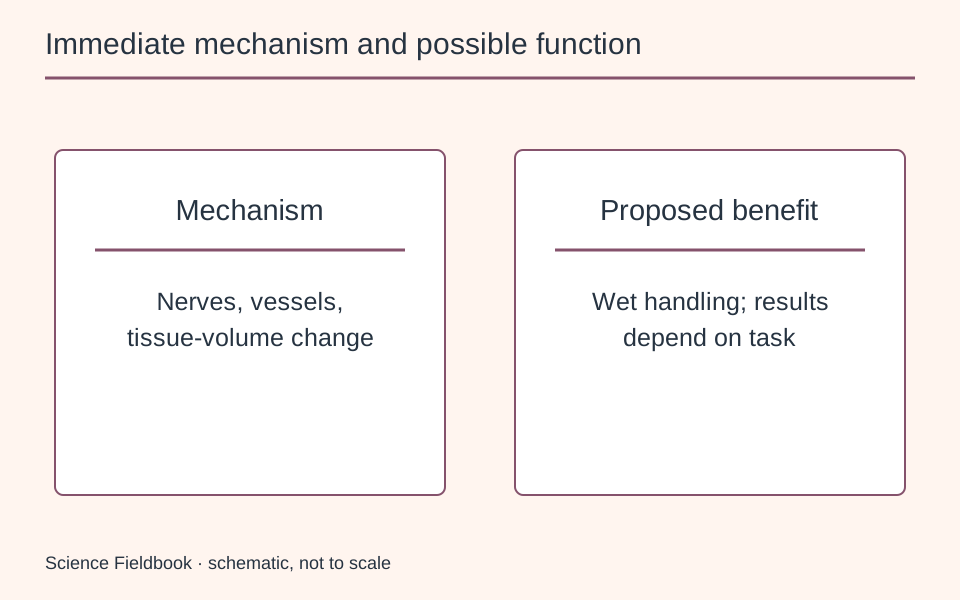
One hypothesis compares the folds with drainage channels that might help manage water between the skin and an object. If the response improves handling in wet conditions, that could help explain why an active mechanism has been maintained.
A 2013 handling experiment reported faster manipulation of submerged objects with wrinkled fingers. A 2014 study did not find the same improvement in dexterity or measured touch sensitivity. A later grip-force study found changes consistent with more efficient wet gripping.
These results address related but different outcomes. Time to move an object, the force used to hold it, and touch sensitivity are not interchangeable measurements. Different tasks can therefore reveal different aspects of the same physiological change.
The balanced conclusion is that a functional wet-grip benefit remains an evidence-based possibility, not an established explanation for every feature of the response. Neither one supportive experiment nor one negative result settles the entire evolutionary question.
Why the water's properties change the timing
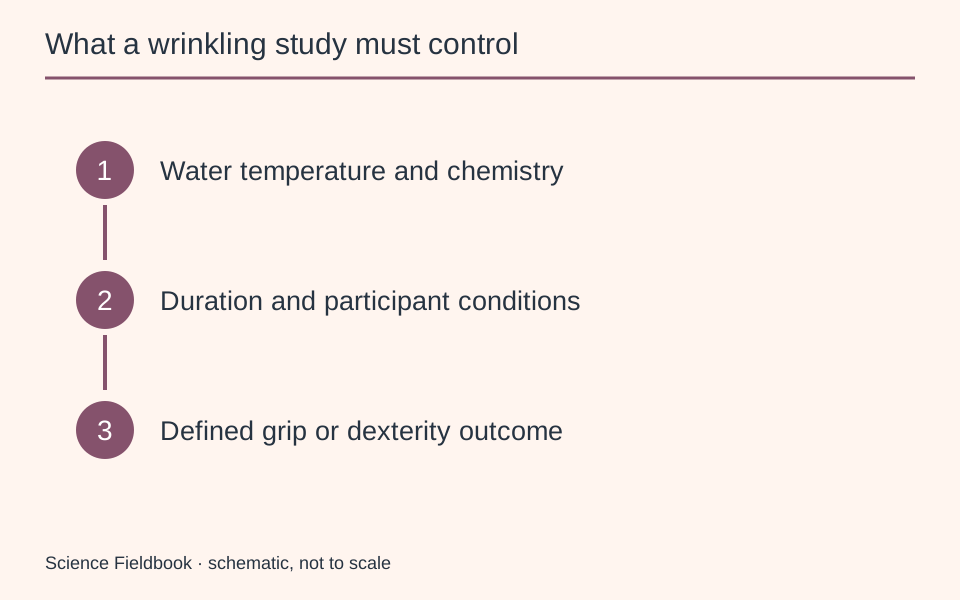
Water temperature and dissolved substances affect immersion wrinkling. They can change skin interactions and the physiological conditions under which the response develops. Researchers control these factors when comparing participants or experimental conditions.
A study of solution tonicity found that the solution influenced the time to wrinkling. More recent work has examined several physical and chemical factors. Those laboratory observations are reasons for caution in interpreting a bathtub experience, not instructions to perform a medical test at home.
The role of dissolved particles is different from salt lowering water's freezing point. Both involve solutions, but a chemical effect in a beaker cannot simply be substituted for the behavior of living tissue.
What a wrinkling observation cannot diagnose
Because nerves and circulation are involved, controlled wrinkling tests have been explored in clinical settings. That does not make the appearance of your fingers after washing a reliable self-test for nerve disease or overall health.
Many ordinary variables affect the response, and a clinical interpretation depends on context and standardized methods. A single delayed or uneven result does not establish a diagnosis. This article explains the phenomenon and does not recommend testing or treatment.
The same boundary matters for body temperature regulation: visible changes can illustrate physiology, but assessing an individual's symptoms requires more than applying a general educational description.
Mechanism and evolutionary benefit require different tests
Showing that a response depends on intact nerves helps identify how it happens. Showing that a wrinkled fingertip uses a different grip force addresses a possible consequence. Establishing why the response evolved requires a broader argument about benefits, costs, and comparative biology.
Those questions should not be collapsed into one sentence such as “the brain makes tire treads so humans can hold wet things.” The tire analogy communicates the proposed drainage idea, but it is not a literal description of the nervous system or an established evolutionary history.
Researchers also need to define what counts as improvement. A task can become faster without requiring less force, or require less force without becoming faster. Skin sensitivity measures add another outcome again. Naming the measured result precisely makes apparently conflicting papers easier to compare and prevents a single attractive explanation from outrunning its evidence.
The takeaway
Water-induced fingertip wrinkling is more than skin passively becoming waterlogged. Autonomic nerve activity and changes in small blood vessels help reshape the support beneath the surface. The possible benefit for handling wet objects is interesting but still needs careful interpretation across different experimental tasks.