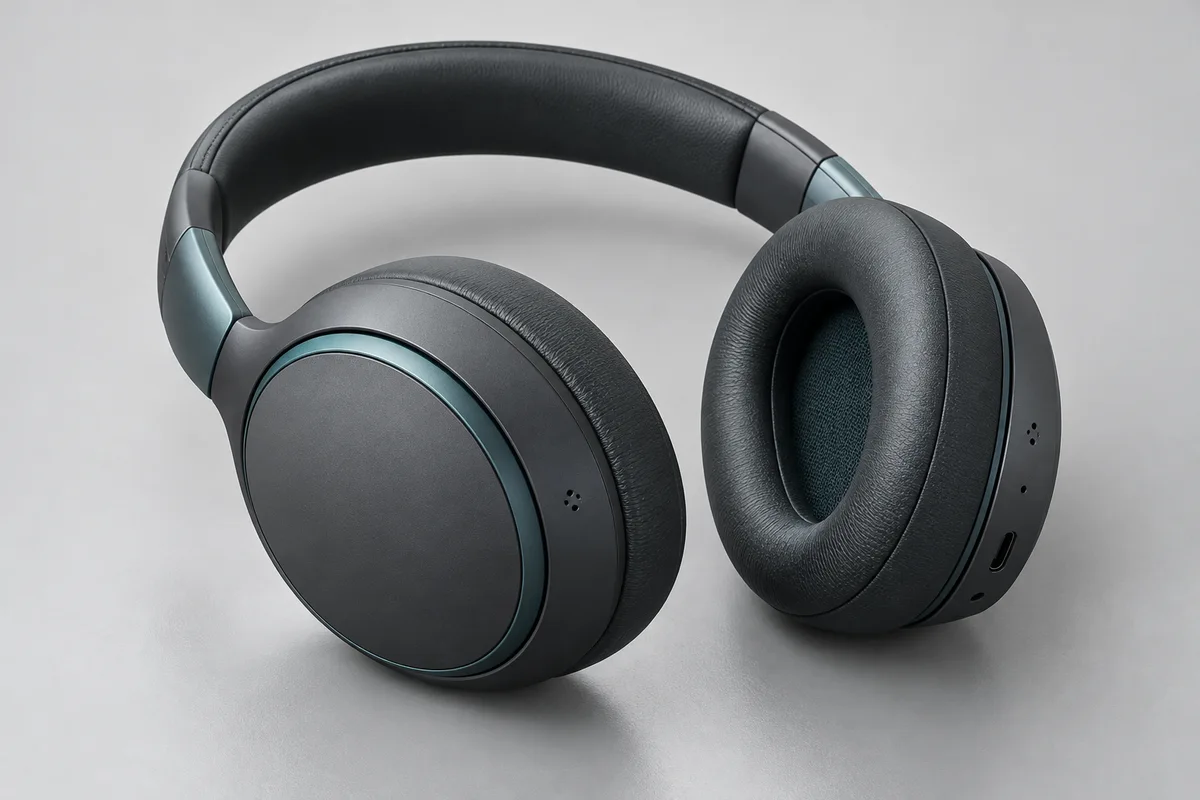
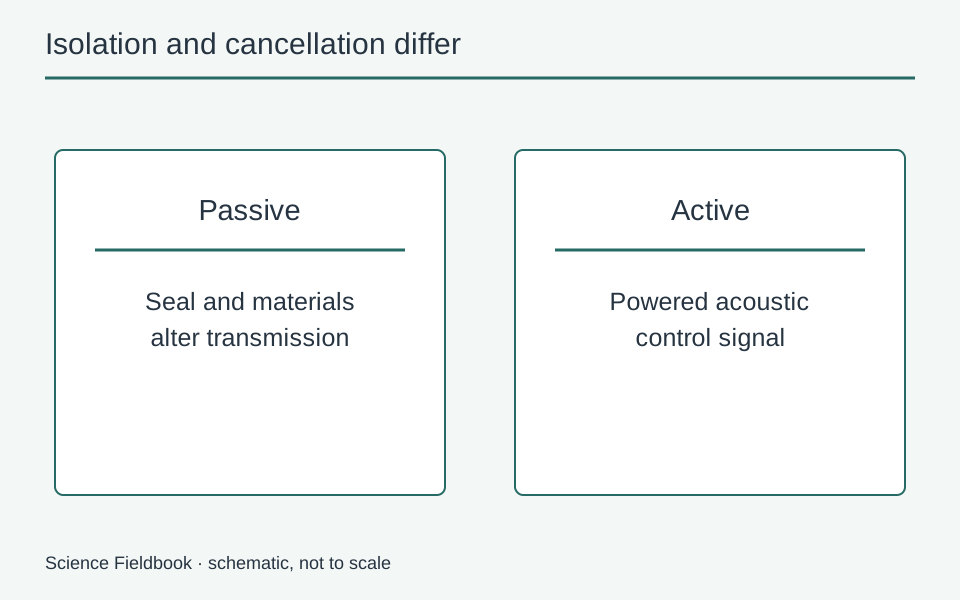
Noise-canceling headphones reduce unwanted sound through two complementary mechanisms. Passive isolation physically limits sound entering the ear, while active noise cancellation uses microphones, processing, and a speaker-generated signal to reduce part of the remaining pressure variation near the ear. The active effect depends on wave superposition, often described as destructive interference.
They do not erase sound everywhere in the room. Nor do they simply play music loudly enough to hide the noise. The useful result is local and depends on the noise, the fit, the electronics, and the acoustic path between the outside world and the listener.
Passive isolation comes first
Ear cushions, earcup materials, and in-ear tips can obstruct sound and change how it travels to the ear canal. A good seal often makes a substantial difference. Gaps caused by fit, hair, glasses, or movement can change the acoustic result.
Passive isolation does not require battery power. It is a mechanical and material effect, though the design may be optimized alongside electronic cancellation. Different frequencies are reduced by different amounts, so a product's physical seal is not a universal soundproof wall.
This distinction also explains why powered-off headphones can still quiet some sounds. The active system may be disabled while the physical barrier remains. Conversely, sophisticated electronics cannot always compensate for a severely compromised fit.
Active cancellation adds a pressure signal
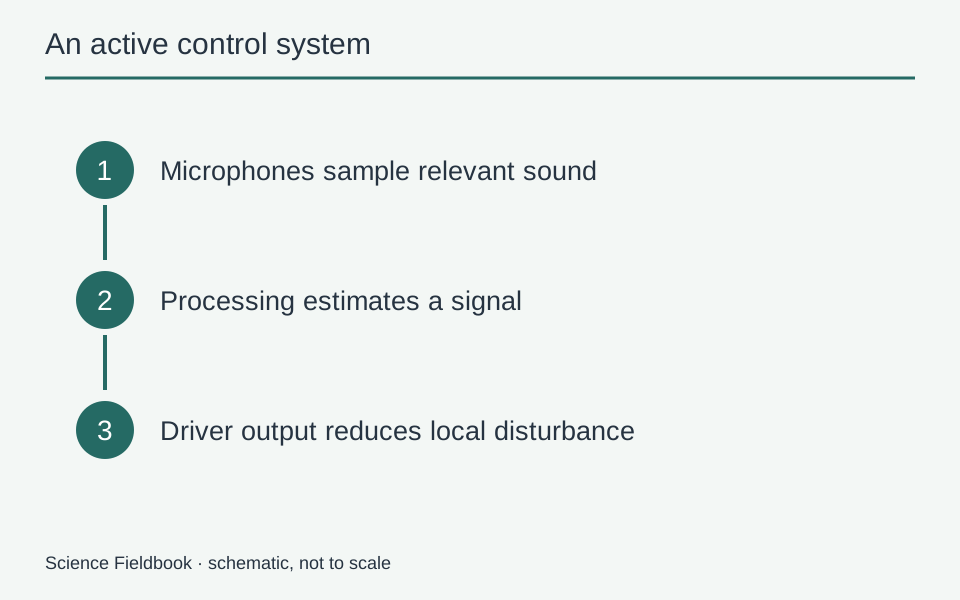
A microphone measures aspects of the incoming or residual sound. Processing estimates an appropriate control signal, and the headphone driver produces a corresponding pressure wave. At the intended location, that wave can oppose part of the unwanted disturbance.
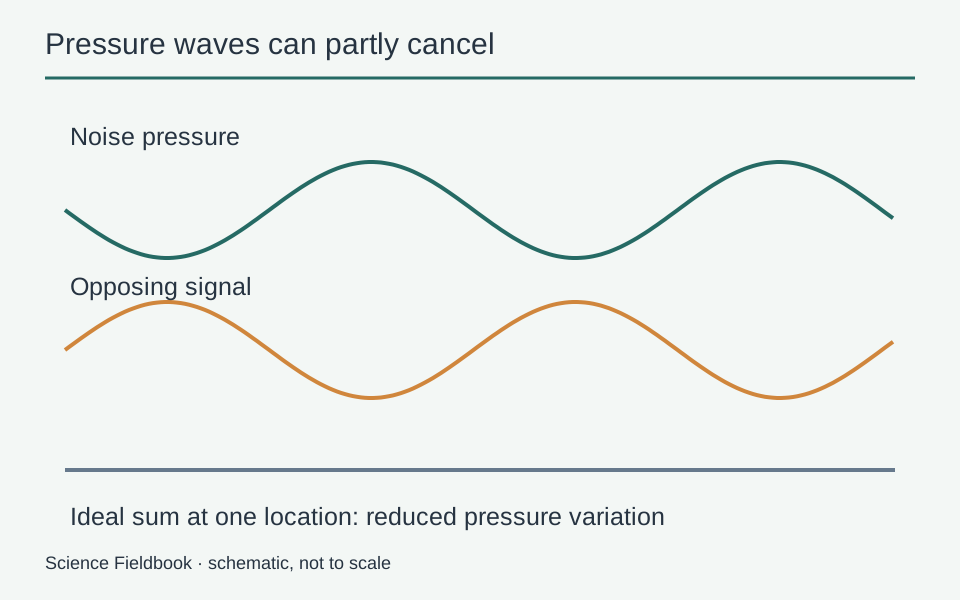
Pressure changes from overlapping waves add. If one wave raises pressure while another lowers it by a similar amount at the same place and time, the combined variation can be smaller. That is the central destructive-interference idea.
The result is not produced by converting a sound into an opposite kind of physical substance. Both signals are pressure variations in the same air. Their combined pattern matters. A simple waveform diagram illustrates that principle, not the exact real-time behavior of a commercial control algorithm.
Why “180 degrees out of phase” is only the beginning
For a simple steady tone, equal-amplitude waves with the right opposite phase can strongly reduce the result at a point. Real background noise contains multiple frequencies, and the path to the ear changes with movement and fit. A useful system must adapt to those complications.
Electronic delay matters because the cancellation signal must arrive at the appropriate time. The microphone and driver are also in different locations, with acoustic structures between them. Simply inverting an arbitrary microphone recording is not enough to build an effective headphone.
The underlying wave concepts are described in how sound travels through air. Frequency and wavelength help explain why timing and position become more demanding for some sounds than for others.
Feedforward, feedback, and hybrid arrangements
In a feedforward arrangement, a microphone outside the earcup or tip samples incoming noise before it reaches the ear region. The system uses that information to estimate a cancellation signal. Its performance depends on how well the external measurement predicts what will arrive inside.
A feedback arrangement uses a microphone closer to the listening region to measure residual sound. The system adjusts its output based on that result. This can address errors that a purely external measurement misses, while introducing its own control-system constraints.
Hybrid systems combine information from different microphone locations. The goal is not merely to include more microphones, but to use their signals in a stable and useful way. Microphone count alone is not a complete measure of cancellation quality.
Why steady low-frequency noise is often reduced well
Low-frequency sound has a relatively long wavelength. Timing and small position errors are often more manageable over the small region around the ear, particularly for steady components such as a continuous mechanical rumble.
Rapidly changing or higher-frequency sounds are generally harder to cancel actively over that region. A small error in position or timing can represent a larger fraction of a short wavelength. The physical seal and passive materials therefore remain important for higher-frequency reduction.
This is a broad engineering pattern, not a promise that every product handles every low note better than every high note. Actual designs, noise spectra, fit, and control methods determine measured results. Speech, for example, contains a changing mixture rather than one simple frequency.
The Bose explanation of active and passive mechanisms provides a manufacturer's description of the combined approach. It is used here for the mechanism, not as a product comparison or endorsement.
Cancellation is different from masking
Masking makes a sound less noticeable by introducing another sound that competes with it perceptually. Turning up music or playing background noise can mask some distractions without reducing the original pressure signal in the same way as active cancellation.
Active cancellation instead aims to reduce a component of the disturbance at the listening location through a controlled acoustic output. A headset may use cancellation while also playing music, but those are separate functions.
That distinction matters when judging a demonstration. If one recording is louder or uses different background music, the impression of quiet may change for reasons unrelated to the cancellation itself. A fair comparison controls playback level and the relevant listening conditions.
Why the whole room does not become silent
The appropriate anti-noise signal depends on position. A wave that cancels at one point can combine differently a short distance away. Headphones exploit the small controlled region near the ear rather than attempting to impose silence throughout an open space.
They are therefore different from a physical enclosure designed to reduce sound transmission across a room boundary. The two approaches can complement one another, but neither is a universal replacement for the other.
Electrical power also remains necessary for the active system. Wireless charging or a cable may replenish a battery in a compatible device, but charging technology and acoustic cancellation are distinct processes.
What a quiet impression cannot guarantee
Feeling less distracted does not establish a particular measured attenuation or a safe listening level. Product-specific testing uses defined equipment and procedures. This article does not claim a decibel reduction, hearing-protection certification, or clinical benefit for an unnamed headset.
Awareness modes likewise vary by design. Some deliberately pass or reconstruct outside sound, but their presence does not guarantee that every warning or environmental cue will be heard. Use the device's instructions and the requirements of the setting rather than treating a general science explanation as safety approval.
The thermal behavior of batteries and electronics is another separate issue. Heat transfer affects comfort and device operation, but a cool-feeling earcup does not prove that its acoustic control system works better.
A simple calculation shows why timing matters
A 100-hertz tone has a period of 10 milliseconds. A 1,000-hertz tone repeats every millisecond. A fixed electronic delay therefore represents a much larger fraction of a cycle at the higher frequency. This helps explain why cancellation becomes more demanding as frequency rises.
The calculation does not provide a performance limit for a real headset. Control systems account for their acoustic and electronic paths in more sophisticated ways, and several factors contribute to the result. It isolates one reason that “just play an upside-down wave” is incomplete engineering advice.
Fit changes the acoustic model
Moving an earcup or changing an ear tip can alter how noise reaches the listening region and how the driver output arrives there. A control signal calculated for the earlier condition may no longer be ideal. Adaptive processing can respond to some changes, while the physical seal still sets important constraints.
This is why a consistent comparison uses the same fit and the same source conditions. A person reseating headphones between trials can change both passive isolation and active behavior at once. The perceived result may be genuine, but attributing it to only one component requires more controlled testing.
The takeaway
Noise-canceling headphones combine a physical barrier with a powered control system that creates a locally opposing pressure signal. Their strengths and limitations follow from wave behavior, timing, geometry, and fit. They reduce selected noise at the ear rather than deleting sound from the surrounding world.