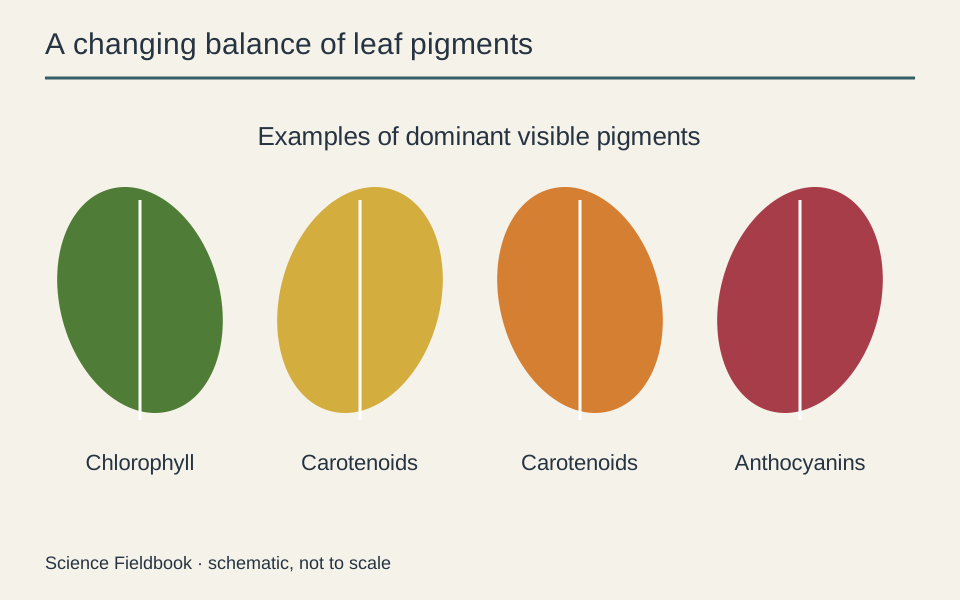
Leaves change color in fall because the balance of pigments in their tissues changes as many deciduous trees prepare for winter. Green chlorophyll breaks down, revealing yellow and orange carotenoids that were already present. Some leaves also make red and purple anthocyanins during autumn. Species, day length, temperature, and water conditions help determine the final display.
Autumn color is therefore not one green substance simply turning red. Different pigments have different histories and roles. Following those differences explains why a forest can contain yellow trees, red trees, brown leaves, and partly green branches at the same time.
What makes a summer leaf look green?
Chlorophyll absorbs light for photosynthesis, the process plants use to convert light energy into chemical energy. Its absorption properties make green wavelengths relatively prominent in the light reflected and transmitted by many healthy leaves.
Other pigments are present too. Carotenoids participate in capturing light and protecting the photosynthetic system, but the strong green signal of chlorophyll can dominate what an observer sees. A leaf's apparent color depends on the combined absorption and scattering of its tissues, not on one isolated pigment molecule.
The idea of selectively absorbing light also appears in solar cells, although a leaf and a photovoltaic device use very different mechanisms to store or deliver energy. In both cases, sunlight contains a range of wavelengths rather than one uniform color.
Shorter days help begin the seasonal transition
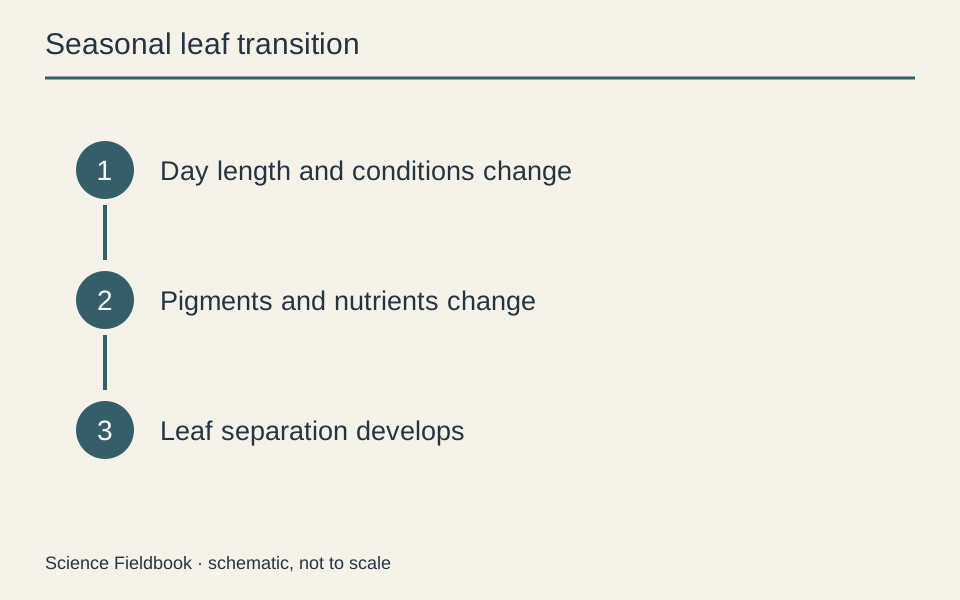
In many temperate deciduous species, shortening days are an important cue for autumn senescence, the controlled aging of leaves. Temperature and the tree's condition modify the timing. There is no universal day on which all trees in one city receive the same “turn red” instruction.
As the tree prepares to lose leaves, it reduces investment in maintaining the photosynthetic machinery and recovers useful nutrients. Chlorophyll is dismantled as part of those changes. The fading green allows other colors to become more visible.
This is a regulated transition, not necessarily a sign that the whole tree is dying. Dropping leaves can help a deciduous tree avoid the costs and risks of keeping a large, exposed leaf surface through an unfavorable season.
Yellow and orange are often revealed, not newly painted
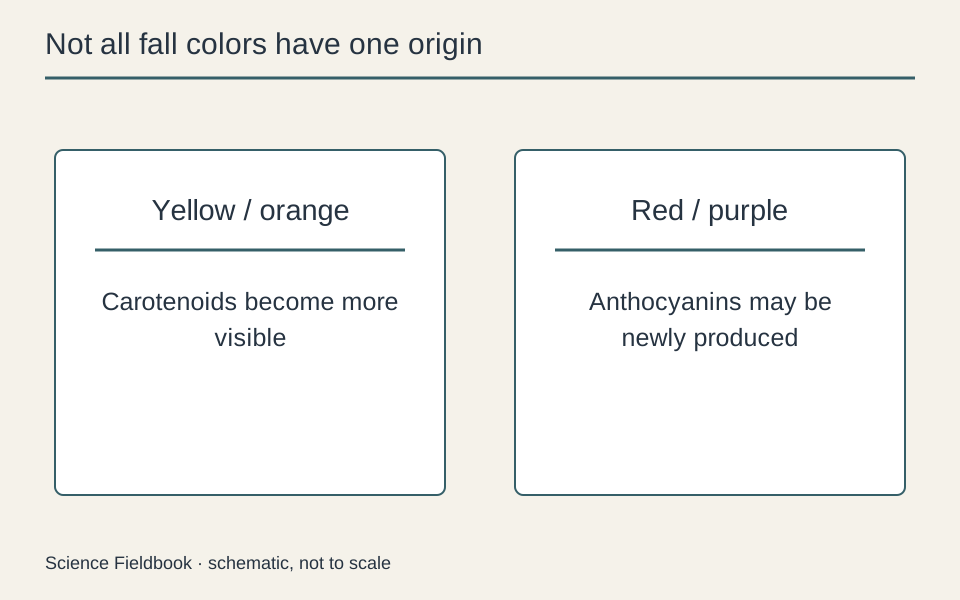
Carotenoids produce many yellow and orange tones. Because these pigments can already be present in summer leaves, the disappearance of chlorophyll changes which colors dominate. A yellow autumn leaf can therefore reveal chemistry that was visually masked earlier in the year.
The exact shade depends on pigment concentration, the remaining chlorophyll, the leaf's internal structure, and how the light reaches it. A backlit leaf can appear different from the same leaf photographed in shade, even without a change in its chemistry.
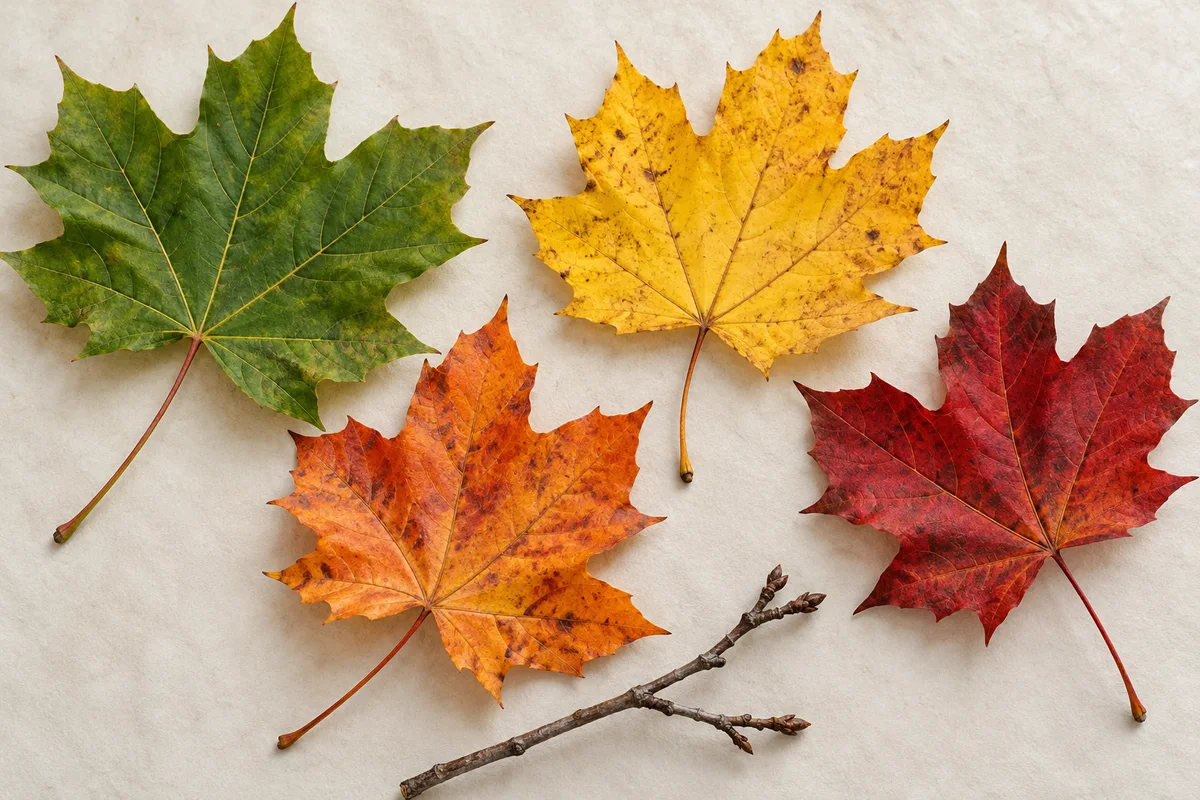
Comparing images requires consistent lighting and exposure. The still-life illustration here shows different leaves as examples of visible colors. It is not a time-lapse experiment proving that every leaf passes through the same sequence.
Red and purple can involve new pigment production
Anthocyanins are responsible for many red and purple autumn colors. Unlike the common “unmasking” explanation for carotenoids, these pigments can be synthesized during the fall transition. Their color also depends on chemical surroundings within the cells.
Sugar availability, light, and cool conditions can influence anthocyanin accumulation. A period of sunny days and cool, nonfreezing nights may favor vivid reds in suitable species. But weather alone cannot make a species produce a pigment it does not normally accumulate in the same way.
The Forest Service-hosted review of autumn color evolution distinguishes preexisting carotenoids from autumn anthocyanin production. It also discusses competing explanations for the biological value of red colors, rather than treating one proposed benefit as the final answer.
Why would a tree invest in a leaf it will soon drop?
One proposed benefit of anthocyanins is protection of leaf tissues during nutrient recovery, particularly when bright light coincides with conditions that slow photosynthetic metabolism. Researchers have also considered other ecological and evolutionary explanations.
The important distinction is between showing that a pigment changes light absorption and proving its main adaptive role in every species. A useful mechanism does not automatically establish one universal evolutionary purpose.
That kind of evidence boundary appears elsewhere in science. For example, yawning has observable features but an unsettled overall function. An honest explanation can describe what is known without pretending that every “why” has one complete answer.
Why neighboring trees change at different times
Species and individual genetics influence pigment production and seasonal responses. Leaf position also matters: sun-exposed outer leaves and shaded inner leaves experience different light and temperature conditions. A single tree can therefore show several colors at once.
Water stress can cause earlier changes or premature leaf loss. Severe stress does not always make a more colorful autumn; it may shorten the display or produce browning. A dramatic season is not simply the season with the harshest weather.
Local conditions add another layer. A tree beside pavement, near a building, or in a sheltered valley can experience a different microclimate from a similar tree nearby. Those small-scale differences can affect the timing visible from one street to the next.
What turns a leaf brown and makes it fall?
As living processes end and tissues deteriorate, brown tones from remaining compounds and structural changes become more prominent. Brown is not necessarily a separate late-stage “fall pigment” added by the tree in the same way as an anthocyanin.
A specialized separation region develops where the leaf joins its twig. Changes there help the leaf detach while protecting the tree's remaining tissues. Wind and rain often finish the separation, but the biological preparation occurs before the leaf hits the ground.
The fallen leaf becomes part of the forest's recycling system. Decomposition returns constituents to the soil and supports organisms involved in nutrient turnover. Those processes help connect seasonal biology with the weathering and groundwater chemistry that shape landscapes.
How to observe autumn colors without overinterpreting them
Choose one tree and photograph the same branch repeatedly from the same position and at a similar time of day. Record weather and note whether leaves are still attached. The record can reveal a sequence that a collection of unrelated colorful photographs cannot.
Keep the interpretation modest. Camera settings can exaggerate reds, and a wet leaf may look darker or more saturated than a dry one. Visible color can suggest pigment changes, but measuring pigment concentrations requires a suitable laboratory or calibrated imaging method.
Avoid damaging branches or removing leaves where collecting is prohibited. A careful visual record can answer many observational questions without disturbing the tree. The aim is to distinguish a pattern you actually recorded from one you merely expected to see.
One leaf can contain several colors at once
A leaf's veins, exposed edges, and shaded portions need not change together. Differences in tissue condition and light exposure can produce green regions beside yellow or red ones. The pattern reflects local pigment balance rather than a paint-like color wave that must move uniformly from the tip to the stem.
Comparing species is equally important. A yellow birch and a red maple do not represent the same tree photographed at different stages. Their different pigment tendencies can create neighboring displays at similar seasonal times. A useful field notebook records the species and location alongside the color instead of collecting every bright leaf into one universal sequence.
The takeaway
Autumn foliage reflects changing pigment mixtures during a seasonal biological transition. Chlorophyll loss reveals many yellows and oranges, while new anthocyanins can contribute reds and purples. Weather modifies the display, but species and leaf biology set the possibilities. A forest's varied colors are evidence of several interacting processes, not one universal green-to-red reaction.